
by 3PB Team
Share
by 3PB Team
Share
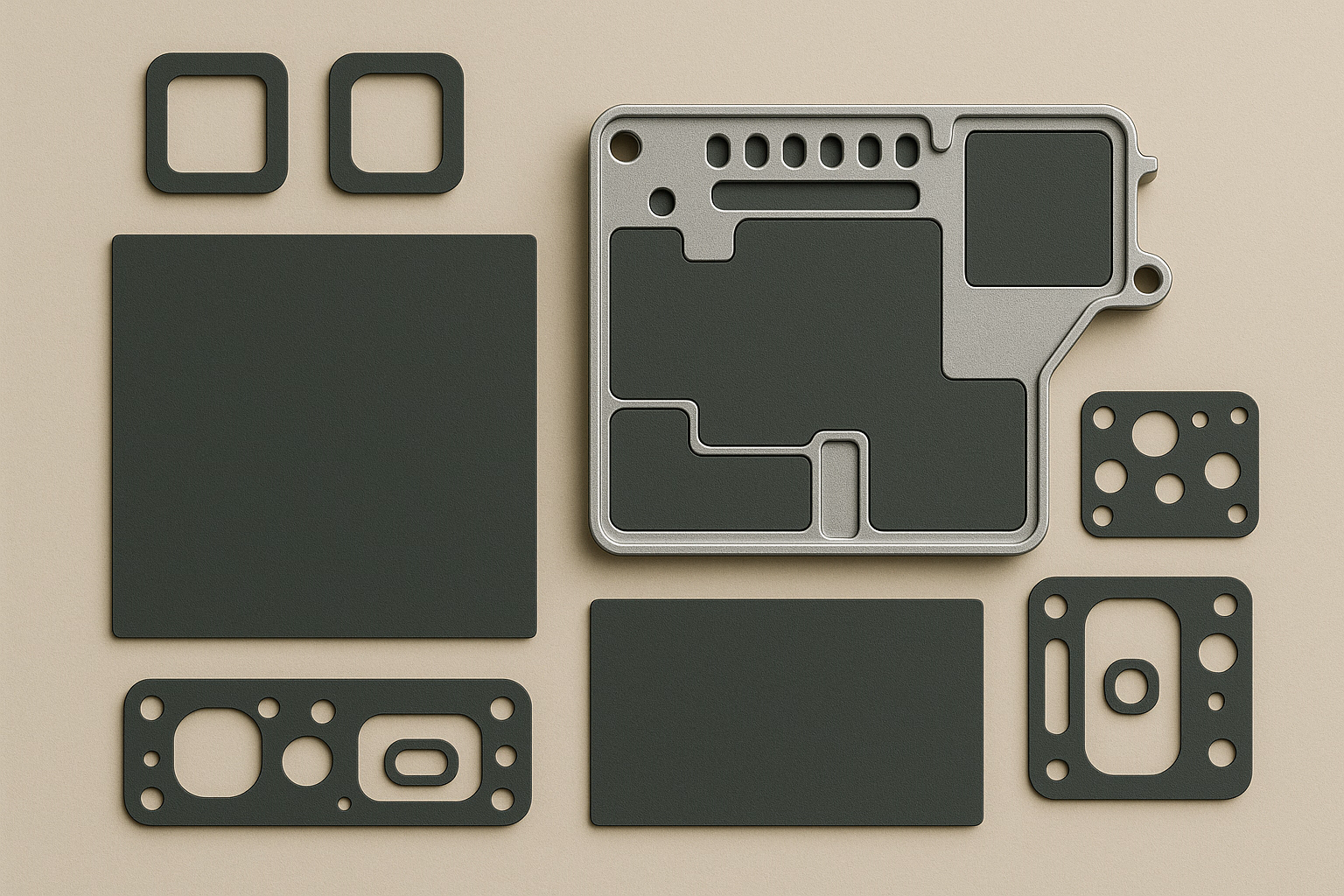
Short version: Cavity resonance is what happens when a shielded enclosure amplifies EMI instead of containing it. RF absorbers fix it by dissipating resonant energy as heat, lowering the Q factor of the cavity. The most cost-effective approach is to apply absorber material to every shield lid proactively, before problems surface. 3PB Solutions manufactures absorber materials covering 0.5 to 40 GHz for cavity resonance suppression. Request a free sample kit to test in your application, or keep reading for the full technical breakdown.
What Is Cavity Resonance?
Every conductive enclosure is a resonant cavity. When the internal dimensions of a shielded enclosure are a significant fraction of a wavelength at a given frequency, electromagnetic energy can set up standing waves inside the cavity. The enclosure walls reflect energy back and forth, and at specific frequencies the reflections reinforce each other. The result is a strong electromagnetic field inside the enclosure at those resonant frequencies.
The resonant frequency of a rectangular cavity depends on its physical dimensions. Larger cavities resonate at lower frequencies. A board-level shield cavity measuring roughly 1″ x 1″ x 0.25″ will typically see its first resonance somewhere in the range of 4 to 8 GHz. A larger enclosure, say 6″ x 6″, will resonate at much lower frequencies, potentially below 1 GHz.
This is a problem because the whole point of the shield was to contain EMI, not amplify it. At resonant frequencies, a shielded enclosure can actually increase coupling between components inside the cavity and cause emissions to leak through any aperture, seam, or gap in the shield. An engineer might see a clean emissions scan on an open bench, then put the shield lid on and watch a new spike appear. That spike is almost always cavity resonance.
Why Shields Alone Don’t Solve High-Frequency EMI
Metal shields are effective at blocking external interference and containing emissions at frequencies where the cavity dimensions are electrically small. At those frequencies, the shield simply acts as a conductive barrier. But as frequencies increase (or as enclosure dimensions grow), the cavity modes kick in and the shield becomes part of the problem.
Adding more shielding doesn’t help. Making the shield thicker, adding gaskets to improve the seal, or reducing aperture size can actually make cavity resonance worse by increasing the Q factor of the enclosure. A higher Q means the resonance is sharper and more intense.
The fix isn’t more shielding. The fix is energy dissipation inside the cavity. That’s what RF absorbers do.
How RF Absorbers Suppress Cavity Resonance
An RF absorber placed inside a shielded enclosure converts resonant electromagnetic energy into a small amount of heat. Instead of bouncing between the cavity walls and building up, the energy gets absorbed by the magnetic or dielectric filler in the material and dissipated.
In technical terms, the absorber lowers the Q factor of the cavity. A lower Q means the resonance is weaker, broader, and less likely to cause coupling between components or emissions through apertures. The standing wave pattern gets disrupted, surface currents on the cavity walls are attenuated, and the internal electromagnetic environment becomes much quieter.
The most effective cavity resonance absorbers work primarily through magnetic loss. Because the tangential magnetic field is at its maximum on the conductive walls of the cavity (while the electric field is at zero there), a magnetically loaded absorber placed directly on the cavity wall sits right where the field energy is concentrated. This is why thin, flexible, magnetically loaded elastomer sheets are the standard solution for cavity resonance. They go right on the inside surface of the shield lid or cavity wall, directly where the energy is.
A Smart Approach: Absorber in Every Shield
The traditional way to deal with cavity resonance is reactive. An engineer runs an emissions scan, sees a failure, identifies it as a resonance, and then starts experimenting with absorber placement and material selection. This works, but it happens at the worst possible time: the end of the design cycle, when schedule pressure is highest and design changes are most expensive.
The smarter approach is proactive. Apply absorber material to the inside of every shield lid from the start, before any EMI testing. Die-cut pads sized to fit each cavity get placed on the lid as part of the standard assembly process. The material cost per cavity is a few dollars. If the absorber prevents even one resonance issue, it has already paid for itself many times over in avoided testing cycles, engineering time, and schedule delays.
In some cavities, the absorber may not be doing anything measurable because the resonance frequency doesn’t align with an active noise source. That’s fine. It’s cheap insurance. In most cavities, it’s solving a problem before it surfaces. The trend across electronics manufacturing is moving in this direction: absorber as a standard design practice, not as a last-minute fix.
Selecting the Right Material
Start with the US Series
For most cavity resonance applications, the 3PB Solutions US Series is the recommended starting point. It’s a proprietary magnetic-loaded acrylic elastomer designed for 0.5 to 3.0 GHz, but it has been fielded successfully in applications up to 18 GHz.
The US Series makes sense as a first try for several reasons. Its broad frequency coverage means it provides useful attenuation across a wide range of cavity sizes without needing to precisely identify the resonance frequency first. The acrylic base eliminates silicone oil migration concerns, which matters in optical, medical, and aerospace environments. It’s available in 0.010″, 0.020″, and 0.040″ thicknesses. And it’s the most cost-effective material in the 3PB Solutions line, which makes it practical for the proactive “absorber on every lid” approach.
If the US Series solves the problem, you’re done. If you need more attenuation at a specific frequency, step up to a band-specific material.
Band-Specific Silicone Elastomers
When the resonance frequency is known and you need maximum attenuation at that frequency, the tuned silicone series delivers higher peak absorption than the US Series in each target band.
The LS Series (1.0 to 4.0 GHz) covers larger enclosures and lower-frequency resonances common in IoT gateways, wireless infrastructure, and industrial control housings. The CB Series (4.0 to 8.0 GHz) and XB Series (8.0 to 12.0 GHz) address the most common cavity resonance range for board-level shields in consumer and handheld electronics. The KU Series (12.0 to 18.0 GHz), KB Series (18.0 to 27.0 GHz), and KA Series (27.0 to 40.0 GHz) cover higher-order resonances and smaller cavities common in 5G, automotive radar, and satellite systems.
For narrowband applications where you need peak absorption at a single exact frequency, the TF Series (2.0 to 18.0 GHz) provides formulation and thickness combinations tuned to specific frequencies.
Foam Absorbers for Larger Enclosures and Chambers
For larger enclosures, test chambers, and antenna system housings where cavity dimensions push resonance frequencies below 1 GHz, carbon-loaded foam absorbers are an effective solution. The AF Series lossy and reticulated foams provide broadband absorption starting from 1.0 GHz and extending to 100+ GHz.
For wireless carriers dealing with passive intermodulation (PIM) interference in cellular antenna systems, the PIM Mitigation Series is a weatherproof foam absorber solution deployed at scale by major carriers on 3G, 4G/LTE, and 5G macro cell and small cell installations.
A Note on Attenuation Specifications
When engineers evaluate cavity resonance absorbers, they typically want to see -20 dB of attenuation on the datasheet. That’s 99% absorption, and it looks convincing in a design review. In practice, -10 dB (90% absorption) inside a cavity is often enough to resolve the problem and pass compliance testing.
The reason is that datasheet numbers come from far-field measurements in standardized fixtures like the NRL arch. Those measurements characterize the material’s intrinsic properties in a controlled environment. But installed performance inside a specific cavity depends on where the absorber is placed, the geometry and dimensions of the enclosure, the coupling paths between components, and the mode structure of the resonance. A material that shows -15 dB on a datasheet might deliver -8 dB or -25 dB in your cavity depending on the specifics.
This is why the most reliable approach is to test candidate materials in your actual enclosure. Don’t just compare datasheets. Put the material in and measure the result.
For engineers who want to model absorber performance before physical testing, 3PB Solutions provides complex permeability and permittivity data for all elastomer products. This data can be imported into electromagnetic simulation tools like Ansys HFSS, CST Studio Suite, or COMSOL Multiphysics to predict how a given material will perform in your specific cavity geometry. Email our engineering team to request this data for the materials you’re evaluating.
Practical Applications
IoT and Handheld Electronics
IoT devices, handheld GPS units, and portable electronics pack multiple radios, processors, and sensors into small shielded enclosures. Board-level shields on these products typically contain 2 to 15 individual cavities, each of which can resonate at frequencies from a few GHz up into the X band and beyond depending on cavity size. Absorber pads applied to the inside of each shield lid suppress resonances across all cavities simultaneously. The US Series or CB Series are common choices for these applications depending on the target frequency range.
Antenna Systems
Antenna housings contain enclosures where resonance can degrade antenna pattern performance, increase sidelobe levels, and reduce overall system sensitivity. Small die-cut absorber pieces placed inside the housing suppress internal reflections and coupling. These applications often run to high volumes (tens of thousands of units per year) with tight dimensional requirements. 3PB Solutions provides die-cut parts to drawing with consistent lot-to-lot performance.
Telecom and Wireless Infrastructure
Base stations, small cells, and wireless access points contain larger enclosures where resonances can fall in the 1 to 4 GHz range, directly overlapping with the operating frequencies of the radio. The LS Series is commonly used in these applications. For outdoor installations dealing with PIM interference at the antenna level, the AF Series PIM Mitigation materials provide a proven, weatherproof solution deployed by major carriers.
Getting Started
The fastest path to solving a cavity resonance problem is to request a free sample kit. Tell us your cavity dimensions and target frequency (if known), and we’ll send the right materials to test.
If you’re designing absorber into a new product proactively, send us your shield drawing and we’ll recommend material, thickness, and placement for each cavity. We provide die-cut parts to your drawing, with PSA backing, ready to assemble.
For engineers who want to simulate before testing, email us to request complex permeability and permittivity data for any material in the 3PB Solutions line.
Quick Contact: Call (855) 785-5660 or email sales@3pbsolutions.com.
Frequently Asked Questions
What causes cavity resonance in shielded enclosures?
Cavity resonance occurs when the internal dimensions of a conductive enclosure are a significant fraction of a wavelength at a given frequency. Electromagnetic energy reflects between the cavity walls, and at specific frequencies these reflections reinforce each other, creating strong standing waves inside the enclosure. This can amplify EMI, increase coupling between components, and cause emissions to leak through apertures and seams in the shield.
How do RF absorbers fix cavity resonance?
RF absorbers placed inside the cavity convert resonant electromagnetic energy into heat through magnetic or dielectric loss mechanisms. This lowers the Q factor of the cavity, weakening the resonance and reducing coupling between components. Magnetically loaded elastomer sheets placed directly on the cavity wall are the most common solution because the magnetic field is at its maximum at the conductive boundary.
What RF absorber should I use for cavity resonance?
Start with the 3PB Solutions US Series, a magnetic-loaded acrylic elastomer designed for 0.5 to 3.0 GHz that has been fielded up to 18 GHz. It provides broad coverage across a wide range of cavity sizes at the lowest cost. If you need higher peak absorption at a specific frequency, step up to the band-specific silicone series: LS (1 to 4 GHz), CB (4 to 8 GHz), XB (8 to 12 GHz), KU (12 to 18 GHz), KB (18 to 27 GHz), or KA (27 to 40 GHz). For exact-frequency tuning, use the TF Series. Request a sample kit to test in your application.
How much attenuation does a cavity resonance absorber need?
Many engineers specify -20 dB (99% absorption) on paper, but in practice -10 dB (90% absorption) inside a cavity is often sufficient to resolve EMI issues and pass compliance testing. Installed performance depends on absorber placement, cavity geometry, and coupling paths. Datasheet numbers from far-field NRL arch measurements don’t directly translate to installed performance. The best approach is to test materials in your actual enclosure. 3PB Solutions provides complex permeability and permittivity data for electromagnetic modeling before physical testing.
Should I add absorber to every shielded cavity?
Yes. The most cost-effective approach is to apply absorber material to the inside of every shield lid as part of standard assembly. The material cost per cavity is a few dollars. If it prevents even one resonance issue, it pays for itself many times over in avoided testing, engineering time, and schedule delays. In some cavities the absorber may not be addressing an active resonance, but in most cases it’s solving a problem before it surfaces. This proactive approach is becoming standard practice in electronics manufacturing.
Short version: Cavity resonance is what happens when a shielded enclosure amplifies EMI instead of containing it. RF absorbers fix it by dissipating resonant energy as heat, lowering the Q factor of the cavity. The most cost-effective approach is to apply absorber material to every shield lid proactively, before problems surface. 3PB Solutions manufactures absorber materials covering 0.5 to 40 GHz for cavity resonance suppression. Request a free sample kit to test in your application, or keep reading for the full technical breakdown.
What Is Cavity Resonance?
Every conductive enclosure is a resonant cavity. When the internal dimensions of a shielded enclosure are a significant fraction of a wavelength at a given frequency, electromagnetic energy can set up standing waves inside the cavity. The enclosure walls reflect energy back and forth, and at specific frequencies the reflections reinforce each other. The result is a strong electromagnetic field inside the enclosure at those resonant frequencies.
The resonant frequency of a rectangular cavity depends on its physical dimensions. Larger cavities resonate at lower frequencies. A board-level shield cavity measuring roughly 1″ x 1″ x 0.25″ will typically see its first resonance somewhere in the range of 4 to 8 GHz. A larger enclosure, say 6″ x 6″, will resonate at much lower frequencies, potentially below 1 GHz.
This is a problem because the whole point of the shield was to contain EMI, not amplify it. At resonant frequencies, a shielded enclosure can actually increase coupling between components inside the cavity and cause emissions to leak through any aperture, seam, or gap in the shield. An engineer might see a clean emissions scan on an open bench, then put the shield lid on and watch a new spike appear. That spike is almost always cavity resonance.
Why Shields Alone Don’t Solve High-Frequency EMI
Metal shields are effective at blocking external interference and containing emissions at frequencies where the cavity dimensions are electrically small. At those frequencies, the shield simply acts as a conductive barrier. But as frequencies increase (or as enclosure dimensions grow), the cavity modes kick in and the shield becomes part of the problem.
Adding more shielding doesn’t help. Making the shield thicker, adding gaskets to improve the seal, or reducing aperture size can actually make cavity resonance worse by increasing the Q factor of the enclosure. A higher Q means the resonance is sharper and more intense.
The fix isn’t more shielding. The fix is energy dissipation inside the cavity. That’s what RF absorbers do.
How RF Absorbers Suppress Cavity Resonance
An RF absorber placed inside a shielded enclosure converts resonant electromagnetic energy into a small amount of heat. Instead of bouncing between the cavity walls and building up, the energy gets absorbed by the magnetic or dielectric filler in the material and dissipated.
In technical terms, the absorber lowers the Q factor of the cavity. A lower Q means the resonance is weaker, broader, and less likely to cause coupling between components or emissions through apertures. The standing wave pattern gets disrupted, surface currents on the cavity walls are attenuated, and the internal electromagnetic environment becomes much quieter.
The most effective cavity resonance absorbers work primarily through magnetic loss. Because the tangential magnetic field is at its maximum on the conductive walls of the cavity (while the electric field is at zero there), a magnetically loaded absorber placed directly on the cavity wall sits right where the field energy is concentrated. This is why thin, flexible, magnetically loaded elastomer sheets are the standard solution for cavity resonance. They go right on the inside surface of the shield lid or cavity wall, directly where the energy is.
A Smart Approach: Absorber in Every Shield
The traditional way to deal with cavity resonance is reactive. An engineer runs an emissions scan, sees a failure, identifies it as a resonance, and then starts experimenting with absorber placement and material selection. This works, but it happens at the worst possible time: the end of the design cycle, when schedule pressure is highest and design changes are most expensive.
The smarter approach is proactive. Apply absorber material to the inside of every shield lid from the start, before any EMI testing. Die-cut pads sized to fit each cavity get placed on the lid as part of the standard assembly process. The material cost per cavity is a few dollars. If the absorber prevents even one resonance issue, it has already paid for itself many times over in avoided testing cycles, engineering time, and schedule delays.
In some cavities, the absorber may not be doing anything measurable because the resonance frequency doesn’t align with an active noise source. That’s fine. It’s cheap insurance. In most cavities, it’s solving a problem before it surfaces. The trend across electronics manufacturing is moving in this direction: absorber as a standard design practice, not as a last-minute fix.
Selecting the Right Material
Start with the US Series
For most cavity resonance applications, the 3PB Solutions US Series is the recommended starting point. It’s a proprietary magnetic-loaded acrylic elastomer designed for 0.5 to 3.0 GHz, but it has been fielded successfully in applications up to 18 GHz.
The US Series makes sense as a first try for several reasons. Its broad frequency coverage means it provides useful attenuation across a wide range of cavity sizes without needing to precisely identify the resonance frequency first. The acrylic base eliminates silicone oil migration concerns, which matters in optical, medical, and aerospace environments. It’s available in 0.010″, 0.020″, and 0.040″ thicknesses. And it’s the most cost-effective material in the 3PB Solutions line, which makes it practical for the proactive “absorber on every lid” approach.
If the US Series solves the problem, you’re done. If you need more attenuation at a specific frequency, step up to a band-specific material.
Band-Specific Silicone Elastomers
When the resonance frequency is known and you need maximum attenuation at that frequency, the tuned silicone series delivers higher peak absorption than the US Series in each target band.
The LS Series (1.0 to 4.0 GHz) covers larger enclosures and lower-frequency resonances common in IoT gateways, wireless infrastructure, and industrial control housings. The CB Series (4.0 to 8.0 GHz) and XB Series (8.0 to 12.0 GHz) address the most common cavity resonance range for board-level shields in consumer and handheld electronics. The KU Series (12.0 to 18.0 GHz), KB Series (18.0 to 27.0 GHz), and KA Series (27.0 to 40.0 GHz) cover higher-order resonances and smaller cavities common in 5G, automotive radar, and satellite systems.
For narrowband applications where you need peak absorption at a single exact frequency, the TF Series (2.0 to 18.0 GHz) provides formulation and thickness combinations tuned to specific frequencies.
Foam Absorbers for Larger Enclosures and Chambers
For larger enclosures, test chambers, and antenna system housings where cavity dimensions push resonance frequencies below 1 GHz, carbon-loaded foam absorbers are an effective solution. The AF Series lossy and reticulated foams provide broadband absorption starting from 1.0 GHz and extending to 100+ GHz.
For wireless carriers dealing with passive intermodulation (PIM) interference in cellular antenna systems, the PIM Mitigation Series is a weatherproof foam absorber solution deployed at scale by major carriers on 3G, 4G/LTE, and 5G macro cell and small cell installations.
A Note on Attenuation Specifications
When engineers evaluate cavity resonance absorbers, they typically want to see -20 dB of attenuation on the datasheet. That’s 99% absorption, and it looks convincing in a design review. In practice, -10 dB (90% absorption) inside a cavity is often enough to resolve the problem and pass compliance testing.
The reason is that datasheet numbers come from far-field measurements in standardized fixtures like the NRL arch. Those measurements characterize the material’s intrinsic properties in a controlled environment. But installed performance inside a specific cavity depends on where the absorber is placed, the geometry and dimensions of the enclosure, the coupling paths between components, and the mode structure of the resonance. A material that shows -15 dB on a datasheet might deliver -8 dB or -25 dB in your cavity depending on the specifics.
This is why the most reliable approach is to test candidate materials in your actual enclosure. Don’t just compare datasheets. Put the material in and measure the result.
For engineers who want to model absorber performance before physical testing, 3PB Solutions provides complex permeability and permittivity data for all elastomer products. This data can be imported into electromagnetic simulation tools like Ansys HFSS, CST Studio Suite, or COMSOL Multiphysics to predict how a given material will perform in your specific cavity geometry. Email our engineering team to request this data for the materials you’re evaluating.
Practical Applications
IoT and Handheld Electronics
IoT devices, handheld GPS units, and portable electronics pack multiple radios, processors, and sensors into small shielded enclosures. Board-level shields on these products typically contain 2 to 15 individual cavities, each of which can resonate at frequencies from a few GHz up into the X band and beyond depending on cavity size. Absorber pads applied to the inside of each shield lid suppress resonances across all cavities simultaneously. The US Series or CB Series are common choices for these applications depending on the target frequency range.
Antenna Systems
Antenna housings contain enclosures where resonance can degrade antenna pattern performance, increase sidelobe levels, and reduce overall system sensitivity. Small die-cut absorber pieces placed inside the housing suppress internal reflections and coupling. These applications often run to high volumes (tens of thousands of units per year) with tight dimensional requirements. 3PB Solutions provides die-cut parts to drawing with consistent lot-to-lot performance.
Telecom and Wireless Infrastructure
Base stations, small cells, and wireless access points contain larger enclosures where resonances can fall in the 1 to 4 GHz range, directly overlapping with the operating frequencies of the radio. The LS Series is commonly used in these applications. For outdoor installations dealing with PIM interference at the antenna level, the AF Series PIM Mitigation materials provide a proven, weatherproof solution deployed by major carriers.
Getting Started
The fastest path to solving a cavity resonance problem is to request a free sample kit. Tell us your cavity dimensions and target frequency (if known), and we’ll send the right materials to test.
If you’re designing absorber into a new product proactively, send us your shield drawing and we’ll recommend material, thickness, and placement for each cavity. We provide die-cut parts to your drawing, with PSA backing, ready to assemble.
For engineers who want to simulate before testing, email us to request complex permeability and permittivity data for any material in the 3PB Solutions line.
Quick Contact: Call (855) 785-5660 or email sales@3pbsolutions.com.
Frequently Asked Questions
What causes cavity resonance in shielded enclosures?
Cavity resonance occurs when the internal dimensions of a conductive enclosure are a significant fraction of a wavelength at a given frequency. Electromagnetic energy reflects between the cavity walls, and at specific frequencies these reflections reinforce each other, creating strong standing waves inside the enclosure. This can amplify EMI, increase coupling between components, and cause emissions to leak through apertures and seams in the shield.
How do RF absorbers fix cavity resonance?
RF absorbers placed inside the cavity convert resonant electromagnetic energy into heat through magnetic or dielectric loss mechanisms. This lowers the Q factor of the cavity, weakening the resonance and reducing coupling between components. Magnetically loaded elastomer sheets placed directly on the cavity wall are the most common solution because the magnetic field is at its maximum at the conductive boundary.
What RF absorber should I use for cavity resonance?
Start with the 3PB Solutions US Series, a magnetic-loaded acrylic elastomer designed for 0.5 to 3.0 GHz that has been fielded up to 18 GHz. It provides broad coverage across a wide range of cavity sizes at the lowest cost. If you need higher peak absorption at a specific frequency, step up to the band-specific silicone series: LS (1 to 4 GHz), CB (4 to 8 GHz), XB (8 to 12 GHz), KU (12 to 18 GHz), KB (18 to 27 GHz), or KA (27 to 40 GHz). For exact-frequency tuning, use the TF Series. Request a sample kit to test in your application.
How much attenuation does a cavity resonance absorber need?
Many engineers specify -20 dB (99% absorption) on paper, but in practice -10 dB (90% absorption) inside a cavity is often sufficient to resolve EMI issues and pass compliance testing. Installed performance depends on absorber placement, cavity geometry, and coupling paths. Datasheet numbers from far-field NRL arch measurements don’t directly translate to installed performance. The best approach is to test materials in your actual enclosure. 3PB Solutions provides complex permeability and permittivity data for electromagnetic modeling before physical testing.
Should I add absorber to every shielded cavity?
Yes. The most cost-effective approach is to apply absorber material to the inside of every shield lid as part of standard assembly. The material cost per cavity is a few dollars. If it prevents even one resonance issue, it pays for itself many times over in avoided testing, engineering time, and schedule delays. In some cavities the absorber may not be addressing an active resonance, but in most cases it’s solving a problem before it surfaces. This proactive approach is becoming standard practice in electronics manufacturing.
Short version: Cavity resonance is what happens when a shielded enclosure amplifies EMI instead of containing it. RF absorbers fix it by dissipating resonant energy as heat, lowering the Q factor of the cavity. The most cost-effective approach is to apply absorber material to every shield lid proactively, before problems surface. 3PB Solutions manufactures absorber materials covering 0.5 to 40 GHz for cavity resonance suppression. Request a free sample kit to test in your application, or keep reading for the full technical breakdown.
What Is Cavity Resonance?
Every conductive enclosure is a resonant cavity. When the internal dimensions of a shielded enclosure are a significant fraction of a wavelength at a given frequency, electromagnetic energy can set up standing waves inside the cavity. The enclosure walls reflect energy back and forth, and at specific frequencies the reflections reinforce each other. The result is a strong electromagnetic field inside the enclosure at those resonant frequencies.
The resonant frequency of a rectangular cavity depends on its physical dimensions. Larger cavities resonate at lower frequencies. A board-level shield cavity measuring roughly 1″ x 1″ x 0.25″ will typically see its first resonance somewhere in the range of 4 to 8 GHz. A larger enclosure, say 6″ x 6″, will resonate at much lower frequencies, potentially below 1 GHz.
This is a problem because the whole point of the shield was to contain EMI, not amplify it. At resonant frequencies, a shielded enclosure can actually increase coupling between components inside the cavity and cause emissions to leak through any aperture, seam, or gap in the shield. An engineer might see a clean emissions scan on an open bench, then put the shield lid on and watch a new spike appear. That spike is almost always cavity resonance.
Why Shields Alone Don’t Solve High-Frequency EMI
Metal shields are effective at blocking external interference and containing emissions at frequencies where the cavity dimensions are electrically small. At those frequencies, the shield simply acts as a conductive barrier. But as frequencies increase (or as enclosure dimensions grow), the cavity modes kick in and the shield becomes part of the problem.
Adding more shielding doesn’t help. Making the shield thicker, adding gaskets to improve the seal, or reducing aperture size can actually make cavity resonance worse by increasing the Q factor of the enclosure. A higher Q means the resonance is sharper and more intense.
The fix isn’t more shielding. The fix is energy dissipation inside the cavity. That’s what RF absorbers do.
How RF Absorbers Suppress Cavity Resonance
An RF absorber placed inside a shielded enclosure converts resonant electromagnetic energy into a small amount of heat. Instead of bouncing between the cavity walls and building up, the energy gets absorbed by the magnetic or dielectric filler in the material and dissipated.
In technical terms, the absorber lowers the Q factor of the cavity. A lower Q means the resonance is weaker, broader, and less likely to cause coupling between components or emissions through apertures. The standing wave pattern gets disrupted, surface currents on the cavity walls are attenuated, and the internal electromagnetic environment becomes much quieter.
The most effective cavity resonance absorbers work primarily through magnetic loss. Because the tangential magnetic field is at its maximum on the conductive walls of the cavity (while the electric field is at zero there), a magnetically loaded absorber placed directly on the cavity wall sits right where the field energy is concentrated. This is why thin, flexible, magnetically loaded elastomer sheets are the standard solution for cavity resonance. They go right on the inside surface of the shield lid or cavity wall, directly where the energy is.
A Smart Approach: Absorber in Every Shield
The traditional way to deal with cavity resonance is reactive. An engineer runs an emissions scan, sees a failure, identifies it as a resonance, and then starts experimenting with absorber placement and material selection. This works, but it happens at the worst possible time: the end of the design cycle, when schedule pressure is highest and design changes are most expensive.
The smarter approach is proactive. Apply absorber material to the inside of every shield lid from the start, before any EMI testing. Die-cut pads sized to fit each cavity get placed on the lid as part of the standard assembly process. The material cost per cavity is a few dollars. If the absorber prevents even one resonance issue, it has already paid for itself many times over in avoided testing cycles, engineering time, and schedule delays.
In some cavities, the absorber may not be doing anything measurable because the resonance frequency doesn’t align with an active noise source. That’s fine. It’s cheap insurance. In most cavities, it’s solving a problem before it surfaces. The trend across electronics manufacturing is moving in this direction: absorber as a standard design practice, not as a last-minute fix.
Selecting the Right Material
Start with the US Series
For most cavity resonance applications, the 3PB Solutions US Series is the recommended starting point. It’s a proprietary magnetic-loaded acrylic elastomer designed for 0.5 to 3.0 GHz, but it has been fielded successfully in applications up to 18 GHz.
The US Series makes sense as a first try for several reasons. Its broad frequency coverage means it provides useful attenuation across a wide range of cavity sizes without needing to precisely identify the resonance frequency first. The acrylic base eliminates silicone oil migration concerns, which matters in optical, medical, and aerospace environments. It’s available in 0.010″, 0.020″, and 0.040″ thicknesses. And it’s the most cost-effective material in the 3PB Solutions line, which makes it practical for the proactive “absorber on every lid” approach.
If the US Series solves the problem, you’re done. If you need more attenuation at a specific frequency, step up to a band-specific material.
Band-Specific Silicone Elastomers
When the resonance frequency is known and you need maximum attenuation at that frequency, the tuned silicone series delivers higher peak absorption than the US Series in each target band.
The LS Series (1.0 to 4.0 GHz) covers larger enclosures and lower-frequency resonances common in IoT gateways, wireless infrastructure, and industrial control housings. The CB Series (4.0 to 8.0 GHz) and XB Series (8.0 to 12.0 GHz) address the most common cavity resonance range for board-level shields in consumer and handheld electronics. The KU Series (12.0 to 18.0 GHz), KB Series (18.0 to 27.0 GHz), and KA Series (27.0 to 40.0 GHz) cover higher-order resonances and smaller cavities common in 5G, automotive radar, and satellite systems.
For narrowband applications where you need peak absorption at a single exact frequency, the TF Series (2.0 to 18.0 GHz) provides formulation and thickness combinations tuned to specific frequencies.
Foam Absorbers for Larger Enclosures and Chambers
For larger enclosures, test chambers, and antenna system housings where cavity dimensions push resonance frequencies below 1 GHz, carbon-loaded foam absorbers are an effective solution. The AF Series lossy and reticulated foams provide broadband absorption starting from 1.0 GHz and extending to 100+ GHz.
For wireless carriers dealing with passive intermodulation (PIM) interference in cellular antenna systems, the PIM Mitigation Series is a weatherproof foam absorber solution deployed at scale by major carriers on 3G, 4G/LTE, and 5G macro cell and small cell installations.
A Note on Attenuation Specifications
When engineers evaluate cavity resonance absorbers, they typically want to see -20 dB of attenuation on the datasheet. That’s 99% absorption, and it looks convincing in a design review. In practice, -10 dB (90% absorption) inside a cavity is often enough to resolve the problem and pass compliance testing.
The reason is that datasheet numbers come from far-field measurements in standardized fixtures like the NRL arch. Those measurements characterize the material’s intrinsic properties in a controlled environment. But installed performance inside a specific cavity depends on where the absorber is placed, the geometry and dimensions of the enclosure, the coupling paths between components, and the mode structure of the resonance. A material that shows -15 dB on a datasheet might deliver -8 dB or -25 dB in your cavity depending on the specifics.
This is why the most reliable approach is to test candidate materials in your actual enclosure. Don’t just compare datasheets. Put the material in and measure the result.
For engineers who want to model absorber performance before physical testing, 3PB Solutions provides complex permeability and permittivity data for all elastomer products. This data can be imported into electromagnetic simulation tools like Ansys HFSS, CST Studio Suite, or COMSOL Multiphysics to predict how a given material will perform in your specific cavity geometry. Email our engineering team to request this data for the materials you’re evaluating.
Practical Applications
IoT and Handheld Electronics
IoT devices, handheld GPS units, and portable electronics pack multiple radios, processors, and sensors into small shielded enclosures. Board-level shields on these products typically contain 2 to 15 individual cavities, each of which can resonate at frequencies from a few GHz up into the X band and beyond depending on cavity size. Absorber pads applied to the inside of each shield lid suppress resonances across all cavities simultaneously. The US Series or CB Series are common choices for these applications depending on the target frequency range.
Antenna Systems
Antenna housings contain enclosures where resonance can degrade antenna pattern performance, increase sidelobe levels, and reduce overall system sensitivity. Small die-cut absorber pieces placed inside the housing suppress internal reflections and coupling. These applications often run to high volumes (tens of thousands of units per year) with tight dimensional requirements. 3PB Solutions provides die-cut parts to drawing with consistent lot-to-lot performance.
Telecom and Wireless Infrastructure
Base stations, small cells, and wireless access points contain larger enclosures where resonances can fall in the 1 to 4 GHz range, directly overlapping with the operating frequencies of the radio. The LS Series is commonly used in these applications. For outdoor installations dealing with PIM interference at the antenna level, the AF Series PIM Mitigation materials provide a proven, weatherproof solution deployed by major carriers.
Getting Started
The fastest path to solving a cavity resonance problem is to request a free sample kit. Tell us your cavity dimensions and target frequency (if known), and we’ll send the right materials to test.
If you’re designing absorber into a new product proactively, send us your shield drawing and we’ll recommend material, thickness, and placement for each cavity. We provide die-cut parts to your drawing, with PSA backing, ready to assemble.
For engineers who want to simulate before testing, email us to request complex permeability and permittivity data for any material in the 3PB Solutions line.
Quick Contact: Call (855) 785-5660 or email sales@3pbsolutions.com.
Frequently Asked Questions
What causes cavity resonance in shielded enclosures?
Cavity resonance occurs when the internal dimensions of a conductive enclosure are a significant fraction of a wavelength at a given frequency. Electromagnetic energy reflects between the cavity walls, and at specific frequencies these reflections reinforce each other, creating strong standing waves inside the enclosure. This can amplify EMI, increase coupling between components, and cause emissions to leak through apertures and seams in the shield.
How do RF absorbers fix cavity resonance?
RF absorbers placed inside the cavity convert resonant electromagnetic energy into heat through magnetic or dielectric loss mechanisms. This lowers the Q factor of the cavity, weakening the resonance and reducing coupling between components. Magnetically loaded elastomer sheets placed directly on the cavity wall are the most common solution because the magnetic field is at its maximum at the conductive boundary.
What RF absorber should I use for cavity resonance?
Start with the 3PB Solutions US Series, a magnetic-loaded acrylic elastomer designed for 0.5 to 3.0 GHz that has been fielded up to 18 GHz. It provides broad coverage across a wide range of cavity sizes at the lowest cost. If you need higher peak absorption at a specific frequency, step up to the band-specific silicone series: LS (1 to 4 GHz), CB (4 to 8 GHz), XB (8 to 12 GHz), KU (12 to 18 GHz), KB (18 to 27 GHz), or KA (27 to 40 GHz). For exact-frequency tuning, use the TF Series. Request a sample kit to test in your application.
How much attenuation does a cavity resonance absorber need?
Many engineers specify -20 dB (99% absorption) on paper, but in practice -10 dB (90% absorption) inside a cavity is often sufficient to resolve EMI issues and pass compliance testing. Installed performance depends on absorber placement, cavity geometry, and coupling paths. Datasheet numbers from far-field NRL arch measurements don’t directly translate to installed performance. The best approach is to test materials in your actual enclosure. 3PB Solutions provides complex permeability and permittivity data for electromagnetic modeling before physical testing.
Should I add absorber to every shielded cavity?
Yes. The most cost-effective approach is to apply absorber material to the inside of every shield lid as part of standard assembly. The material cost per cavity is a few dollars. If it prevents even one resonance issue, it pays for itself many times over in avoided testing, engineering time, and schedule delays. In some cavities the absorber may not be addressing an active resonance, but in most cases it’s solving a problem before it surfaces. This proactive approach is becoming standard practice in electronics manufacturing.
Short version: Cavity resonance is what happens when a shielded enclosure amplifies EMI instead of containing it. RF absorbers fix it by dissipating resonant energy as heat, lowering the Q factor of the cavity. The most cost-effective approach is to apply absorber material to every shield lid proactively, before problems surface. 3PB Solutions manufactures absorber materials covering 0.5 to 40 GHz for cavity resonance suppression. Request a free sample kit to test in your application, or keep reading for the full technical breakdown.
What Is Cavity Resonance?
Every conductive enclosure is a resonant cavity. When the internal dimensions of a shielded enclosure are a significant fraction of a wavelength at a given frequency, electromagnetic energy can set up standing waves inside the cavity. The enclosure walls reflect energy back and forth, and at specific frequencies the reflections reinforce each other. The result is a strong electromagnetic field inside the enclosure at those resonant frequencies.
The resonant frequency of a rectangular cavity depends on its physical dimensions. Larger cavities resonate at lower frequencies. A board-level shield cavity measuring roughly 1″ x 1″ x 0.25″ will typically see its first resonance somewhere in the range of 4 to 8 GHz. A larger enclosure, say 6″ x 6″, will resonate at much lower frequencies, potentially below 1 GHz.
This is a problem because the whole point of the shield was to contain EMI, not amplify it. At resonant frequencies, a shielded enclosure can actually increase coupling between components inside the cavity and cause emissions to leak through any aperture, seam, or gap in the shield. An engineer might see a clean emissions scan on an open bench, then put the shield lid on and watch a new spike appear. That spike is almost always cavity resonance.
Why Shields Alone Don’t Solve High-Frequency EMI
Metal shields are effective at blocking external interference and containing emissions at frequencies where the cavity dimensions are electrically small. At those frequencies, the shield simply acts as a conductive barrier. But as frequencies increase (or as enclosure dimensions grow), the cavity modes kick in and the shield becomes part of the problem.
Adding more shielding doesn’t help. Making the shield thicker, adding gaskets to improve the seal, or reducing aperture size can actually make cavity resonance worse by increasing the Q factor of the enclosure. A higher Q means the resonance is sharper and more intense.
The fix isn’t more shielding. The fix is energy dissipation inside the cavity. That’s what RF absorbers do.
How RF Absorbers Suppress Cavity Resonance
An RF absorber placed inside a shielded enclosure converts resonant electromagnetic energy into a small amount of heat. Instead of bouncing between the cavity walls and building up, the energy gets absorbed by the magnetic or dielectric filler in the material and dissipated.
In technical terms, the absorber lowers the Q factor of the cavity. A lower Q means the resonance is weaker, broader, and less likely to cause coupling between components or emissions through apertures. The standing wave pattern gets disrupted, surface currents on the cavity walls are attenuated, and the internal electromagnetic environment becomes much quieter.
The most effective cavity resonance absorbers work primarily through magnetic loss. Because the tangential magnetic field is at its maximum on the conductive walls of the cavity (while the electric field is at zero there), a magnetically loaded absorber placed directly on the cavity wall sits right where the field energy is concentrated. This is why thin, flexible, magnetically loaded elastomer sheets are the standard solution for cavity resonance. They go right on the inside surface of the shield lid or cavity wall, directly where the energy is.
A Smart Approach: Absorber in Every Shield
The traditional way to deal with cavity resonance is reactive. An engineer runs an emissions scan, sees a failure, identifies it as a resonance, and then starts experimenting with absorber placement and material selection. This works, but it happens at the worst possible time: the end of the design cycle, when schedule pressure is highest and design changes are most expensive.
The smarter approach is proactive. Apply absorber material to the inside of every shield lid from the start, before any EMI testing. Die-cut pads sized to fit each cavity get placed on the lid as part of the standard assembly process. The material cost per cavity is a few dollars. If the absorber prevents even one resonance issue, it has already paid for itself many times over in avoided testing cycles, engineering time, and schedule delays.
In some cavities, the absorber may not be doing anything measurable because the resonance frequency doesn’t align with an active noise source. That’s fine. It’s cheap insurance. In most cavities, it’s solving a problem before it surfaces. The trend across electronics manufacturing is moving in this direction: absorber as a standard design practice, not as a last-minute fix.
Selecting the Right Material
Start with the US Series
For most cavity resonance applications, the 3PB Solutions US Series is the recommended starting point. It’s a proprietary magnetic-loaded acrylic elastomer designed for 0.5 to 3.0 GHz, but it has been fielded successfully in applications up to 18 GHz.
The US Series makes sense as a first try for several reasons. Its broad frequency coverage means it provides useful attenuation across a wide range of cavity sizes without needing to precisely identify the resonance frequency first. The acrylic base eliminates silicone oil migration concerns, which matters in optical, medical, and aerospace environments. It’s available in 0.010″, 0.020″, and 0.040″ thicknesses. And it’s the most cost-effective material in the 3PB Solutions line, which makes it practical for the proactive “absorber on every lid” approach.
If the US Series solves the problem, you’re done. If you need more attenuation at a specific frequency, step up to a band-specific material.
Band-Specific Silicone Elastomers
When the resonance frequency is known and you need maximum attenuation at that frequency, the tuned silicone series delivers higher peak absorption than the US Series in each target band.
The LS Series (1.0 to 4.0 GHz) covers larger enclosures and lower-frequency resonances common in IoT gateways, wireless infrastructure, and industrial control housings. The CB Series (4.0 to 8.0 GHz) and XB Series (8.0 to 12.0 GHz) address the most common cavity resonance range for board-level shields in consumer and handheld electronics. The KU Series (12.0 to 18.0 GHz), KB Series (18.0 to 27.0 GHz), and KA Series (27.0 to 40.0 GHz) cover higher-order resonances and smaller cavities common in 5G, automotive radar, and satellite systems.
For narrowband applications where you need peak absorption at a single exact frequency, the TF Series (2.0 to 18.0 GHz) provides formulation and thickness combinations tuned to specific frequencies.
Foam Absorbers for Larger Enclosures and Chambers
For larger enclosures, test chambers, and antenna system housings where cavity dimensions push resonance frequencies below 1 GHz, carbon-loaded foam absorbers are an effective solution. The AF Series lossy and reticulated foams provide broadband absorption starting from 1.0 GHz and extending to 100+ GHz.
For wireless carriers dealing with passive intermodulation (PIM) interference in cellular antenna systems, the PIM Mitigation Series is a weatherproof foam absorber solution deployed at scale by major carriers on 3G, 4G/LTE, and 5G macro cell and small cell installations.
A Note on Attenuation Specifications
When engineers evaluate cavity resonance absorbers, they typically want to see -20 dB of attenuation on the datasheet. That’s 99% absorption, and it looks convincing in a design review. In practice, -10 dB (90% absorption) inside a cavity is often enough to resolve the problem and pass compliance testing.
The reason is that datasheet numbers come from far-field measurements in standardized fixtures like the NRL arch. Those measurements characterize the material’s intrinsic properties in a controlled environment. But installed performance inside a specific cavity depends on where the absorber is placed, the geometry and dimensions of the enclosure, the coupling paths between components, and the mode structure of the resonance. A material that shows -15 dB on a datasheet might deliver -8 dB or -25 dB in your cavity depending on the specifics.
This is why the most reliable approach is to test candidate materials in your actual enclosure. Don’t just compare datasheets. Put the material in and measure the result.
For engineers who want to model absorber performance before physical testing, 3PB Solutions provides complex permeability and permittivity data for all elastomer products. This data can be imported into electromagnetic simulation tools like Ansys HFSS, CST Studio Suite, or COMSOL Multiphysics to predict how a given material will perform in your specific cavity geometry. Email our engineering team to request this data for the materials you’re evaluating.
Practical Applications
IoT and Handheld Electronics
IoT devices, handheld GPS units, and portable electronics pack multiple radios, processors, and sensors into small shielded enclosures. Board-level shields on these products typically contain 2 to 15 individual cavities, each of which can resonate at frequencies from a few GHz up into the X band and beyond depending on cavity size. Absorber pads applied to the inside of each shield lid suppress resonances across all cavities simultaneously. The US Series or CB Series are common choices for these applications depending on the target frequency range.
Antenna Systems
Antenna housings contain enclosures where resonance can degrade antenna pattern performance, increase sidelobe levels, and reduce overall system sensitivity. Small die-cut absorber pieces placed inside the housing suppress internal reflections and coupling. These applications often run to high volumes (tens of thousands of units per year) with tight dimensional requirements. 3PB Solutions provides die-cut parts to drawing with consistent lot-to-lot performance.
Telecom and Wireless Infrastructure
Base stations, small cells, and wireless access points contain larger enclosures where resonances can fall in the 1 to 4 GHz range, directly overlapping with the operating frequencies of the radio. The LS Series is commonly used in these applications. For outdoor installations dealing with PIM interference at the antenna level, the AF Series PIM Mitigation materials provide a proven, weatherproof solution deployed by major carriers.
Getting Started
The fastest path to solving a cavity resonance problem is to request a free sample kit. Tell us your cavity dimensions and target frequency (if known), and we’ll send the right materials to test.
If you’re designing absorber into a new product proactively, send us your shield drawing and we’ll recommend material, thickness, and placement for each cavity. We provide die-cut parts to your drawing, with PSA backing, ready to assemble.
For engineers who want to simulate before testing, email us to request complex permeability and permittivity data for any material in the 3PB Solutions line.
Quick Contact: Call (855) 785-5660 or email sales@3pbsolutions.com.
Frequently Asked Questions
What causes cavity resonance in shielded enclosures?
Cavity resonance occurs when the internal dimensions of a conductive enclosure are a significant fraction of a wavelength at a given frequency. Electromagnetic energy reflects between the cavity walls, and at specific frequencies these reflections reinforce each other, creating strong standing waves inside the enclosure. This can amplify EMI, increase coupling between components, and cause emissions to leak through apertures and seams in the shield.
How do RF absorbers fix cavity resonance?
RF absorbers placed inside the cavity convert resonant electromagnetic energy into heat through magnetic or dielectric loss mechanisms. This lowers the Q factor of the cavity, weakening the resonance and reducing coupling between components. Magnetically loaded elastomer sheets placed directly on the cavity wall are the most common solution because the magnetic field is at its maximum at the conductive boundary.
What RF absorber should I use for cavity resonance?
Start with the 3PB Solutions US Series, a magnetic-loaded acrylic elastomer designed for 0.5 to 3.0 GHz that has been fielded up to 18 GHz. It provides broad coverage across a wide range of cavity sizes at the lowest cost. If you need higher peak absorption at a specific frequency, step up to the band-specific silicone series: LS (1 to 4 GHz), CB (4 to 8 GHz), XB (8 to 12 GHz), KU (12 to 18 GHz), KB (18 to 27 GHz), or KA (27 to 40 GHz). For exact-frequency tuning, use the TF Series. Request a sample kit to test in your application.
How much attenuation does a cavity resonance absorber need?
Many engineers specify -20 dB (99% absorption) on paper, but in practice -10 dB (90% absorption) inside a cavity is often sufficient to resolve EMI issues and pass compliance testing. Installed performance depends on absorber placement, cavity geometry, and coupling paths. Datasheet numbers from far-field NRL arch measurements don’t directly translate to installed performance. The best approach is to test materials in your actual enclosure. 3PB Solutions provides complex permeability and permittivity data for electromagnetic modeling before physical testing.
Should I add absorber to every shielded cavity?
Yes. The most cost-effective approach is to apply absorber material to the inside of every shield lid as part of standard assembly. The material cost per cavity is a few dollars. If it prevents even one resonance issue, it pays for itself many times over in avoided testing, engineering time, and schedule delays. In some cavities the absorber may not be addressing an active resonance, but in most cases it’s solving a problem before it surfaces. This proactive approach is becoming standard practice in electronics manufacturing.
