
by 3PB Team
Share
by 3PB Team
Share
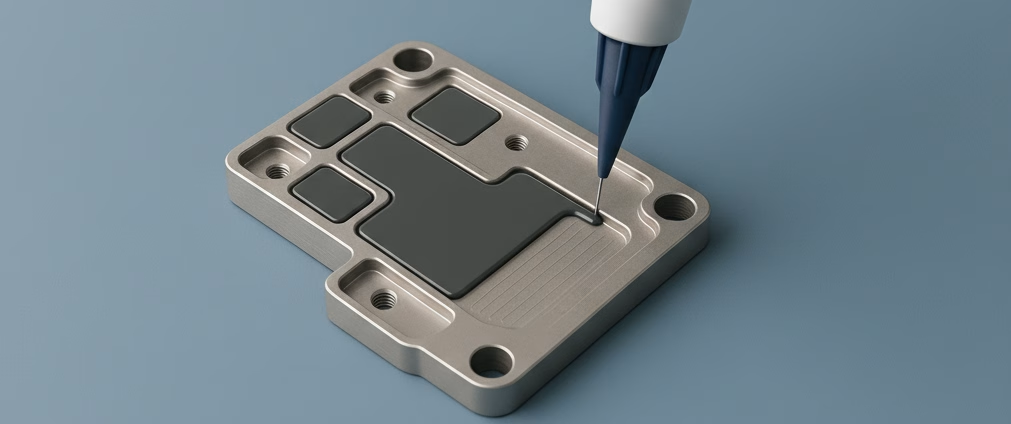
Short version: If you’re placing die-cut RF absorber pads into shielded cavities by hand, dispensable absorbers can eliminate that labor entirely. The 3PB Solutions AC-001 Series is a liquid silicone absorber covering 1.0 to 40.0 GHz that can be dispensed by hand or with automated equipment, self-levels to a consistent thickness, and cures with heat in as little as 20 minutes. Available as material only or as part of a turnkey solution that includes shield fabrication, dispensed absorber, and form-in-place gaskets under one roof. Request a sample or keep reading for the full technical breakdown.
The Problem with Die-Cut Absorber in Production
RF absorbers are one of the most effective tools for suppressing cavity resonance and reducing EMI inside shielded enclosures. But in production, applying them is a pain.
A typical shielded PCB might have 10, 20, or more individual cavities that need absorber material. Each cavity gets a die-cut pad, and each pad gets placed by hand. Peel the PSA liner, position the part, press it down, repeat. For a contract manufacturer building thousands of boards a day, that’s a significant labor line item. Parts can be misaligned, skipped, or placed in the wrong cavity. Quality control adds another step.
This is the problem dispensable RF absorbers solve. Instead of manually placing dozens of pre-cut pieces, the absorber material is dispensed directly into the cavities as a liquid, self-levels to a consistent thickness, and cures in place. One dispensing pass replaces what used to be a manual, piece-by-piece assembly operation.
What Is a Dispensable RF Absorber?
A dispensable RF absorber is a liquid silicone elastomer loaded with carbonyl iron powder. It works through the same magnetic loss mechanism as traditional sheet absorbers. The iron particles dissipate electromagnetic energy as heat when exposed to an alternating RF field. The difference is the delivery method. Instead of arriving as a pre-formed sheet that gets cut and adhered, the material arrives as a paste that gets dispensed, flows to fill the target area, and cures into a solid elastomer.
Once cured, a dispensable absorber performs the same function as a die-cut sheet absorber: it attenuates cavity resonances, reduces coupling between components, and suppresses surface currents inside shielded enclosures. The physics don’t change. The manufacturing process does.
How It Works in Practice
The dispensing process follows a straightforward sequence. The liquid absorber is deposited into each cavity using either a syringe-based system for prototyping and low volume, or automated dispensing equipment for production. Dispensing methods range from pneumatically driven syringe barrels to jet valve systems with piezo actuators, depending on the material viscosity, cavity geometry, target thickness, and production volume.
After dispensing, the material is left to self-level for 1 to 2 hours. Gravity pulls the liquid to a consistent thickness across the floor of each cavity. There is slight wicking up the cavity sidewalls, which actually provides additional coverage. Sidewall reflections are a real contributor to cavity resonance, and this natural wicking helps attenuate them without requiring a separate absorber placement on the walls.
Once leveled, the parts go into an oven to cure. Standard cure profiles are 45 minutes at 85 degrees C, 30 minutes at 100 degrees C, or 20 minutes at 150 degrees C. The material will also cure at room temperature in 5 to 7 days, but heat-accelerated curing is recommended for production throughput.
The result is a solid, flexible silicone absorber pad that is bonded in place inside the cavity with no adhesive layer, no manual placement, and no alignment concerns.
Where Dispensable Absorbers Make Sense
Dispensable absorbers aren’t a replacement for sheet materials in every application. They solve specific manufacturing and design problems that sheets can’t address efficiently.
High cavity count assemblies. If your design has dozens of shielded cavities on a single board, manual placement of die-cut pads is slow and error-prone. Automated dispensing handles all cavities in one pass with consistent results.
Complex or irregular cavity geometries. Die-cut parts are limited to 2D shapes. If your cavity has steps, posts, or irregular boundaries, a liquid material conforms to the geometry naturally.
Tight thickness constraints. Sheet absorbers come in fixed thicknesses. Dispensable material can be deposited at any thickness within its min/max range by controlling the dispense volume per cavity.
Labor cost reduction. For high-volume electronics manufacturing, the labor content of manually placing absorber pads adds up. Dispensing converts that manual operation into an automated one.
Proactive EMI design. The traditional approach is to add absorber as a band-aid after an EMI problem is discovered late in the design cycle. The smarter approach is to design absorber into every shielded cavity from the start, whether it’s strictly needed or not. Dispensing makes this economically viable because the incremental cost of adding absorber to every cavity during automated production is far less than the cost of retroactively fixing EMI problems in the field.
The AC-001 Product Line
The 3PB Solutions AC-001 Series is a carbonyl iron-loaded liquid silicone absorber available in six loading levels, each optimized for a specific frequency band and thickness range.
| Property | 01-500 | 01-425 | 01-375 | 01-325 | 01-275 | 01-250 |
|---|---|---|---|---|---|---|
| Frequency Range | 1.0-4.0 GHz | 4.0-8.0 GHz | 8.0-12.0 GHz | 12.0-18.0 GHz | 18.0-27.0 GHz | 27.0-40.0 GHz |
| Frequency Band | S, C Band | C, X Band | X Band | Ku Band | K Band | Ka Band |
| Min Thickness (in) | 0.070 | 0.050 | 0.050 | 0.045 | 0.038 | 0.035 |
| Max Thickness (in) | 0.165 | 0.100 | 0.070 | 0.055 | 0.042 | 0.039 |
| Density (g/cm3) | 4.449 | 3.947 | 3.627 | 3.354 | 3.062 | 2.919 |
| Operating Temp (degrees C) | -55 to 200 | -55 to 200 | -55 to 200 | -55 to 200 | -55 to 200 | -55 to 200 |
All AC-001 variants use a two-part, platinum cured liquid silicone elastomer base. The proper loading level and thickness combination will be unique to each application.
Selecting the Right Loading Level
Start with your interference frequency. If you have an EMI problem at 8 GHz, the 01-375 (X band) is the natural starting point. An issue at 14 GHz points to the 01-325 (Ku band).
But frequency isn’t the only factor. Thickness constraints inside the cavity often dictate which loading level to choose. A standard X band absorber might call for 0.050 to 0.055 inches at 37.5% loading. But if your cavity only has 0.040 inches of clearance, you’d move to a higher loading level like 42.5% to achieve absorption at the same frequency in a thinner deposit. There’s a trade-off: higher loading means higher density and a narrower effective thickness window, but it lets you hit the target frequency in less space.
The most commonly specified variant is the 01-375, which covers the X band (8.0 to 12.0 GHz) and provides the closest cross-reference to competing dispensable absorber products on the market. But if your application doesn’t fall neatly into a standard band, 3PB Solutions can optimize the formulation for your specific frequency, thickness constraint, and dispensing process.
3PB Solutions also provides complex permeability and permittivity data for all AC-001 variants, so engineers can model absorber performance in electromagnetic simulation tools (HFSS, CST, COMSOL) before committing to physical prototyping.
Turnkey Cavity Solutions
This is where 3PB Solutions’ approach differs from buying dispensable absorber material off the shelf and figuring out the rest yourself.
3PB Solutions works with dispensing partners who are experienced with the AC-001 material and can handle everything from initial prototyping through high-volume production. These same partners also fabricate board-level shields and apply form-in-place (FIP) conductive gaskets. That means you can get your shield fabrication, dispensed RF absorber, and FIP gasket application all from one supply chain, managed as a single project.
For an electronics manufacturer, this simplifies sourcing significantly. Instead of coordinating a shield vendor, an absorber supplier, a gasket material supplier, and a dispensing house separately, you get a turnkey shielded cavity with absorber and gasket applied, ready to drop onto your board.
There are two ways to engage. You can work directly with 3PB Solutions’ dispensing partners and call out the AC-001 part number in your specification. Or 3PB Solutions can manage the entire project end to end, acting as a single point of contact for the complete cavity solution. Either way, the dispensing process is optimized for your specific cavity geometry, production volume, and throughput requirements.
Dispensable vs. Die-Cut: When to Use Which
Dispensable absorbers don’t replace die-cut sheets in every scenario. Each has a sweet spot.
Die-cut sheets make sense when you have a small number of cavities (one to five), simple rectangular geometries, low to moderate production volumes, or when the absorber needs to be removable for rework. Die-cut parts with PSA backing are fast to prototype, easy to evaluate, and don’t require any special equipment to install.
Dispensable absorbers make sense when you have many cavities per board, complex or irregular cavity shapes, high production volumes where labor content matters, tight thickness constraints that don’t match standard sheet gauges, or when you want to proactively add absorber to every cavity as a preventive measure rather than a fix. The upfront investment in dispensing process development pays back quickly at volume.
Not sure which approach fits your application? Start with die-cut samples from the US Series or one of the band-specific silicone series to confirm that absorber material solves the problem. Once you’ve validated the approach, transition to dispensable AC-001 for production if the economics and cavity count justify it.
Getting Started
The fastest path to evaluating dispensable absorbers is to request AC-001 samples. Tell us your target frequency, cavity dimensions, and thickness constraint, and we’ll recommend the right loading level and send material for prototyping.
If you’re further along and want to discuss a turnkey solution that includes shield fabrication, dispensed absorber, and FIP gaskets, contact our engineering team with your project details. We’ll connect you with the right dispensing partner and scope the full solution.
Quick Contact: Call (855) 785-5660 or email sales@3pbsolutions.com.
Frequently Asked Questions
What is a dispensable RF absorber?
A dispensable RF absorber is a liquid silicone elastomer loaded with carbonyl iron powder that can be dispensed into shielded cavities using a syringe or automated equipment. It self-levels to a consistent thickness, cures with heat (as fast as 20 minutes at 150 degrees C), and functions identically to a traditional die-cut sheet absorber once cured. The advantage is that it eliminates manual placement labor, conforms to complex cavity geometries, and can be applied at precise thicknesses that may not be available in standard sheet form.
What frequencies does the AC-001 dispensable absorber cover?
The AC-001 Series covers 1.0 to 40.0 GHz across six loading levels. The 01-500 covers S and C bands (1.0 to 4.0 GHz), 01-425 covers C and X bands (4.0 to 8.0 GHz), 01-375 covers X band (8.0 to 12.0 GHz), 01-325 covers Ku band (12.0 to 18.0 GHz), 01-275 covers K band (18.0 to 27.0 GHz), and 01-250 covers Ka band (27.0 to 40.0 GHz). Custom formulations are available for applications that don’t fit standard loading levels.
How do I choose the right AC-001 loading level?
Start with your interference frequency to identify the target band, then check whether your cavity thickness constraint falls within the min/max range for that loading level. If the cavity is too shallow for the standard loading level at your target frequency, move to a higher loading level to achieve absorption in a thinner deposit. 3PB Solutions provides complex permeability and permittivity data for electromagnetic modeling, and can recommend the best loading level for your specific application.
Can 3PB Solutions provide a turnkey shielded cavity solution?
Yes. 3PB Solutions works with dispensing partners who fabricate board-level shields, dispense AC-001 absorber material, and apply form-in-place conductive gaskets. You can receive a complete shielded cavity with absorber and gasket applied as a single assembly, managed through either 3PB Solutions or directly through the dispensing partner. This eliminates the need to coordinate separate vendors for shields, absorber, and gaskets.
How does the AC-001 compare to Laird Robzorb™?
The AC-001 Series covers the same 1.0 to 40.0 GHz frequency range as competing dispensable absorber products. Key differentiators include six loading levels (vs. fewer options from other suppliers), the ability to customize viscosity and cure profile to match your specific dispensing equipment and production process, access to turnkey dispensing and shield fabrication partners, and complex permeability/permittivity data for electromagnetic modeling. Request samples of both and test them side by side in your application.
Short version: If you’re placing die-cut RF absorber pads into shielded cavities by hand, dispensable absorbers can eliminate that labor entirely. The 3PB Solutions AC-001 Series is a liquid silicone absorber covering 1.0 to 40.0 GHz that can be dispensed by hand or with automated equipment, self-levels to a consistent thickness, and cures with heat in as little as 20 minutes. Available as material only or as part of a turnkey solution that includes shield fabrication, dispensed absorber, and form-in-place gaskets under one roof. Request a sample or keep reading for the full technical breakdown.
The Problem with Die-Cut Absorber in Production
RF absorbers are one of the most effective tools for suppressing cavity resonance and reducing EMI inside shielded enclosures. But in production, applying them is a pain.
A typical shielded PCB might have 10, 20, or more individual cavities that need absorber material. Each cavity gets a die-cut pad, and each pad gets placed by hand. Peel the PSA liner, position the part, press it down, repeat. For a contract manufacturer building thousands of boards a day, that’s a significant labor line item. Parts can be misaligned, skipped, or placed in the wrong cavity. Quality control adds another step.
This is the problem dispensable RF absorbers solve. Instead of manually placing dozens of pre-cut pieces, the absorber material is dispensed directly into the cavities as a liquid, self-levels to a consistent thickness, and cures in place. One dispensing pass replaces what used to be a manual, piece-by-piece assembly operation.
What Is a Dispensable RF Absorber?
A dispensable RF absorber is a liquid silicone elastomer loaded with carbonyl iron powder. It works through the same magnetic loss mechanism as traditional sheet absorbers. The iron particles dissipate electromagnetic energy as heat when exposed to an alternating RF field. The difference is the delivery method. Instead of arriving as a pre-formed sheet that gets cut and adhered, the material arrives as a paste that gets dispensed, flows to fill the target area, and cures into a solid elastomer.
Once cured, a dispensable absorber performs the same function as a die-cut sheet absorber: it attenuates cavity resonances, reduces coupling between components, and suppresses surface currents inside shielded enclosures. The physics don’t change. The manufacturing process does.
How It Works in Practice
The dispensing process follows a straightforward sequence. The liquid absorber is deposited into each cavity using either a syringe-based system for prototyping and low volume, or automated dispensing equipment for production. Dispensing methods range from pneumatically driven syringe barrels to jet valve systems with piezo actuators, depending on the material viscosity, cavity geometry, target thickness, and production volume.
After dispensing, the material is left to self-level for 1 to 2 hours. Gravity pulls the liquid to a consistent thickness across the floor of each cavity. There is slight wicking up the cavity sidewalls, which actually provides additional coverage. Sidewall reflections are a real contributor to cavity resonance, and this natural wicking helps attenuate them without requiring a separate absorber placement on the walls.
Once leveled, the parts go into an oven to cure. Standard cure profiles are 45 minutes at 85 degrees C, 30 minutes at 100 degrees C, or 20 minutes at 150 degrees C. The material will also cure at room temperature in 5 to 7 days, but heat-accelerated curing is recommended for production throughput.
The result is a solid, flexible silicone absorber pad that is bonded in place inside the cavity with no adhesive layer, no manual placement, and no alignment concerns.
Where Dispensable Absorbers Make Sense
Dispensable absorbers aren’t a replacement for sheet materials in every application. They solve specific manufacturing and design problems that sheets can’t address efficiently.
High cavity count assemblies. If your design has dozens of shielded cavities on a single board, manual placement of die-cut pads is slow and error-prone. Automated dispensing handles all cavities in one pass with consistent results.
Complex or irregular cavity geometries. Die-cut parts are limited to 2D shapes. If your cavity has steps, posts, or irregular boundaries, a liquid material conforms to the geometry naturally.
Tight thickness constraints. Sheet absorbers come in fixed thicknesses. Dispensable material can be deposited at any thickness within its min/max range by controlling the dispense volume per cavity.
Labor cost reduction. For high-volume electronics manufacturing, the labor content of manually placing absorber pads adds up. Dispensing converts that manual operation into an automated one.
Proactive EMI design. The traditional approach is to add absorber as a band-aid after an EMI problem is discovered late in the design cycle. The smarter approach is to design absorber into every shielded cavity from the start, whether it’s strictly needed or not. Dispensing makes this economically viable because the incremental cost of adding absorber to every cavity during automated production is far less than the cost of retroactively fixing EMI problems in the field.
The AC-001 Product Line
The 3PB Solutions AC-001 Series is a carbonyl iron-loaded liquid silicone absorber available in six loading levels, each optimized for a specific frequency band and thickness range.
| Property | 01-500 | 01-425 | 01-375 | 01-325 | 01-275 | 01-250 |
|---|---|---|---|---|---|---|
| Frequency Range | 1.0-4.0 GHz | 4.0-8.0 GHz | 8.0-12.0 GHz | 12.0-18.0 GHz | 18.0-27.0 GHz | 27.0-40.0 GHz |
| Frequency Band | S, C Band | C, X Band | X Band | Ku Band | K Band | Ka Band |
| Min Thickness (in) | 0.070 | 0.050 | 0.050 | 0.045 | 0.038 | 0.035 |
| Max Thickness (in) | 0.165 | 0.100 | 0.070 | 0.055 | 0.042 | 0.039 |
| Density (g/cm3) | 4.449 | 3.947 | 3.627 | 3.354 | 3.062 | 2.919 |
| Operating Temp (degrees C) | -55 to 200 | -55 to 200 | -55 to 200 | -55 to 200 | -55 to 200 | -55 to 200 |
All AC-001 variants use a two-part, platinum cured liquid silicone elastomer base. The proper loading level and thickness combination will be unique to each application.
Selecting the Right Loading Level
Start with your interference frequency. If you have an EMI problem at 8 GHz, the 01-375 (X band) is the natural starting point. An issue at 14 GHz points to the 01-325 (Ku band).
But frequency isn’t the only factor. Thickness constraints inside the cavity often dictate which loading level to choose. A standard X band absorber might call for 0.050 to 0.055 inches at 37.5% loading. But if your cavity only has 0.040 inches of clearance, you’d move to a higher loading level like 42.5% to achieve absorption at the same frequency in a thinner deposit. There’s a trade-off: higher loading means higher density and a narrower effective thickness window, but it lets you hit the target frequency in less space.
The most commonly specified variant is the 01-375, which covers the X band (8.0 to 12.0 GHz) and provides the closest cross-reference to competing dispensable absorber products on the market. But if your application doesn’t fall neatly into a standard band, 3PB Solutions can optimize the formulation for your specific frequency, thickness constraint, and dispensing process.
3PB Solutions also provides complex permeability and permittivity data for all AC-001 variants, so engineers can model absorber performance in electromagnetic simulation tools (HFSS, CST, COMSOL) before committing to physical prototyping.
Turnkey Cavity Solutions
This is where 3PB Solutions’ approach differs from buying dispensable absorber material off the shelf and figuring out the rest yourself.
3PB Solutions works with dispensing partners who are experienced with the AC-001 material and can handle everything from initial prototyping through high-volume production. These same partners also fabricate board-level shields and apply form-in-place (FIP) conductive gaskets. That means you can get your shield fabrication, dispensed RF absorber, and FIP gasket application all from one supply chain, managed as a single project.
For an electronics manufacturer, this simplifies sourcing significantly. Instead of coordinating a shield vendor, an absorber supplier, a gasket material supplier, and a dispensing house separately, you get a turnkey shielded cavity with absorber and gasket applied, ready to drop onto your board.
There are two ways to engage. You can work directly with 3PB Solutions’ dispensing partners and call out the AC-001 part number in your specification. Or 3PB Solutions can manage the entire project end to end, acting as a single point of contact for the complete cavity solution. Either way, the dispensing process is optimized for your specific cavity geometry, production volume, and throughput requirements.
Dispensable vs. Die-Cut: When to Use Which
Dispensable absorbers don’t replace die-cut sheets in every scenario. Each has a sweet spot.
Die-cut sheets make sense when you have a small number of cavities (one to five), simple rectangular geometries, low to moderate production volumes, or when the absorber needs to be removable for rework. Die-cut parts with PSA backing are fast to prototype, easy to evaluate, and don’t require any special equipment to install.
Dispensable absorbers make sense when you have many cavities per board, complex or irregular cavity shapes, high production volumes where labor content matters, tight thickness constraints that don’t match standard sheet gauges, or when you want to proactively add absorber to every cavity as a preventive measure rather than a fix. The upfront investment in dispensing process development pays back quickly at volume.
Not sure which approach fits your application? Start with die-cut samples from the US Series or one of the band-specific silicone series to confirm that absorber material solves the problem. Once you’ve validated the approach, transition to dispensable AC-001 for production if the economics and cavity count justify it.
Getting Started
The fastest path to evaluating dispensable absorbers is to request AC-001 samples. Tell us your target frequency, cavity dimensions, and thickness constraint, and we’ll recommend the right loading level and send material for prototyping.
If you’re further along and want to discuss a turnkey solution that includes shield fabrication, dispensed absorber, and FIP gaskets, contact our engineering team with your project details. We’ll connect you with the right dispensing partner and scope the full solution.
Quick Contact: Call (855) 785-5660 or email sales@3pbsolutions.com.
Frequently Asked Questions
What is a dispensable RF absorber?
A dispensable RF absorber is a liquid silicone elastomer loaded with carbonyl iron powder that can be dispensed into shielded cavities using a syringe or automated equipment. It self-levels to a consistent thickness, cures with heat (as fast as 20 minutes at 150 degrees C), and functions identically to a traditional die-cut sheet absorber once cured. The advantage is that it eliminates manual placement labor, conforms to complex cavity geometries, and can be applied at precise thicknesses that may not be available in standard sheet form.
What frequencies does the AC-001 dispensable absorber cover?
The AC-001 Series covers 1.0 to 40.0 GHz across six loading levels. The 01-500 covers S and C bands (1.0 to 4.0 GHz), 01-425 covers C and X bands (4.0 to 8.0 GHz), 01-375 covers X band (8.0 to 12.0 GHz), 01-325 covers Ku band (12.0 to 18.0 GHz), 01-275 covers K band (18.0 to 27.0 GHz), and 01-250 covers Ka band (27.0 to 40.0 GHz). Custom formulations are available for applications that don’t fit standard loading levels.
How do I choose the right AC-001 loading level?
Start with your interference frequency to identify the target band, then check whether your cavity thickness constraint falls within the min/max range for that loading level. If the cavity is too shallow for the standard loading level at your target frequency, move to a higher loading level to achieve absorption in a thinner deposit. 3PB Solutions provides complex permeability and permittivity data for electromagnetic modeling, and can recommend the best loading level for your specific application.
Can 3PB Solutions provide a turnkey shielded cavity solution?
Yes. 3PB Solutions works with dispensing partners who fabricate board-level shields, dispense AC-001 absorber material, and apply form-in-place conductive gaskets. You can receive a complete shielded cavity with absorber and gasket applied as a single assembly, managed through either 3PB Solutions or directly through the dispensing partner. This eliminates the need to coordinate separate vendors for shields, absorber, and gaskets.
How does the AC-001 compare to Laird Robzorb™?
The AC-001 Series covers the same 1.0 to 40.0 GHz frequency range as competing dispensable absorber products. Key differentiators include six loading levels (vs. fewer options from other suppliers), the ability to customize viscosity and cure profile to match your specific dispensing equipment and production process, access to turnkey dispensing and shield fabrication partners, and complex permeability/permittivity data for electromagnetic modeling. Request samples of both and test them side by side in your application.
Short version: If you’re placing die-cut RF absorber pads into shielded cavities by hand, dispensable absorbers can eliminate that labor entirely. The 3PB Solutions AC-001 Series is a liquid silicone absorber covering 1.0 to 40.0 GHz that can be dispensed by hand or with automated equipment, self-levels to a consistent thickness, and cures with heat in as little as 20 minutes. Available as material only or as part of a turnkey solution that includes shield fabrication, dispensed absorber, and form-in-place gaskets under one roof. Request a sample or keep reading for the full technical breakdown.
The Problem with Die-Cut Absorber in Production
RF absorbers are one of the most effective tools for suppressing cavity resonance and reducing EMI inside shielded enclosures. But in production, applying them is a pain.
A typical shielded PCB might have 10, 20, or more individual cavities that need absorber material. Each cavity gets a die-cut pad, and each pad gets placed by hand. Peel the PSA liner, position the part, press it down, repeat. For a contract manufacturer building thousands of boards a day, that’s a significant labor line item. Parts can be misaligned, skipped, or placed in the wrong cavity. Quality control adds another step.
This is the problem dispensable RF absorbers solve. Instead of manually placing dozens of pre-cut pieces, the absorber material is dispensed directly into the cavities as a liquid, self-levels to a consistent thickness, and cures in place. One dispensing pass replaces what used to be a manual, piece-by-piece assembly operation.
What Is a Dispensable RF Absorber?
A dispensable RF absorber is a liquid silicone elastomer loaded with carbonyl iron powder. It works through the same magnetic loss mechanism as traditional sheet absorbers. The iron particles dissipate electromagnetic energy as heat when exposed to an alternating RF field. The difference is the delivery method. Instead of arriving as a pre-formed sheet that gets cut and adhered, the material arrives as a paste that gets dispensed, flows to fill the target area, and cures into a solid elastomer.
Once cured, a dispensable absorber performs the same function as a die-cut sheet absorber: it attenuates cavity resonances, reduces coupling between components, and suppresses surface currents inside shielded enclosures. The physics don’t change. The manufacturing process does.
How It Works in Practice
The dispensing process follows a straightforward sequence. The liquid absorber is deposited into each cavity using either a syringe-based system for prototyping and low volume, or automated dispensing equipment for production. Dispensing methods range from pneumatically driven syringe barrels to jet valve systems with piezo actuators, depending on the material viscosity, cavity geometry, target thickness, and production volume.
After dispensing, the material is left to self-level for 1 to 2 hours. Gravity pulls the liquid to a consistent thickness across the floor of each cavity. There is slight wicking up the cavity sidewalls, which actually provides additional coverage. Sidewall reflections are a real contributor to cavity resonance, and this natural wicking helps attenuate them without requiring a separate absorber placement on the walls.
Once leveled, the parts go into an oven to cure. Standard cure profiles are 45 minutes at 85 degrees C, 30 minutes at 100 degrees C, or 20 minutes at 150 degrees C. The material will also cure at room temperature in 5 to 7 days, but heat-accelerated curing is recommended for production throughput.
The result is a solid, flexible silicone absorber pad that is bonded in place inside the cavity with no adhesive layer, no manual placement, and no alignment concerns.
Where Dispensable Absorbers Make Sense
Dispensable absorbers aren’t a replacement for sheet materials in every application. They solve specific manufacturing and design problems that sheets can’t address efficiently.
High cavity count assemblies. If your design has dozens of shielded cavities on a single board, manual placement of die-cut pads is slow and error-prone. Automated dispensing handles all cavities in one pass with consistent results.
Complex or irregular cavity geometries. Die-cut parts are limited to 2D shapes. If your cavity has steps, posts, or irregular boundaries, a liquid material conforms to the geometry naturally.
Tight thickness constraints. Sheet absorbers come in fixed thicknesses. Dispensable material can be deposited at any thickness within its min/max range by controlling the dispense volume per cavity.
Labor cost reduction. For high-volume electronics manufacturing, the labor content of manually placing absorber pads adds up. Dispensing converts that manual operation into an automated one.
Proactive EMI design. The traditional approach is to add absorber as a band-aid after an EMI problem is discovered late in the design cycle. The smarter approach is to design absorber into every shielded cavity from the start, whether it’s strictly needed or not. Dispensing makes this economically viable because the incremental cost of adding absorber to every cavity during automated production is far less than the cost of retroactively fixing EMI problems in the field.
The AC-001 Product Line
The 3PB Solutions AC-001 Series is a carbonyl iron-loaded liquid silicone absorber available in six loading levels, each optimized for a specific frequency band and thickness range.
| Property | 01-500 | 01-425 | 01-375 | 01-325 | 01-275 | 01-250 |
|---|---|---|---|---|---|---|
| Frequency Range | 1.0-4.0 GHz | 4.0-8.0 GHz | 8.0-12.0 GHz | 12.0-18.0 GHz | 18.0-27.0 GHz | 27.0-40.0 GHz |
| Frequency Band | S, C Band | C, X Band | X Band | Ku Band | K Band | Ka Band |
| Min Thickness (in) | 0.070 | 0.050 | 0.050 | 0.045 | 0.038 | 0.035 |
| Max Thickness (in) | 0.165 | 0.100 | 0.070 | 0.055 | 0.042 | 0.039 |
| Density (g/cm3) | 4.449 | 3.947 | 3.627 | 3.354 | 3.062 | 2.919 |
| Operating Temp (degrees C) | -55 to 200 | -55 to 200 | -55 to 200 | -55 to 200 | -55 to 200 | -55 to 200 |
All AC-001 variants use a two-part, platinum cured liquid silicone elastomer base. The proper loading level and thickness combination will be unique to each application.
Selecting the Right Loading Level
Start with your interference frequency. If you have an EMI problem at 8 GHz, the 01-375 (X band) is the natural starting point. An issue at 14 GHz points to the 01-325 (Ku band).
But frequency isn’t the only factor. Thickness constraints inside the cavity often dictate which loading level to choose. A standard X band absorber might call for 0.050 to 0.055 inches at 37.5% loading. But if your cavity only has 0.040 inches of clearance, you’d move to a higher loading level like 42.5% to achieve absorption at the same frequency in a thinner deposit. There’s a trade-off: higher loading means higher density and a narrower effective thickness window, but it lets you hit the target frequency in less space.
The most commonly specified variant is the 01-375, which covers the X band (8.0 to 12.0 GHz) and provides the closest cross-reference to competing dispensable absorber products on the market. But if your application doesn’t fall neatly into a standard band, 3PB Solutions can optimize the formulation for your specific frequency, thickness constraint, and dispensing process.
3PB Solutions also provides complex permeability and permittivity data for all AC-001 variants, so engineers can model absorber performance in electromagnetic simulation tools (HFSS, CST, COMSOL) before committing to physical prototyping.
Turnkey Cavity Solutions
This is where 3PB Solutions’ approach differs from buying dispensable absorber material off the shelf and figuring out the rest yourself.
3PB Solutions works with dispensing partners who are experienced with the AC-001 material and can handle everything from initial prototyping through high-volume production. These same partners also fabricate board-level shields and apply form-in-place (FIP) conductive gaskets. That means you can get your shield fabrication, dispensed RF absorber, and FIP gasket application all from one supply chain, managed as a single project.
For an electronics manufacturer, this simplifies sourcing significantly. Instead of coordinating a shield vendor, an absorber supplier, a gasket material supplier, and a dispensing house separately, you get a turnkey shielded cavity with absorber and gasket applied, ready to drop onto your board.
There are two ways to engage. You can work directly with 3PB Solutions’ dispensing partners and call out the AC-001 part number in your specification. Or 3PB Solutions can manage the entire project end to end, acting as a single point of contact for the complete cavity solution. Either way, the dispensing process is optimized for your specific cavity geometry, production volume, and throughput requirements.
Dispensable vs. Die-Cut: When to Use Which
Dispensable absorbers don’t replace die-cut sheets in every scenario. Each has a sweet spot.
Die-cut sheets make sense when you have a small number of cavities (one to five), simple rectangular geometries, low to moderate production volumes, or when the absorber needs to be removable for rework. Die-cut parts with PSA backing are fast to prototype, easy to evaluate, and don’t require any special equipment to install.
Dispensable absorbers make sense when you have many cavities per board, complex or irregular cavity shapes, high production volumes where labor content matters, tight thickness constraints that don’t match standard sheet gauges, or when you want to proactively add absorber to every cavity as a preventive measure rather than a fix. The upfront investment in dispensing process development pays back quickly at volume.
Not sure which approach fits your application? Start with die-cut samples from the US Series or one of the band-specific silicone series to confirm that absorber material solves the problem. Once you’ve validated the approach, transition to dispensable AC-001 for production if the economics and cavity count justify it.
Getting Started
The fastest path to evaluating dispensable absorbers is to request AC-001 samples. Tell us your target frequency, cavity dimensions, and thickness constraint, and we’ll recommend the right loading level and send material for prototyping.
If you’re further along and want to discuss a turnkey solution that includes shield fabrication, dispensed absorber, and FIP gaskets, contact our engineering team with your project details. We’ll connect you with the right dispensing partner and scope the full solution.
Quick Contact: Call (855) 785-5660 or email sales@3pbsolutions.com.
Frequently Asked Questions
What is a dispensable RF absorber?
A dispensable RF absorber is a liquid silicone elastomer loaded with carbonyl iron powder that can be dispensed into shielded cavities using a syringe or automated equipment. It self-levels to a consistent thickness, cures with heat (as fast as 20 minutes at 150 degrees C), and functions identically to a traditional die-cut sheet absorber once cured. The advantage is that it eliminates manual placement labor, conforms to complex cavity geometries, and can be applied at precise thicknesses that may not be available in standard sheet form.
What frequencies does the AC-001 dispensable absorber cover?
The AC-001 Series covers 1.0 to 40.0 GHz across six loading levels. The 01-500 covers S and C bands (1.0 to 4.0 GHz), 01-425 covers C and X bands (4.0 to 8.0 GHz), 01-375 covers X band (8.0 to 12.0 GHz), 01-325 covers Ku band (12.0 to 18.0 GHz), 01-275 covers K band (18.0 to 27.0 GHz), and 01-250 covers Ka band (27.0 to 40.0 GHz). Custom formulations are available for applications that don’t fit standard loading levels.
How do I choose the right AC-001 loading level?
Start with your interference frequency to identify the target band, then check whether your cavity thickness constraint falls within the min/max range for that loading level. If the cavity is too shallow for the standard loading level at your target frequency, move to a higher loading level to achieve absorption in a thinner deposit. 3PB Solutions provides complex permeability and permittivity data for electromagnetic modeling, and can recommend the best loading level for your specific application.
Can 3PB Solutions provide a turnkey shielded cavity solution?
Yes. 3PB Solutions works with dispensing partners who fabricate board-level shields, dispense AC-001 absorber material, and apply form-in-place conductive gaskets. You can receive a complete shielded cavity with absorber and gasket applied as a single assembly, managed through either 3PB Solutions or directly through the dispensing partner. This eliminates the need to coordinate separate vendors for shields, absorber, and gaskets.
How does the AC-001 compare to Laird Robzorb™?
The AC-001 Series covers the same 1.0 to 40.0 GHz frequency range as competing dispensable absorber products. Key differentiators include six loading levels (vs. fewer options from other suppliers), the ability to customize viscosity and cure profile to match your specific dispensing equipment and production process, access to turnkey dispensing and shield fabrication partners, and complex permeability/permittivity data for electromagnetic modeling. Request samples of both and test them side by side in your application.
Short version: If you’re placing die-cut RF absorber pads into shielded cavities by hand, dispensable absorbers can eliminate that labor entirely. The 3PB Solutions AC-001 Series is a liquid silicone absorber covering 1.0 to 40.0 GHz that can be dispensed by hand or with automated equipment, self-levels to a consistent thickness, and cures with heat in as little as 20 minutes. Available as material only or as part of a turnkey solution that includes shield fabrication, dispensed absorber, and form-in-place gaskets under one roof. Request a sample or keep reading for the full technical breakdown.
The Problem with Die-Cut Absorber in Production
RF absorbers are one of the most effective tools for suppressing cavity resonance and reducing EMI inside shielded enclosures. But in production, applying them is a pain.
A typical shielded PCB might have 10, 20, or more individual cavities that need absorber material. Each cavity gets a die-cut pad, and each pad gets placed by hand. Peel the PSA liner, position the part, press it down, repeat. For a contract manufacturer building thousands of boards a day, that’s a significant labor line item. Parts can be misaligned, skipped, or placed in the wrong cavity. Quality control adds another step.
This is the problem dispensable RF absorbers solve. Instead of manually placing dozens of pre-cut pieces, the absorber material is dispensed directly into the cavities as a liquid, self-levels to a consistent thickness, and cures in place. One dispensing pass replaces what used to be a manual, piece-by-piece assembly operation.
What Is a Dispensable RF Absorber?
A dispensable RF absorber is a liquid silicone elastomer loaded with carbonyl iron powder. It works through the same magnetic loss mechanism as traditional sheet absorbers. The iron particles dissipate electromagnetic energy as heat when exposed to an alternating RF field. The difference is the delivery method. Instead of arriving as a pre-formed sheet that gets cut and adhered, the material arrives as a paste that gets dispensed, flows to fill the target area, and cures into a solid elastomer.
Once cured, a dispensable absorber performs the same function as a die-cut sheet absorber: it attenuates cavity resonances, reduces coupling between components, and suppresses surface currents inside shielded enclosures. The physics don’t change. The manufacturing process does.
How It Works in Practice
The dispensing process follows a straightforward sequence. The liquid absorber is deposited into each cavity using either a syringe-based system for prototyping and low volume, or automated dispensing equipment for production. Dispensing methods range from pneumatically driven syringe barrels to jet valve systems with piezo actuators, depending on the material viscosity, cavity geometry, target thickness, and production volume.
After dispensing, the material is left to self-level for 1 to 2 hours. Gravity pulls the liquid to a consistent thickness across the floor of each cavity. There is slight wicking up the cavity sidewalls, which actually provides additional coverage. Sidewall reflections are a real contributor to cavity resonance, and this natural wicking helps attenuate them without requiring a separate absorber placement on the walls.
Once leveled, the parts go into an oven to cure. Standard cure profiles are 45 minutes at 85 degrees C, 30 minutes at 100 degrees C, or 20 minutes at 150 degrees C. The material will also cure at room temperature in 5 to 7 days, but heat-accelerated curing is recommended for production throughput.
The result is a solid, flexible silicone absorber pad that is bonded in place inside the cavity with no adhesive layer, no manual placement, and no alignment concerns.
Where Dispensable Absorbers Make Sense
Dispensable absorbers aren’t a replacement for sheet materials in every application. They solve specific manufacturing and design problems that sheets can’t address efficiently.
High cavity count assemblies. If your design has dozens of shielded cavities on a single board, manual placement of die-cut pads is slow and error-prone. Automated dispensing handles all cavities in one pass with consistent results.
Complex or irregular cavity geometries. Die-cut parts are limited to 2D shapes. If your cavity has steps, posts, or irregular boundaries, a liquid material conforms to the geometry naturally.
Tight thickness constraints. Sheet absorbers come in fixed thicknesses. Dispensable material can be deposited at any thickness within its min/max range by controlling the dispense volume per cavity.
Labor cost reduction. For high-volume electronics manufacturing, the labor content of manually placing absorber pads adds up. Dispensing converts that manual operation into an automated one.
Proactive EMI design. The traditional approach is to add absorber as a band-aid after an EMI problem is discovered late in the design cycle. The smarter approach is to design absorber into every shielded cavity from the start, whether it’s strictly needed or not. Dispensing makes this economically viable because the incremental cost of adding absorber to every cavity during automated production is far less than the cost of retroactively fixing EMI problems in the field.
The AC-001 Product Line
The 3PB Solutions AC-001 Series is a carbonyl iron-loaded liquid silicone absorber available in six loading levels, each optimized for a specific frequency band and thickness range.
| Property | 01-500 | 01-425 | 01-375 | 01-325 | 01-275 | 01-250 |
|---|---|---|---|---|---|---|
| Frequency Range | 1.0-4.0 GHz | 4.0-8.0 GHz | 8.0-12.0 GHz | 12.0-18.0 GHz | 18.0-27.0 GHz | 27.0-40.0 GHz |
| Frequency Band | S, C Band | C, X Band | X Band | Ku Band | K Band | Ka Band |
| Min Thickness (in) | 0.070 | 0.050 | 0.050 | 0.045 | 0.038 | 0.035 |
| Max Thickness (in) | 0.165 | 0.100 | 0.070 | 0.055 | 0.042 | 0.039 |
| Density (g/cm3) | 4.449 | 3.947 | 3.627 | 3.354 | 3.062 | 2.919 |
| Operating Temp (degrees C) | -55 to 200 | -55 to 200 | -55 to 200 | -55 to 200 | -55 to 200 | -55 to 200 |
All AC-001 variants use a two-part, platinum cured liquid silicone elastomer base. The proper loading level and thickness combination will be unique to each application.
Selecting the Right Loading Level
Start with your interference frequency. If you have an EMI problem at 8 GHz, the 01-375 (X band) is the natural starting point. An issue at 14 GHz points to the 01-325 (Ku band).
But frequency isn’t the only factor. Thickness constraints inside the cavity often dictate which loading level to choose. A standard X band absorber might call for 0.050 to 0.055 inches at 37.5% loading. But if your cavity only has 0.040 inches of clearance, you’d move to a higher loading level like 42.5% to achieve absorption at the same frequency in a thinner deposit. There’s a trade-off: higher loading means higher density and a narrower effective thickness window, but it lets you hit the target frequency in less space.
The most commonly specified variant is the 01-375, which covers the X band (8.0 to 12.0 GHz) and provides the closest cross-reference to competing dispensable absorber products on the market. But if your application doesn’t fall neatly into a standard band, 3PB Solutions can optimize the formulation for your specific frequency, thickness constraint, and dispensing process.
3PB Solutions also provides complex permeability and permittivity data for all AC-001 variants, so engineers can model absorber performance in electromagnetic simulation tools (HFSS, CST, COMSOL) before committing to physical prototyping.
Turnkey Cavity Solutions
This is where 3PB Solutions’ approach differs from buying dispensable absorber material off the shelf and figuring out the rest yourself.
3PB Solutions works with dispensing partners who are experienced with the AC-001 material and can handle everything from initial prototyping through high-volume production. These same partners also fabricate board-level shields and apply form-in-place (FIP) conductive gaskets. That means you can get your shield fabrication, dispensed RF absorber, and FIP gasket application all from one supply chain, managed as a single project.
For an electronics manufacturer, this simplifies sourcing significantly. Instead of coordinating a shield vendor, an absorber supplier, a gasket material supplier, and a dispensing house separately, you get a turnkey shielded cavity with absorber and gasket applied, ready to drop onto your board.
There are two ways to engage. You can work directly with 3PB Solutions’ dispensing partners and call out the AC-001 part number in your specification. Or 3PB Solutions can manage the entire project end to end, acting as a single point of contact for the complete cavity solution. Either way, the dispensing process is optimized for your specific cavity geometry, production volume, and throughput requirements.
Dispensable vs. Die-Cut: When to Use Which
Dispensable absorbers don’t replace die-cut sheets in every scenario. Each has a sweet spot.
Die-cut sheets make sense when you have a small number of cavities (one to five), simple rectangular geometries, low to moderate production volumes, or when the absorber needs to be removable for rework. Die-cut parts with PSA backing are fast to prototype, easy to evaluate, and don’t require any special equipment to install.
Dispensable absorbers make sense when you have many cavities per board, complex or irregular cavity shapes, high production volumes where labor content matters, tight thickness constraints that don’t match standard sheet gauges, or when you want to proactively add absorber to every cavity as a preventive measure rather than a fix. The upfront investment in dispensing process development pays back quickly at volume.
Not sure which approach fits your application? Start with die-cut samples from the US Series or one of the band-specific silicone series to confirm that absorber material solves the problem. Once you’ve validated the approach, transition to dispensable AC-001 for production if the economics and cavity count justify it.
Getting Started
The fastest path to evaluating dispensable absorbers is to request AC-001 samples. Tell us your target frequency, cavity dimensions, and thickness constraint, and we’ll recommend the right loading level and send material for prototyping.
If you’re further along and want to discuss a turnkey solution that includes shield fabrication, dispensed absorber, and FIP gaskets, contact our engineering team with your project details. We’ll connect you with the right dispensing partner and scope the full solution.
Quick Contact: Call (855) 785-5660 or email sales@3pbsolutions.com.
Frequently Asked Questions
What is a dispensable RF absorber?
A dispensable RF absorber is a liquid silicone elastomer loaded with carbonyl iron powder that can be dispensed into shielded cavities using a syringe or automated equipment. It self-levels to a consistent thickness, cures with heat (as fast as 20 minutes at 150 degrees C), and functions identically to a traditional die-cut sheet absorber once cured. The advantage is that it eliminates manual placement labor, conforms to complex cavity geometries, and can be applied at precise thicknesses that may not be available in standard sheet form.
What frequencies does the AC-001 dispensable absorber cover?
The AC-001 Series covers 1.0 to 40.0 GHz across six loading levels. The 01-500 covers S and C bands (1.0 to 4.0 GHz), 01-425 covers C and X bands (4.0 to 8.0 GHz), 01-375 covers X band (8.0 to 12.0 GHz), 01-325 covers Ku band (12.0 to 18.0 GHz), 01-275 covers K band (18.0 to 27.0 GHz), and 01-250 covers Ka band (27.0 to 40.0 GHz). Custom formulations are available for applications that don’t fit standard loading levels.
How do I choose the right AC-001 loading level?
Start with your interference frequency to identify the target band, then check whether your cavity thickness constraint falls within the min/max range for that loading level. If the cavity is too shallow for the standard loading level at your target frequency, move to a higher loading level to achieve absorption in a thinner deposit. 3PB Solutions provides complex permeability and permittivity data for electromagnetic modeling, and can recommend the best loading level for your specific application.
Can 3PB Solutions provide a turnkey shielded cavity solution?
Yes. 3PB Solutions works with dispensing partners who fabricate board-level shields, dispense AC-001 absorber material, and apply form-in-place conductive gaskets. You can receive a complete shielded cavity with absorber and gasket applied as a single assembly, managed through either 3PB Solutions or directly through the dispensing partner. This eliminates the need to coordinate separate vendors for shields, absorber, and gaskets.
How does the AC-001 compare to Laird Robzorb™?
The AC-001 Series covers the same 1.0 to 40.0 GHz frequency range as competing dispensable absorber products. Key differentiators include six loading levels (vs. fewer options from other suppliers), the ability to customize viscosity and cure profile to match your specific dispensing equipment and production process, access to turnkey dispensing and shield fabrication partners, and complex permeability/permittivity data for electromagnetic modeling. Request samples of both and test them side by side in your application.
