
by 3PB Team
Share
by 3PB Team
Share
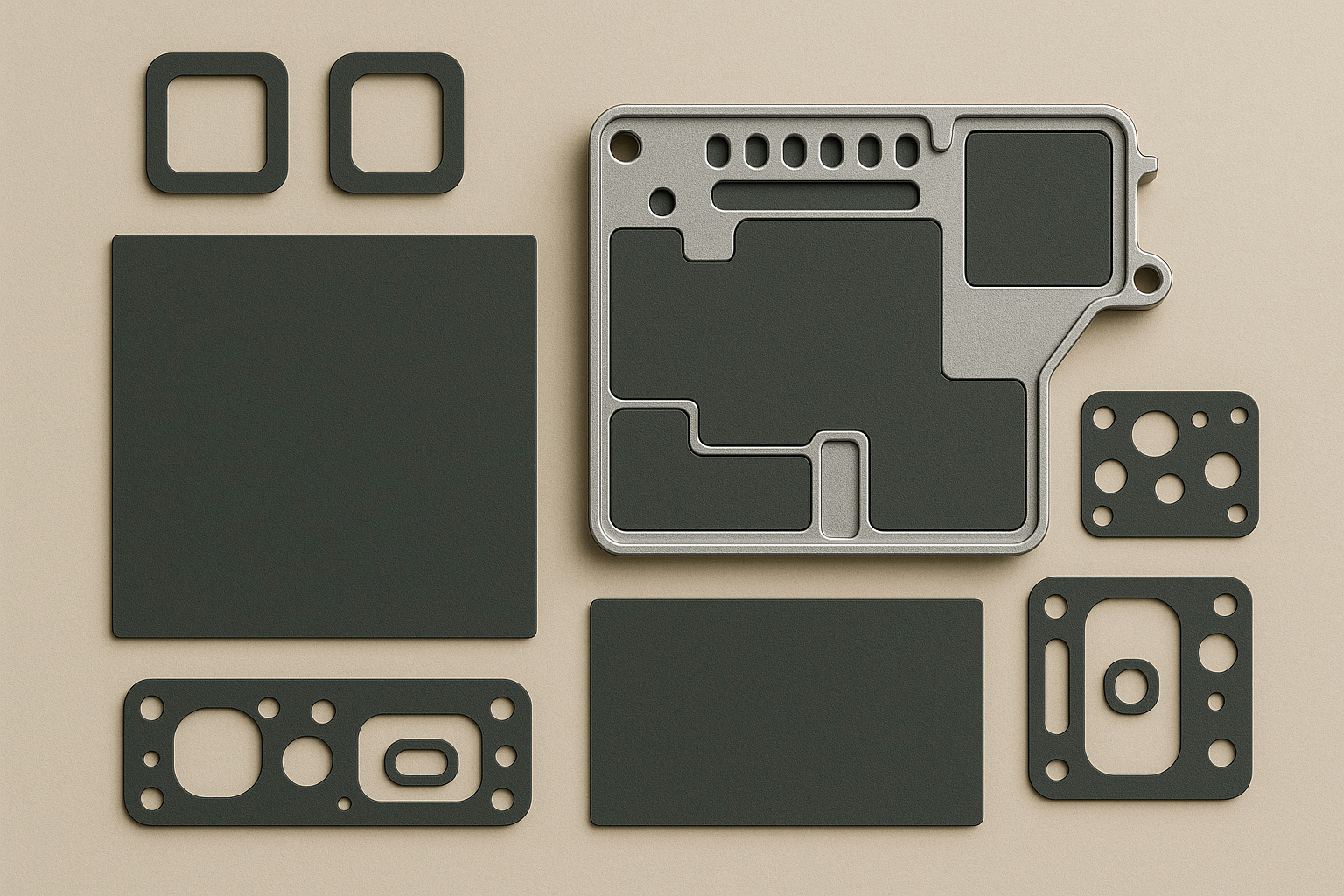
Short version: 3PB Solutions designs and manufactures RF absorber materials from 0.5 to 40 GHz that cross-reference directly to Eccosorb™ products. Lower cost, 2 to 3 week lead times, custom thicknesses and formulations as standard service. Request a free sample kit or keep reading for the full cross-reference table and product details.
Eccosorb™ has been the go-to RF absorber line for decades, and for good reason. The materials work. If you’re reading this, you probably already know that. You’re looking for an Eccosorb™ alternative because something about your current situation isn’t working.
Maybe you’re three weeks from an FCC pre-scan and Laird is quoting you 8 to 10 weeks on a direct order. Maybe procurement just flagged absorber costs on a production BOM and asked if there’s a cheaper option that actually performs. Maybe your enclosure needs a thickness or loading level that doesn’t exist in any standard catalog. Or maybe you just want a second source qualified before your single supplier becomes a supply chain problem.
Whatever brought you here, this page has the cross-reference table, product details, and technical context you need to evaluate 3PB Solutions RF and microwave absorber materials against what you’re currently using.
Why Engineers Switch from Eccosorb™
Nobody switches absorber materials for fun. It’s extra work, extra testing, and extra paperwork. Engineers start looking for an Eccosorb™ alternative when the pain of staying outweighs the pain of switching. That usually comes down to one of four things.
Lead time. Eccosorb™ materials ordered directly from Laird can take 8 to 10 weeks depending on product and quantity. Some standard SKUs may be available faster through distributors like Digi-Key or Mouser if they happen to be in stock, but for custom thicknesses, non-standard sizes, or die-cut parts, you’re waiting. 3PB Solutions ships most materials in 2 to 3 weeks, including custom die-cuts.
Cost. Eccosorb™ performance has never been the issue. Price has. When you’re buying absorber for every unit in a production run and not just a prototype, the difference between legacy absorber pricing and a direct manufacturer adds up fast. No distributor markup, no corporate overhead layered into the quote.
Customization. Standard catalogs only go so far. If your enclosure has a 0.035″ gap, you need 0.035″ material. If your application needs a different loading level to shift the absorption peak, you need a manufacturer who can adjust the formulation. If your mechanical envelope requires a specific die-cut geometry, you need someone with in-house fabrication. 3PB Solutions treats custom thicknesses, formulations, and fabricated parts as part of the standard offering.
Second source. Single-sourcing any critical material carries risk, especially on programs with multi-year production runs. Having a qualified alternative on file means you’re not scrambling if lead times slip or pricing changes.
What Makes a Credible Eccosorb™ Alternative
There are a lot of “absorber materials” on the market. Not all of them are serious Eccosorb™ alternatives. Before you spend time evaluating anything, here’s what separates a credible alternative from a catalog filler.
It has to perform at your frequency. This sounds obvious, but absorber materials are frequency-dependent. A material that provides 15 dB of reflection loss at 2 GHz might give you 3 dB at 10 GHz. For cavity resonance applications, you need sufficient attenuation at the frequencies where your enclosure actually resonates. For near-field suppression, the material’s permeability and loss characteristics need to match or exceed what you’re currently using. Ask for NRL arch data or waveguide test results at your operating frequency.
It has to fit your design. Thickness, flexibility, operating temperature range, adhesive compatibility, UL 94 flammability rating, and outgassing characteristics all need to align with your mechanical and environmental requirements. A material that performs well electrically but melts in your thermal environment or doesn’t fit your 0.040″ gap isn’t a practical replacement.
It has to be consistent. Production absorber materials need to be repeatable from lot to lot. If the first batch works and the second batch doesn’t, you have a bigger problem than the one you started with. Ask about quality systems, incoming material inspection, and lot traceability. 3PB Solutions maintains full traceability on all materials.
Someone has to answer the phone. The best absorber suppliers don’t just ship sheets. They help you pick the right material for your specific application and frequency range. This matters most when you’re crossing from one product line to another, where loading levels, base materials, and frequency ranges may all differ. When you contact 3PB Solutions, you talk to the people who formulate and manufacture the material.
Eccosorb™ to 3PB Solutions Cross-Reference Table
This table maps common Eccosorb™ products to their 3PB Solutions equivalents. In each case, the 3PB material has successfully crossed into applications previously served by the corresponding Eccosorb™ product. Every material listed is available with pressure-sensitive adhesive (PSA) and can be die-cut to your drawing.
| Your Current Material | 3PB Solutions Alternative | Frequency Range | Base Material | Primary Application |
|---|---|---|---|---|
| Eccosorb™ RF-LB | US Series | 0.5 – 3.0 GHz | Acrylic (non-silicone) | Near-field noise suppression, cable shielding, cavity damping |
| Eccosorb™ MCS | LS Series | 1.0 – 4.0 GHz | Iron-loaded silicone | Cavity resonance, Wi-Fi and LTE interference |
| Eccosorb™ BSR / MFS | CB Series / XB Series | 4.0 – 12.0 GHz | Iron-loaded silicone | Cavity resonance, radar, satellite communications |
| Eccosorb™ GDS | KU Series / KB Series | 12.0 – 27.0 GHz | Iron-loaded silicone | VSAT terminals, automotive radar, 5G mmWave |
| Eccosorb™ 5G MeF / HiF | KA Series | 27.0 – 40.0 GHz | Iron-loaded silicone | 5G FR2, Ka-band satellite, precision test equipment |
| Laird Robzorb™ | AC-001 Series | 1.0 – 40.0 GHz | Dispensable silicone | Automated cavity fills, complex geometries, high-volume production |
Datasheets are available for every product listed above. Request a sample kit and we’ll include the relevant datasheets for your frequency range.
Start Here: The US Series
If you’re not sure where to begin, start with the US Series. It’s the material we recommend for first-time evaluations regardless of what Eccosorb™ product you’re currently using, and here’s why.
The US Series is an acrylic-based, high-permeability absorber that covers 0.5 to 18.0 GHz, with peak performance in the 0.5 to 3.0 GHz band. High magnetic permeability makes it effective at attenuating cavity resonances, suppressing near-field noise coupling, and reducing surface currents. Those are the same jobs typically handled by magnetically loaded silicone absorbers like Eccosorb™ RF-LB.
Four things make it a smart first try:
It’s thin. Available in 0.010″, 0.020″, 0.040″, and 0.060″ thicknesses. The 0.010″ option is among the thinnest high-permeability absorbers you can buy. If your enclosure has tight mechanical tolerances, this is the material that fits where thicker tuned absorbers physically can’t.
No silicone. The acrylic base means zero risk of silicone oil migration or contamination. If you work with optical assemblies, certain medical devices, or anything where silicone bleed could interfere with adjacent components or coatings, this is a meaningful differentiator. It’s also preferred in automotive and aerospace environments where silicone-free materials are specified.
It works across a wide range. The US Series is optimized for 0.5 to 3.0 GHz, but it has successfully crossed into applications up to 18.0 GHz where cavity resonance suppression is the primary goal. In many enclosures, it provides enough attenuation to resolve the interference problem at a lower cost and thinner profile than a frequency-tuned alternative. Try it first. If it works, you just saved yourself time and money.
One material, fewer SKUs. Because it covers so much ground, the US Series reduces the number of materials you need to evaluate. Test it in your cavity. If it resolves your issue, you’re done. If your application demands maximum attenuation at a very specific frequency, that’s when you step up to the tuned silicone series.
Tuned Silicone Series: When You Know Exactly What Frequency You Need
Some applications need every last dB at a specific frequency. Precision test equipment, narrowband radar, designs where the cavity resonance frequency is well-characterized and you need peak absorption right there. That’s what the tuned silicone series is for.
Each product is an iron-loaded silicone elastomer engineered for peak absorption in a specific band, with published NRL arch reflection loss data to back it up.
The LS Series (1.0 – 4.0 GHz) covers L and S bands: Wi-Fi, LTE, CBRS. Available from 0.040″ to 0.125″ thick, rated -55°C to +200°C. Common in wireless access points, telecom infrastructure, and IoT gateways.
The CB Series (4.0 – 8.0 GHz) covers the C band: Wi-Fi 5/6, sub-6 GHz 5G, public safety broadband. Frequently specified in enterprise networking hardware, small cells, and backhaul systems.
The XB Series (8.0 – 12.0 GHz) covers X band: maritime radar, satellite downlink, high-frequency test and measurement. The KU Series (12.0 – 18.0 GHz), KB Series (18.0 – 27.0 GHz), and KA Series (27.0 – 40.0 GHz) extend coverage through Ku, K, and Ka bands for VSAT terminals, automotive radar, 5G FR2 mmWave, and satellite communications.
Full reflection loss curves are in the downloadable datasheets on each product page. Need specific dB values at a particular frequency for a design review? Email our engineering team and we’ll get you the numbers.
Dispensable Absorbers: The AC-001 Series
Some enclosures don’t lend themselves to sheet absorber. Complex cavity geometries, tight spaces that are hard to reach with die-cut pieces, or production lines that need to dispense and cure absorber material as part of an automated process. That’s where the AC-001 Series comes in.
The AC-001 is a silicone-based, carbonyl iron-loaded dispensable absorber available in six loading levels covering 1.0 to 40.0 GHz. What sets it apart from other dispensable absorber products on the market is the ability to customize viscosity, cure profile, and electrical performance for your specific process. If your dispensing system needs a particular flow characteristic, or your cure cycle needs to match your existing oven schedule, the formulation can be adjusted. Larger manufacturers sell a fixed formula and that’s what you get. We’ll work with you to get it right.
How to Evaluate and Qualify an Alternative Absorber
Switching absorber materials on an active program takes some care. Here’s the process that works:
1. Request samples at the thicknesses you currently use. Start with the closest cross-reference from the table above. Using Eccosorb™ MCS at 0.060″? Request the LS Series at the nearest available thickness.
2. Test in your actual application. NRL arch data is useful for comparing materials on paper, but what really matters is performance inside your enclosure with your circuit layout. Place the alternative material in the same location as your current absorber and measure the result: radiated emissions, S-parameter isolation, receiver sensitivity, whatever your pass/fail criteria are. If the system meets spec, the material works. Period.
3. Check mechanical and environmental compatibility. Confirm adhesion, flexibility, thickness tolerance, and thermal behavior. Run the material through your standard environmental qualification if your program requires it.
4. Qualify for production. Once performance is confirmed, order a production-quantity sample lot and verify lot-to-lot consistency. 3PB Solutions provides full traceability and consistent material properties from order to order.
Why Engineers Come Back to 3PB Solutions
3PB Solutions is a US-based RF absorber manufacturer with in-house compounding, sheet production, die-cutting, and fabrication. The company was founded by a team with decades of experience in the RF absorber industry, supporting applications in telecom, commercial electronics, industrial systems, medical devices, and aerospace.
What keeps engineers coming back after their first sample order:
Lower cost across every product line. Direct manufacturer, no distributor markup.
2 to 3 week lead times on standard and custom materials, including die-cut parts to your drawing.
Custom formulations and thicknesses as standard service. Non-standard loading level or thickness? We’ll make it.
In-house die-cutting and fabrication. You get finished parts, not sheet stock you have to send to a converter.
Direct engineering support. You talk to the people who formulate and manufacture the material. No distributor layers.
Full product line from 0.5 to 40 GHz covering cavity resonance, near-field suppression, broadband absorption, and dispensable applications.
Get Started
The fastest way to evaluate 3PB Solutions materials is to request a free sample kit. Each kit includes pre-cut samples across multiple frequency ranges and thicknesses so you can test directly in your application.
Have a specific Eccosorb™ part number? Send it to our engineering team with your application details. We’ll recommend the closest match and have samples on your bench within days.
Quick Contact: Call (855) 785-5660 or email sales@3pbsolutions.com.
Frequently Asked Questions
What is the best alternative to Eccosorb™ RF absorber materials?
3PB Solutions manufactures a full line of RF absorber materials from 0.5 to 40 GHz that cross-reference directly to common Eccosorb™ products. The US Series replaces Eccosorb™ RF-LB, the LS Series replaces Eccosorb™ MCS, the CB/XB Series replace Eccosorb™ BSR/MFS, and the KU/KB/KA Series replace Eccosorb™ GDS and 5G products. All materials are available with PSA backing and custom die-cutting at lower cost with 2 to 3 week lead times.
How do I cross-reference my Eccosorb™ part number to a 3PB Solutions equivalent?
Eccosorb™ RF-LB maps to the US Series (0.5 to 3 GHz, acrylic base). Eccosorb™ MCS maps to the LS Series (1 to 4 GHz, silicone). Eccosorb™ BSR/MFS maps to the CB Series (4 to 8 GHz) and XB Series (8 to 12 GHz). Eccosorb™ GDS maps to the KU Series (12 to 18 GHz) and KB Series (18 to 27 GHz). Eccosorb™ 5G MeF/HiF maps to the KA Series (27 to 40 GHz). Laird Robzorb™ maps to the AC-001 dispensable series. See the full cross-reference table above, or email us your specific part number for a direct recommendation.
How long does it take to get RF absorber samples from 3PB Solutions?
Most standard and custom materials ship in 2 to 3 weeks, including custom die-cut parts. Sample kits with pre-cut materials across multiple frequency ranges are available by request. This compares to 8 to 10 weeks typical when ordering direct from larger absorber suppliers.
Can I get a custom thickness or formulation?
Yes. 3PB Solutions manufactures in-house and offers custom thicknesses, loading levels, and die-cut geometries as a standard service. The dispensable AC-001 Series can also be customized for viscosity, cure profile, and electrical performance to match your specific production process.
Is the US Series a direct replacement for Eccosorb™ RF-LB?
The US Series has successfully crossed into applications previously served by Eccosorb™ RF-LB across 0.5 to 18 GHz. It uses an acrylic base instead of silicone, which eliminates silicone oil migration concerns. Available in 0.010″, 0.020″, 0.040″, and 0.060″ thicknesses with PSA backing. The best way to confirm it works for your application is to test it in your actual enclosure and measure the result.
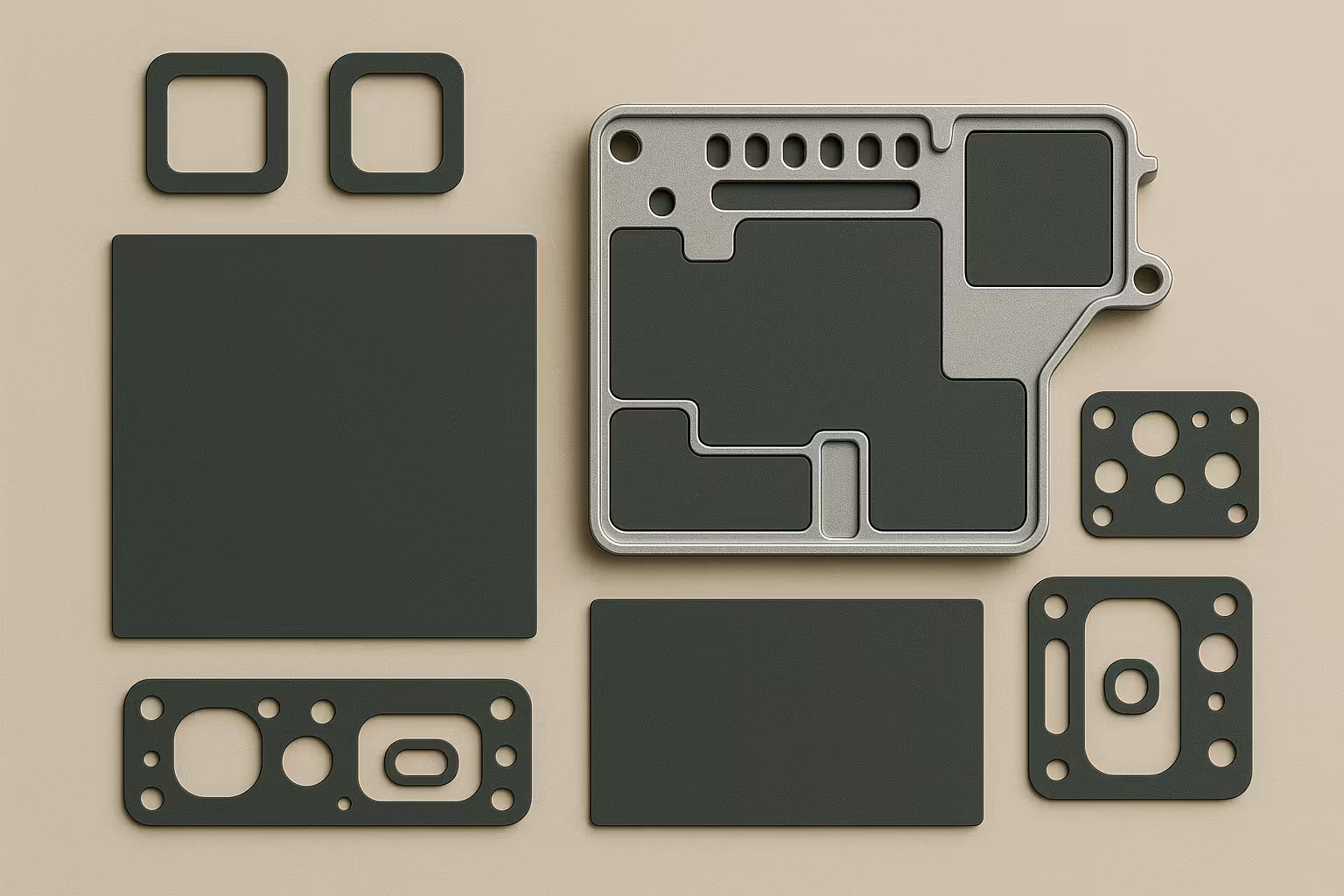
Short version: 3PB Solutions designs and manufactures RF absorber materials from 0.5 to 40 GHz that cross-reference directly to Eccosorb™ products. Lower cost, 2 to 3 week lead times, custom thicknesses and formulations as standard service. Request a free sample kit or keep reading for the full cross-reference table and product details.
Eccosorb™ has been the go-to RF absorber line for decades, and for good reason. The materials work. If you’re reading this, you probably already know that. You’re looking for an Eccosorb™ alternative because something about your current situation isn’t working.
Maybe you’re three weeks from an FCC pre-scan and Laird is quoting you 8 to 10 weeks on a direct order. Maybe procurement just flagged absorber costs on a production BOM and asked if there’s a cheaper option that actually performs. Maybe your enclosure needs a thickness or loading level that doesn’t exist in any standard catalog. Or maybe you just want a second source qualified before your single supplier becomes a supply chain problem.
Whatever brought you here, this page has the cross-reference table, product details, and technical context you need to evaluate 3PB Solutions RF and microwave absorber materials against what you’re currently using.
Why Engineers Switch from Eccosorb™
Nobody switches absorber materials for fun. It’s extra work, extra testing, and extra paperwork. Engineers start looking for an Eccosorb™ alternative when the pain of staying outweighs the pain of switching. That usually comes down to one of four things.
Lead time. Eccosorb™ materials ordered directly from Laird can take 8 to 10 weeks depending on product and quantity. Some standard SKUs may be available faster through distributors like Digi-Key or Mouser if they happen to be in stock, but for custom thicknesses, non-standard sizes, or die-cut parts, you’re waiting. 3PB Solutions ships most materials in 2 to 3 weeks, including custom die-cuts.
Cost. Eccosorb™ performance has never been the issue. Price has. When you’re buying absorber for every unit in a production run and not just a prototype, the difference between legacy absorber pricing and a direct manufacturer adds up fast. No distributor markup, no corporate overhead layered into the quote.
Customization. Standard catalogs only go so far. If your enclosure has a 0.035″ gap, you need 0.035″ material. If your application needs a different loading level to shift the absorption peak, you need a manufacturer who can adjust the formulation. If your mechanical envelope requires a specific die-cut geometry, you need someone with in-house fabrication. 3PB Solutions treats custom thicknesses, formulations, and fabricated parts as part of the standard offering.
Second source. Single-sourcing any critical material carries risk, especially on programs with multi-year production runs. Having a qualified alternative on file means you’re not scrambling if lead times slip or pricing changes.
What Makes a Credible Eccosorb™ Alternative
There are a lot of “absorber materials” on the market. Not all of them are serious Eccosorb™ alternatives. Before you spend time evaluating anything, here’s what separates a credible alternative from a catalog filler.
It has to perform at your frequency. This sounds obvious, but absorber materials are frequency-dependent. A material that provides 15 dB of reflection loss at 2 GHz might give you 3 dB at 10 GHz. For cavity resonance applications, you need sufficient attenuation at the frequencies where your enclosure actually resonates. For near-field suppression, the material’s permeability and loss characteristics need to match or exceed what you’re currently using. Ask for NRL arch data or waveguide test results at your operating frequency.
It has to fit your design. Thickness, flexibility, operating temperature range, adhesive compatibility, UL 94 flammability rating, and outgassing characteristics all need to align with your mechanical and environmental requirements. A material that performs well electrically but melts in your thermal environment or doesn’t fit your 0.040″ gap isn’t a practical replacement.
It has to be consistent. Production absorber materials need to be repeatable from lot to lot. If the first batch works and the second batch doesn’t, you have a bigger problem than the one you started with. Ask about quality systems, incoming material inspection, and lot traceability. 3PB Solutions maintains full traceability on all materials.
Someone has to answer the phone. The best absorber suppliers don’t just ship sheets. They help you pick the right material for your specific application and frequency range. This matters most when you’re crossing from one product line to another, where loading levels, base materials, and frequency ranges may all differ. When you contact 3PB Solutions, you talk to the people who formulate and manufacture the material.
Eccosorb™ to 3PB Solutions Cross-Reference Table
This table maps common Eccosorb™ products to their 3PB Solutions equivalents. In each case, the 3PB material has successfully crossed into applications previously served by the corresponding Eccosorb™ product. Every material listed is available with pressure-sensitive adhesive (PSA) and can be die-cut to your drawing.
| Your Current Material | 3PB Solutions Alternative | Frequency Range | Base Material | Primary Application |
|---|---|---|---|---|
| Eccosorb™ RF-LB | US Series | 0.5 – 3.0 GHz | Acrylic (non-silicone) | Near-field noise suppression, cable shielding, cavity damping |
| Eccosorb™ MCS | LS Series | 1.0 – 4.0 GHz | Iron-loaded silicone | Cavity resonance, Wi-Fi and LTE interference |
| Eccosorb™ BSR / MFS | CB Series / XB Series | 4.0 – 12.0 GHz | Iron-loaded silicone | Cavity resonance, radar, satellite communications |
| Eccosorb™ GDS | KU Series / KB Series | 12.0 – 27.0 GHz | Iron-loaded silicone | VSAT terminals, automotive radar, 5G mmWave |
| Eccosorb™ 5G MeF / HiF | KA Series | 27.0 – 40.0 GHz | Iron-loaded silicone | 5G FR2, Ka-band satellite, precision test equipment |
| Laird Robzorb™ | AC-001 Series | 1.0 – 40.0 GHz | Dispensable silicone | Automated cavity fills, complex geometries, high-volume production |
Datasheets are available for every product listed above. Request a sample kit and we’ll include the relevant datasheets for your frequency range.
Start Here: The US Series
If you’re not sure where to begin, start with the US Series. It’s the material we recommend for first-time evaluations regardless of what Eccosorb™ product you’re currently using, and here’s why.
The US Series is an acrylic-based, high-permeability absorber that covers 0.5 to 18.0 GHz, with peak performance in the 0.5 to 3.0 GHz band. High magnetic permeability makes it effective at attenuating cavity resonances, suppressing near-field noise coupling, and reducing surface currents. Those are the same jobs typically handled by magnetically loaded silicone absorbers like Eccosorb™ RF-LB.
Four things make it a smart first try:
It’s thin. Available in 0.010″, 0.020″, 0.040″, and 0.060″ thicknesses. The 0.010″ option is among the thinnest high-permeability absorbers you can buy. If your enclosure has tight mechanical tolerances, this is the material that fits where thicker tuned absorbers physically can’t.
No silicone. The acrylic base means zero risk of silicone oil migration or contamination. If you work with optical assemblies, certain medical devices, or anything where silicone bleed could interfere with adjacent components or coatings, this is a meaningful differentiator. It’s also preferred in automotive and aerospace environments where silicone-free materials are specified.
It works across a wide range. The US Series is optimized for 0.5 to 3.0 GHz, but it has successfully crossed into applications up to 18.0 GHz where cavity resonance suppression is the primary goal. In many enclosures, it provides enough attenuation to resolve the interference problem at a lower cost and thinner profile than a frequency-tuned alternative. Try it first. If it works, you just saved yourself time and money.
One material, fewer SKUs. Because it covers so much ground, the US Series reduces the number of materials you need to evaluate. Test it in your cavity. If it resolves your issue, you’re done. If your application demands maximum attenuation at a very specific frequency, that’s when you step up to the tuned silicone series.
Tuned Silicone Series: When You Know Exactly What Frequency You Need
Some applications need every last dB at a specific frequency. Precision test equipment, narrowband radar, designs where the cavity resonance frequency is well-characterized and you need peak absorption right there. That’s what the tuned silicone series is for.
Each product is an iron-loaded silicone elastomer engineered for peak absorption in a specific band, with published NRL arch reflection loss data to back it up.
The LS Series (1.0 – 4.0 GHz) covers L and S bands: Wi-Fi, LTE, CBRS. Available from 0.040″ to 0.125″ thick, rated -55°C to +200°C. Common in wireless access points, telecom infrastructure, and IoT gateways.
The CB Series (4.0 – 8.0 GHz) covers the C band: Wi-Fi 5/6, sub-6 GHz 5G, public safety broadband. Frequently specified in enterprise networking hardware, small cells, and backhaul systems.
The XB Series (8.0 – 12.0 GHz) covers X band: maritime radar, satellite downlink, high-frequency test and measurement. The KU Series (12.0 – 18.0 GHz), KB Series (18.0 – 27.0 GHz), and KA Series (27.0 – 40.0 GHz) extend coverage through Ku, K, and Ka bands for VSAT terminals, automotive radar, 5G FR2 mmWave, and satellite communications.
Full reflection loss curves are in the downloadable datasheets on each product page. Need specific dB values at a particular frequency for a design review? Email our engineering team and we’ll get you the numbers.
Dispensable Absorbers: The AC-001 Series
Some enclosures don’t lend themselves to sheet absorber. Complex cavity geometries, tight spaces that are hard to reach with die-cut pieces, or production lines that need to dispense and cure absorber material as part of an automated process. That’s where the AC-001 Series comes in.
The AC-001 is a silicone-based, carbonyl iron-loaded dispensable absorber available in six loading levels covering 1.0 to 40.0 GHz. What sets it apart from other dispensable absorber products on the market is the ability to customize viscosity, cure profile, and electrical performance for your specific process. If your dispensing system needs a particular flow characteristic, or your cure cycle needs to match your existing oven schedule, the formulation can be adjusted. Larger manufacturers sell a fixed formula and that’s what you get. We’ll work with you to get it right.
How to Evaluate and Qualify an Alternative Absorber
Switching absorber materials on an active program takes some care. Here’s the process that works:
1. Request samples at the thicknesses you currently use. Start with the closest cross-reference from the table above. Using Eccosorb™ MCS at 0.060″? Request the LS Series at the nearest available thickness.
2. Test in your actual application. NRL arch data is useful for comparing materials on paper, but what really matters is performance inside your enclosure with your circuit layout. Place the alternative material in the same location as your current absorber and measure the result: radiated emissions, S-parameter isolation, receiver sensitivity, whatever your pass/fail criteria are. If the system meets spec, the material works. Period.
3. Check mechanical and environmental compatibility. Confirm adhesion, flexibility, thickness tolerance, and thermal behavior. Run the material through your standard environmental qualification if your program requires it.
4. Qualify for production. Once performance is confirmed, order a production-quantity sample lot and verify lot-to-lot consistency. 3PB Solutions provides full traceability and consistent material properties from order to order.
Why Engineers Come Back to 3PB Solutions
3PB Solutions is a US-based RF absorber manufacturer with in-house compounding, sheet production, die-cutting, and fabrication. The company was founded by a team with decades of experience in the RF absorber industry, supporting applications in telecom, commercial electronics, industrial systems, medical devices, and aerospace.
What keeps engineers coming back after their first sample order:
Lower cost across every product line. Direct manufacturer, no distributor markup.
2 to 3 week lead times on standard and custom materials, including die-cut parts to your drawing.
Custom formulations and thicknesses as standard service. Non-standard loading level or thickness? We’ll make it.
In-house die-cutting and fabrication. You get finished parts, not sheet stock you have to send to a converter.
Direct engineering support. You talk to the people who formulate and manufacture the material. No distributor layers.
Full product line from 0.5 to 40 GHz covering cavity resonance, near-field suppression, broadband absorption, and dispensable applications.
Get Started
The fastest way to evaluate 3PB Solutions materials is to request a free sample kit. Each kit includes pre-cut samples across multiple frequency ranges and thicknesses so you can test directly in your application.
Have a specific Eccosorb™ part number? Send it to our engineering team with your application details. We’ll recommend the closest match and have samples on your bench within days.
Quick Contact: Call (855) 785-5660 or email sales@3pbsolutions.com.
Frequently Asked Questions
What is the best alternative to Eccosorb™ RF absorber materials?
3PB Solutions manufactures a full line of RF absorber materials from 0.5 to 40 GHz that cross-reference directly to common Eccosorb™ products. The US Series replaces Eccosorb™ RF-LB, the LS Series replaces Eccosorb™ MCS, the CB/XB Series replace Eccosorb™ BSR/MFS, and the KU/KB/KA Series replace Eccosorb™ GDS and 5G products. All materials are available with PSA backing and custom die-cutting at lower cost with 2 to 3 week lead times.
How do I cross-reference my Eccosorb™ part number to a 3PB Solutions equivalent?
Eccosorb™ RF-LB maps to the US Series (0.5 to 3 GHz, acrylic base). Eccosorb™ MCS maps to the LS Series (1 to 4 GHz, silicone). Eccosorb™ BSR/MFS maps to the CB Series (4 to 8 GHz) and XB Series (8 to 12 GHz). Eccosorb™ GDS maps to the KU Series (12 to 18 GHz) and KB Series (18 to 27 GHz). Eccosorb™ 5G MeF/HiF maps to the KA Series (27 to 40 GHz). Laird Robzorb™ maps to the AC-001 dispensable series. See the full cross-reference table above, or email us your specific part number for a direct recommendation.
How long does it take to get RF absorber samples from 3PB Solutions?
Most standard and custom materials ship in 2 to 3 weeks, including custom die-cut parts. Sample kits with pre-cut materials across multiple frequency ranges are available by request. This compares to 8 to 10 weeks typical when ordering direct from larger absorber suppliers.
Can I get a custom thickness or formulation?
Yes. 3PB Solutions manufactures in-house and offers custom thicknesses, loading levels, and die-cut geometries as a standard service. The dispensable AC-001 Series can also be customized for viscosity, cure profile, and electrical performance to match your specific production process.
Is the US Series a direct replacement for Eccosorb™ RF-LB?
The US Series has successfully crossed into applications previously served by Eccosorb™ RF-LB across 0.5 to 18 GHz. It uses an acrylic base instead of silicone, which eliminates silicone oil migration concerns. Available in 0.010″, 0.020″, 0.040″, and 0.060″ thicknesses with PSA backing. The best way to confirm it works for your application is to test it in your actual enclosure and measure the result.
Short version: 3PB Solutions designs and manufactures RF absorber materials from 0.5 to 40 GHz that cross-reference directly to Eccosorb™ products. Lower cost, 2 to 3 week lead times, custom thicknesses and formulations as standard service. Request a free sample kit or keep reading for the full cross-reference table and product details.
Eccosorb™ has been the go-to RF absorber line for decades, and for good reason. The materials work. If you’re reading this, you probably already know that. You’re looking for an Eccosorb™ alternative because something about your current situation isn’t working.
Maybe you’re three weeks from an FCC pre-scan and Laird is quoting you 8 to 10 weeks on a direct order. Maybe procurement just flagged absorber costs on a production BOM and asked if there’s a cheaper option that actually performs. Maybe your enclosure needs a thickness or loading level that doesn’t exist in any standard catalog. Or maybe you just want a second source qualified before your single supplier becomes a supply chain problem.
Whatever brought you here, this page has the cross-reference table, product details, and technical context you need to evaluate 3PB Solutions RF and microwave absorber materials against what you’re currently using.
Why Engineers Switch from Eccosorb™
Nobody switches absorber materials for fun. It’s extra work, extra testing, and extra paperwork. Engineers start looking for an Eccosorb™ alternative when the pain of staying outweighs the pain of switching. That usually comes down to one of four things.
Lead time. Eccosorb™ materials ordered directly from Laird can take 8 to 10 weeks depending on product and quantity. Some standard SKUs may be available faster through distributors like Digi-Key or Mouser if they happen to be in stock, but for custom thicknesses, non-standard sizes, or die-cut parts, you’re waiting. 3PB Solutions ships most materials in 2 to 3 weeks, including custom die-cuts.
Cost. Eccosorb™ performance has never been the issue. Price has. When you’re buying absorber for every unit in a production run and not just a prototype, the difference between legacy absorber pricing and a direct manufacturer adds up fast. No distributor markup, no corporate overhead layered into the quote.
Customization. Standard catalogs only go so far. If your enclosure has a 0.035″ gap, you need 0.035″ material. If your application needs a different loading level to shift the absorption peak, you need a manufacturer who can adjust the formulation. If your mechanical envelope requires a specific die-cut geometry, you need someone with in-house fabrication. 3PB Solutions treats custom thicknesses, formulations, and fabricated parts as part of the standard offering.
Second source. Single-sourcing any critical material carries risk, especially on programs with multi-year production runs. Having a qualified alternative on file means you’re not scrambling if lead times slip or pricing changes.
What Makes a Credible Eccosorb™ Alternative
There are a lot of “absorber materials” on the market. Not all of them are serious Eccosorb™ alternatives. Before you spend time evaluating anything, here’s what separates a credible alternative from a catalog filler.
It has to perform at your frequency. This sounds obvious, but absorber materials are frequency-dependent. A material that provides 15 dB of reflection loss at 2 GHz might give you 3 dB at 10 GHz. For cavity resonance applications, you need sufficient attenuation at the frequencies where your enclosure actually resonates. For near-field suppression, the material’s permeability and loss characteristics need to match or exceed what you’re currently using. Ask for NRL arch data or waveguide test results at your operating frequency.
It has to fit your design. Thickness, flexibility, operating temperature range, adhesive compatibility, UL 94 flammability rating, and outgassing characteristics all need to align with your mechanical and environmental requirements. A material that performs well electrically but melts in your thermal environment or doesn’t fit your 0.040″ gap isn’t a practical replacement.
It has to be consistent. Production absorber materials need to be repeatable from lot to lot. If the first batch works and the second batch doesn’t, you have a bigger problem than the one you started with. Ask about quality systems, incoming material inspection, and lot traceability. 3PB Solutions maintains full traceability on all materials.
Someone has to answer the phone. The best absorber suppliers don’t just ship sheets. They help you pick the right material for your specific application and frequency range. This matters most when you’re crossing from one product line to another, where loading levels, base materials, and frequency ranges may all differ. When you contact 3PB Solutions, you talk to the people who formulate and manufacture the material.
Eccosorb™ to 3PB Solutions Cross-Reference Table
This table maps common Eccosorb™ products to their 3PB Solutions equivalents. In each case, the 3PB material has successfully crossed into applications previously served by the corresponding Eccosorb™ product. Every material listed is available with pressure-sensitive adhesive (PSA) and can be die-cut to your drawing.
| Your Current Material | 3PB Solutions Alternative | Frequency Range | Base Material | Primary Application |
|---|---|---|---|---|
| Eccosorb™ RF-LB | US Series | 0.5 – 3.0 GHz | Acrylic (non-silicone) | Near-field noise suppression, cable shielding, cavity damping |
| Eccosorb™ MCS | LS Series | 1.0 – 4.0 GHz | Iron-loaded silicone | Cavity resonance, Wi-Fi and LTE interference |
| Eccosorb™ BSR / MFS | CB Series / XB Series | 4.0 – 12.0 GHz | Iron-loaded silicone | Cavity resonance, radar, satellite communications |
| Eccosorb™ GDS | KU Series / KB Series | 12.0 – 27.0 GHz | Iron-loaded silicone | VSAT terminals, automotive radar, 5G mmWave |
| Eccosorb™ 5G MeF / HiF | KA Series | 27.0 – 40.0 GHz | Iron-loaded silicone | 5G FR2, Ka-band satellite, precision test equipment |
| Laird Robzorb™ | AC-001 Series | 1.0 – 40.0 GHz | Dispensable silicone | Automated cavity fills, complex geometries, high-volume production |
Datasheets are available for every product listed above. Request a sample kit and we’ll include the relevant datasheets for your frequency range.
Start Here: The US Series
If you’re not sure where to begin, start with the US Series. It’s the material we recommend for first-time evaluations regardless of what Eccosorb™ product you’re currently using, and here’s why.
The US Series is an acrylic-based, high-permeability absorber that covers 0.5 to 18.0 GHz, with peak performance in the 0.5 to 3.0 GHz band. High magnetic permeability makes it effective at attenuating cavity resonances, suppressing near-field noise coupling, and reducing surface currents. Those are the same jobs typically handled by magnetically loaded silicone absorbers like Eccosorb™ RF-LB.
Four things make it a smart first try:
It’s thin. Available in 0.010″, 0.020″, 0.040″, and 0.060″ thicknesses. The 0.010″ option is among the thinnest high-permeability absorbers you can buy. If your enclosure has tight mechanical tolerances, this is the material that fits where thicker tuned absorbers physically can’t.
No silicone. The acrylic base means zero risk of silicone oil migration or contamination. If you work with optical assemblies, certain medical devices, or anything where silicone bleed could interfere with adjacent components or coatings, this is a meaningful differentiator. It’s also preferred in automotive and aerospace environments where silicone-free materials are specified.
It works across a wide range. The US Series is optimized for 0.5 to 3.0 GHz, but it has successfully crossed into applications up to 18.0 GHz where cavity resonance suppression is the primary goal. In many enclosures, it provides enough attenuation to resolve the interference problem at a lower cost and thinner profile than a frequency-tuned alternative. Try it first. If it works, you just saved yourself time and money.
One material, fewer SKUs. Because it covers so much ground, the US Series reduces the number of materials you need to evaluate. Test it in your cavity. If it resolves your issue, you’re done. If your application demands maximum attenuation at a very specific frequency, that’s when you step up to the tuned silicone series.
Tuned Silicone Series: When You Know Exactly What Frequency You Need
Some applications need every last dB at a specific frequency. Precision test equipment, narrowband radar, designs where the cavity resonance frequency is well-characterized and you need peak absorption right there. That’s what the tuned silicone series is for.
Each product is an iron-loaded silicone elastomer engineered for peak absorption in a specific band, with published NRL arch reflection loss data to back it up.
The LS Series (1.0 – 4.0 GHz) covers L and S bands: Wi-Fi, LTE, CBRS. Available from 0.040″ to 0.125″ thick, rated -55°C to +200°C. Common in wireless access points, telecom infrastructure, and IoT gateways.
The CB Series (4.0 – 8.0 GHz) covers the C band: Wi-Fi 5/6, sub-6 GHz 5G, public safety broadband. Frequently specified in enterprise networking hardware, small cells, and backhaul systems.
The XB Series (8.0 – 12.0 GHz) covers X band: maritime radar, satellite downlink, high-frequency test and measurement. The KU Series (12.0 – 18.0 GHz), KB Series (18.0 – 27.0 GHz), and KA Series (27.0 – 40.0 GHz) extend coverage through Ku, K, and Ka bands for VSAT terminals, automotive radar, 5G FR2 mmWave, and satellite communications.
Full reflection loss curves are in the downloadable datasheets on each product page. Need specific dB values at a particular frequency for a design review? Email our engineering team and we’ll get you the numbers.
Dispensable Absorbers: The AC-001 Series
Some enclosures don’t lend themselves to sheet absorber. Complex cavity geometries, tight spaces that are hard to reach with die-cut pieces, or production lines that need to dispense and cure absorber material as part of an automated process. That’s where the AC-001 Series comes in.
The AC-001 is a silicone-based, carbonyl iron-loaded dispensable absorber available in six loading levels covering 1.0 to 40.0 GHz. What sets it apart from other dispensable absorber products on the market is the ability to customize viscosity, cure profile, and electrical performance for your specific process. If your dispensing system needs a particular flow characteristic, or your cure cycle needs to match your existing oven schedule, the formulation can be adjusted. Larger manufacturers sell a fixed formula and that’s what you get. We’ll work with you to get it right.
How to Evaluate and Qualify an Alternative Absorber
Switching absorber materials on an active program takes some care. Here’s the process that works:
1. Request samples at the thicknesses you currently use. Start with the closest cross-reference from the table above. Using Eccosorb™ MCS at 0.060″? Request the LS Series at the nearest available thickness.
2. Test in your actual application. NRL arch data is useful for comparing materials on paper, but what really matters is performance inside your enclosure with your circuit layout. Place the alternative material in the same location as your current absorber and measure the result: radiated emissions, S-parameter isolation, receiver sensitivity, whatever your pass/fail criteria are. If the system meets spec, the material works. Period.
3. Check mechanical and environmental compatibility. Confirm adhesion, flexibility, thickness tolerance, and thermal behavior. Run the material through your standard environmental qualification if your program requires it.
4. Qualify for production. Once performance is confirmed, order a production-quantity sample lot and verify lot-to-lot consistency. 3PB Solutions provides full traceability and consistent material properties from order to order.
Why Engineers Come Back to 3PB Solutions
3PB Solutions is a US-based RF absorber manufacturer with in-house compounding, sheet production, die-cutting, and fabrication. The company was founded by a team with decades of experience in the RF absorber industry, supporting applications in telecom, commercial electronics, industrial systems, medical devices, and aerospace.
What keeps engineers coming back after their first sample order:
Lower cost across every product line. Direct manufacturer, no distributor markup.
2 to 3 week lead times on standard and custom materials, including die-cut parts to your drawing.
Custom formulations and thicknesses as standard service. Non-standard loading level or thickness? We’ll make it.
In-house die-cutting and fabrication. You get finished parts, not sheet stock you have to send to a converter.
Direct engineering support. You talk to the people who formulate and manufacture the material. No distributor layers.
Full product line from 0.5 to 40 GHz covering cavity resonance, near-field suppression, broadband absorption, and dispensable applications.
Get Started
The fastest way to evaluate 3PB Solutions materials is to request a free sample kit. Each kit includes pre-cut samples across multiple frequency ranges and thicknesses so you can test directly in your application.
Have a specific Eccosorb™ part number? Send it to our engineering team with your application details. We’ll recommend the closest match and have samples on your bench within days.
Quick Contact: Call (855) 785-5660 or email sales@3pbsolutions.com.
Frequently Asked Questions
What is the best alternative to Eccosorb™ RF absorber materials?
3PB Solutions manufactures a full line of RF absorber materials from 0.5 to 40 GHz that cross-reference directly to common Eccosorb™ products. The US Series replaces Eccosorb™ RF-LB, the LS Series replaces Eccosorb™ MCS, the CB/XB Series replace Eccosorb™ BSR/MFS, and the KU/KB/KA Series replace Eccosorb™ GDS and 5G products. All materials are available with PSA backing and custom die-cutting at lower cost with 2 to 3 week lead times.
How do I cross-reference my Eccosorb™ part number to a 3PB Solutions equivalent?
Eccosorb™ RF-LB maps to the US Series (0.5 to 3 GHz, acrylic base). Eccosorb™ MCS maps to the LS Series (1 to 4 GHz, silicone). Eccosorb™ BSR/MFS maps to the CB Series (4 to 8 GHz) and XB Series (8 to 12 GHz). Eccosorb™ GDS maps to the KU Series (12 to 18 GHz) and KB Series (18 to 27 GHz). Eccosorb™ 5G MeF/HiF maps to the KA Series (27 to 40 GHz). Laird Robzorb™ maps to the AC-001 dispensable series. See the full cross-reference table above, or email us your specific part number for a direct recommendation.
How long does it take to get RF absorber samples from 3PB Solutions?
Most standard and custom materials ship in 2 to 3 weeks, including custom die-cut parts. Sample kits with pre-cut materials across multiple frequency ranges are available by request. This compares to 8 to 10 weeks typical when ordering direct from larger absorber suppliers.
Can I get a custom thickness or formulation?
Yes. 3PB Solutions manufactures in-house and offers custom thicknesses, loading levels, and die-cut geometries as a standard service. The dispensable AC-001 Series can also be customized for viscosity, cure profile, and electrical performance to match your specific production process.
Is the US Series a direct replacement for Eccosorb™ RF-LB?
The US Series has successfully crossed into applications previously served by Eccosorb™ RF-LB across 0.5 to 18 GHz. It uses an acrylic base instead of silicone, which eliminates silicone oil migration concerns. Available in 0.010″, 0.020″, 0.040″, and 0.060″ thicknesses with PSA backing. The best way to confirm it works for your application is to test it in your actual enclosure and measure the result.
Short version: 3PB Solutions designs and manufactures RF absorber materials from 0.5 to 40 GHz that cross-reference directly to Eccosorb™ products. Lower cost, 2 to 3 week lead times, custom thicknesses and formulations as standard service. Request a free sample kit or keep reading for the full cross-reference table and product details.
Eccosorb™ has been the go-to RF absorber line for decades, and for good reason. The materials work. If you’re reading this, you probably already know that. You’re looking for an Eccosorb™ alternative because something about your current situation isn’t working.
Maybe you’re three weeks from an FCC pre-scan and Laird is quoting you 8 to 10 weeks on a direct order. Maybe procurement just flagged absorber costs on a production BOM and asked if there’s a cheaper option that actually performs. Maybe your enclosure needs a thickness or loading level that doesn’t exist in any standard catalog. Or maybe you just want a second source qualified before your single supplier becomes a supply chain problem.
Whatever brought you here, this page has the cross-reference table, product details, and technical context you need to evaluate 3PB Solutions RF and microwave absorber materials against what you’re currently using.
Why Engineers Switch from Eccosorb™
Nobody switches absorber materials for fun. It’s extra work, extra testing, and extra paperwork. Engineers start looking for an Eccosorb™ alternative when the pain of staying outweighs the pain of switching. That usually comes down to one of four things.
Lead time. Eccosorb™ materials ordered directly from Laird can take 8 to 10 weeks depending on product and quantity. Some standard SKUs may be available faster through distributors like Digi-Key or Mouser if they happen to be in stock, but for custom thicknesses, non-standard sizes, or die-cut parts, you’re waiting. 3PB Solutions ships most materials in 2 to 3 weeks, including custom die-cuts.
Cost. Eccosorb™ performance has never been the issue. Price has. When you’re buying absorber for every unit in a production run and not just a prototype, the difference between legacy absorber pricing and a direct manufacturer adds up fast. No distributor markup, no corporate overhead layered into the quote.
Customization. Standard catalogs only go so far. If your enclosure has a 0.035″ gap, you need 0.035″ material. If your application needs a different loading level to shift the absorption peak, you need a manufacturer who can adjust the formulation. If your mechanical envelope requires a specific die-cut geometry, you need someone with in-house fabrication. 3PB Solutions treats custom thicknesses, formulations, and fabricated parts as part of the standard offering.
Second source. Single-sourcing any critical material carries risk, especially on programs with multi-year production runs. Having a qualified alternative on file means you’re not scrambling if lead times slip or pricing changes.
What Makes a Credible Eccosorb™ Alternative
There are a lot of “absorber materials” on the market. Not all of them are serious Eccosorb™ alternatives. Before you spend time evaluating anything, here’s what separates a credible alternative from a catalog filler.
It has to perform at your frequency. This sounds obvious, but absorber materials are frequency-dependent. A material that provides 15 dB of reflection loss at 2 GHz might give you 3 dB at 10 GHz. For cavity resonance applications, you need sufficient attenuation at the frequencies where your enclosure actually resonates. For near-field suppression, the material’s permeability and loss characteristics need to match or exceed what you’re currently using. Ask for NRL arch data or waveguide test results at your operating frequency.
It has to fit your design. Thickness, flexibility, operating temperature range, adhesive compatibility, UL 94 flammability rating, and outgassing characteristics all need to align with your mechanical and environmental requirements. A material that performs well electrically but melts in your thermal environment or doesn’t fit your 0.040″ gap isn’t a practical replacement.
It has to be consistent. Production absorber materials need to be repeatable from lot to lot. If the first batch works and the second batch doesn’t, you have a bigger problem than the one you started with. Ask about quality systems, incoming material inspection, and lot traceability. 3PB Solutions maintains full traceability on all materials.
Someone has to answer the phone. The best absorber suppliers don’t just ship sheets. They help you pick the right material for your specific application and frequency range. This matters most when you’re crossing from one product line to another, where loading levels, base materials, and frequency ranges may all differ. When you contact 3PB Solutions, you talk to the people who formulate and manufacture the material.
Eccosorb™ to 3PB Solutions Cross-Reference Table
This table maps common Eccosorb™ products to their 3PB Solutions equivalents. In each case, the 3PB material has successfully crossed into applications previously served by the corresponding Eccosorb™ product. Every material listed is available with pressure-sensitive adhesive (PSA) and can be die-cut to your drawing.
| Your Current Material | 3PB Solutions Alternative | Frequency Range | Base Material | Primary Application |
|---|---|---|---|---|
| Eccosorb™ RF-LB | US Series | 0.5 – 3.0 GHz | Acrylic (non-silicone) | Near-field noise suppression, cable shielding, cavity damping |
| Eccosorb™ MCS | LS Series | 1.0 – 4.0 GHz | Iron-loaded silicone | Cavity resonance, Wi-Fi and LTE interference |
| Eccosorb™ BSR / MFS | CB Series / XB Series | 4.0 – 12.0 GHz | Iron-loaded silicone | Cavity resonance, radar, satellite communications |
| Eccosorb™ GDS | KU Series / KB Series | 12.0 – 27.0 GHz | Iron-loaded silicone | VSAT terminals, automotive radar, 5G mmWave |
| Eccosorb™ 5G MeF / HiF | KA Series | 27.0 – 40.0 GHz | Iron-loaded silicone | 5G FR2, Ka-band satellite, precision test equipment |
| Laird Robzorb™ | AC-001 Series | 1.0 – 40.0 GHz | Dispensable silicone | Automated cavity fills, complex geometries, high-volume production |
Datasheets are available for every product listed above. Request a sample kit and we’ll include the relevant datasheets for your frequency range.
Start Here: The US Series
If you’re not sure where to begin, start with the US Series. It’s the material we recommend for first-time evaluations regardless of what Eccosorb™ product you’re currently using, and here’s why.
The US Series is an acrylic-based, high-permeability absorber that covers 0.5 to 18.0 GHz, with peak performance in the 0.5 to 3.0 GHz band. High magnetic permeability makes it effective at attenuating cavity resonances, suppressing near-field noise coupling, and reducing surface currents. Those are the same jobs typically handled by magnetically loaded silicone absorbers like Eccosorb™ RF-LB.
Four things make it a smart first try:
It’s thin. Available in 0.010″, 0.020″, 0.040″, and 0.060″ thicknesses. The 0.010″ option is among the thinnest high-permeability absorbers you can buy. If your enclosure has tight mechanical tolerances, this is the material that fits where thicker tuned absorbers physically can’t.
No silicone. The acrylic base means zero risk of silicone oil migration or contamination. If you work with optical assemblies, certain medical devices, or anything where silicone bleed could interfere with adjacent components or coatings, this is a meaningful differentiator. It’s also preferred in automotive and aerospace environments where silicone-free materials are specified.
It works across a wide range. The US Series is optimized for 0.5 to 3.0 GHz, but it has successfully crossed into applications up to 18.0 GHz where cavity resonance suppression is the primary goal. In many enclosures, it provides enough attenuation to resolve the interference problem at a lower cost and thinner profile than a frequency-tuned alternative. Try it first. If it works, you just saved yourself time and money.
One material, fewer SKUs. Because it covers so much ground, the US Series reduces the number of materials you need to evaluate. Test it in your cavity. If it resolves your issue, you’re done. If your application demands maximum attenuation at a very specific frequency, that’s when you step up to the tuned silicone series.
Tuned Silicone Series: When You Know Exactly What Frequency You Need
Some applications need every last dB at a specific frequency. Precision test equipment, narrowband radar, designs where the cavity resonance frequency is well-characterized and you need peak absorption right there. That’s what the tuned silicone series is for.
Each product is an iron-loaded silicone elastomer engineered for peak absorption in a specific band, with published NRL arch reflection loss data to back it up.
The LS Series (1.0 – 4.0 GHz) covers L and S bands: Wi-Fi, LTE, CBRS. Available from 0.040″ to 0.125″ thick, rated -55°C to +200°C. Common in wireless access points, telecom infrastructure, and IoT gateways.
The CB Series (4.0 – 8.0 GHz) covers the C band: Wi-Fi 5/6, sub-6 GHz 5G, public safety broadband. Frequently specified in enterprise networking hardware, small cells, and backhaul systems.
The XB Series (8.0 – 12.0 GHz) covers X band: maritime radar, satellite downlink, high-frequency test and measurement. The KU Series (12.0 – 18.0 GHz), KB Series (18.0 – 27.0 GHz), and KA Series (27.0 – 40.0 GHz) extend coverage through Ku, K, and Ka bands for VSAT terminals, automotive radar, 5G FR2 mmWave, and satellite communications.
Full reflection loss curves are in the downloadable datasheets on each product page. Need specific dB values at a particular frequency for a design review? Email our engineering team and we’ll get you the numbers.
Dispensable Absorbers: The AC-001 Series
Some enclosures don’t lend themselves to sheet absorber. Complex cavity geometries, tight spaces that are hard to reach with die-cut pieces, or production lines that need to dispense and cure absorber material as part of an automated process. That’s where the AC-001 Series comes in.
The AC-001 is a silicone-based, carbonyl iron-loaded dispensable absorber available in six loading levels covering 1.0 to 40.0 GHz. What sets it apart from other dispensable absorber products on the market is the ability to customize viscosity, cure profile, and electrical performance for your specific process. If your dispensing system needs a particular flow characteristic, or your cure cycle needs to match your existing oven schedule, the formulation can be adjusted. Larger manufacturers sell a fixed formula and that’s what you get. We’ll work with you to get it right.
How to Evaluate and Qualify an Alternative Absorber
Switching absorber materials on an active program takes some care. Here’s the process that works:
1. Request samples at the thicknesses you currently use. Start with the closest cross-reference from the table above. Using Eccosorb™ MCS at 0.060″? Request the LS Series at the nearest available thickness.
2. Test in your actual application. NRL arch data is useful for comparing materials on paper, but what really matters is performance inside your enclosure with your circuit layout. Place the alternative material in the same location as your current absorber and measure the result: radiated emissions, S-parameter isolation, receiver sensitivity, whatever your pass/fail criteria are. If the system meets spec, the material works. Period.
3. Check mechanical and environmental compatibility. Confirm adhesion, flexibility, thickness tolerance, and thermal behavior. Run the material through your standard environmental qualification if your program requires it.
4. Qualify for production. Once performance is confirmed, order a production-quantity sample lot and verify lot-to-lot consistency. 3PB Solutions provides full traceability and consistent material properties from order to order.
Why Engineers Come Back to 3PB Solutions
3PB Solutions is a US-based RF absorber manufacturer with in-house compounding, sheet production, die-cutting, and fabrication. The company was founded by a team with decades of experience in the RF absorber industry, supporting applications in telecom, commercial electronics, industrial systems, medical devices, and aerospace.
What keeps engineers coming back after their first sample order:
Lower cost across every product line. Direct manufacturer, no distributor markup.
2 to 3 week lead times on standard and custom materials, including die-cut parts to your drawing.
Custom formulations and thicknesses as standard service. Non-standard loading level or thickness? We’ll make it.
In-house die-cutting and fabrication. You get finished parts, not sheet stock you have to send to a converter.
Direct engineering support. You talk to the people who formulate and manufacture the material. No distributor layers.
Full product line from 0.5 to 40 GHz covering cavity resonance, near-field suppression, broadband absorption, and dispensable applications.
Get Started
The fastest way to evaluate 3PB Solutions materials is to request a free sample kit. Each kit includes pre-cut samples across multiple frequency ranges and thicknesses so you can test directly in your application.
Have a specific Eccosorb™ part number? Send it to our engineering team with your application details. We’ll recommend the closest match and have samples on your bench within days.
Quick Contact: Call (855) 785-5660 or email sales@3pbsolutions.com.
Frequently Asked Questions
What is the best alternative to Eccosorb™ RF absorber materials?
3PB Solutions manufactures a full line of RF absorber materials from 0.5 to 40 GHz that cross-reference directly to common Eccosorb™ products. The US Series replaces Eccosorb™ RF-LB, the LS Series replaces Eccosorb™ MCS, the CB/XB Series replace Eccosorb™ BSR/MFS, and the KU/KB/KA Series replace Eccosorb™ GDS and 5G products. All materials are available with PSA backing and custom die-cutting at lower cost with 2 to 3 week lead times.
How do I cross-reference my Eccosorb™ part number to a 3PB Solutions equivalent?
Eccosorb™ RF-LB maps to the US Series (0.5 to 3 GHz, acrylic base). Eccosorb™ MCS maps to the LS Series (1 to 4 GHz, silicone). Eccosorb™ BSR/MFS maps to the CB Series (4 to 8 GHz) and XB Series (8 to 12 GHz). Eccosorb™ GDS maps to the KU Series (12 to 18 GHz) and KB Series (18 to 27 GHz). Eccosorb™ 5G MeF/HiF maps to the KA Series (27 to 40 GHz). Laird Robzorb™ maps to the AC-001 dispensable series. See the full cross-reference table above, or email us your specific part number for a direct recommendation.
How long does it take to get RF absorber samples from 3PB Solutions?
Most standard and custom materials ship in 2 to 3 weeks, including custom die-cut parts. Sample kits with pre-cut materials across multiple frequency ranges are available by request. This compares to 8 to 10 weeks typical when ordering direct from larger absorber suppliers.
Can I get a custom thickness or formulation?
Yes. 3PB Solutions manufactures in-house and offers custom thicknesses, loading levels, and die-cut geometries as a standard service. The dispensable AC-001 Series can also be customized for viscosity, cure profile, and electrical performance to match your specific production process.
Is the US Series a direct replacement for Eccosorb™ RF-LB?
The US Series has successfully crossed into applications previously served by Eccosorb™ RF-LB across 0.5 to 18 GHz. It uses an acrylic base instead of silicone, which eliminates silicone oil migration concerns. Available in 0.010″, 0.020″, 0.040″, and 0.060″ thicknesses with PSA backing. The best way to confirm it works for your application is to test it in your actual enclosure and measure the result.
