
by 3PB Team
Share
by 3PB Team
Share

Short version: RF absorbers are not interchangeable. Each type – elastomer sheet, foam, ferrite, dispensable, thermal pad – works through a different loss mechanism and performs best in a specific frequency range and form factor. Picking the wrong type wastes time and money. This guide explains how each type works, where it fits, and how to choose. Request a free sample kit to test materials in your application, or keep reading for the full breakdown.
Why Absorber Type Matters More Than You Think
Walk into most absorber manufacturers’ websites and you’ll see pages of black rectangles that all look the same. But under the surface, the differences are enormous. A carbon-loaded foam absorber and a magnetically loaded elastomer sheet might both claim to “absorb RF energy,” but they do it through completely different physical mechanisms, they work at different frequencies, and they solve different problems.
Picking the wrong absorber type is one of the most common mistakes in EMI troubleshooting. An engineer grabs whatever absorber material is sitting on the shelf, sticks it in the enclosure, and then wonders why the noise didn’t go away. The material wasn’t wrong – it was wrong for that frequency, that cavity, and that coupling mechanism.
Understanding absorber types saves you from that cycle. It’s the difference between solving an EMI problem in one iteration and burning three weeks swapping materials.
How RF Absorbers Work: Two Loss Mechanisms
Every RF absorber converts electromagnetic energy into heat. But there are two fundamentally different ways to get there, and the mechanism determines which frequencies the material can handle.
Magnetic loss absorbers use iron-based fillers – carbonyl iron powder, sendust-type alloys, or ferrite particles – suspended in a flexible matrix like silicone, acrylic, or epoxy. When an electromagnetic wave passes through the material, the magnetic domains in these particles rotate in response to the alternating field. That rotation dissipates energy as heat. Magnetic loss absorbers are most effective from roughly 500 MHz to 40 GHz depending on the filler type, loading level, and material thickness. They tend to be thin, flexible, and work well as sheet materials installed directly on or near the noise source.
Dielectric loss absorbers use carbon-based fillers – carbon black, graphite, or carbon fiber – in a foam or polymer matrix. The carbon particles interact with the electric field component of the wave, converting energy to heat through resistive losses. Carbon-loaded absorbers are typically used from 1 GHz up through 100 GHz and beyond. They tend to be thicker than magnetic absorbers and are commonly used in free-space applications like anechoic chamber linings and antenna isolation.
Some materials combine both mechanisms. But for material selection purposes, knowing which mechanism dominates tells you whether a given absorber type is even in the right ballpark for your application.
Type 1: Magnetically Loaded Elastomer Sheets
This is the workhorse category for in-device EMI suppression. If you’re solving a cavity resonance, suppressing near-field noise coupling between components on a PCB, or reducing surface currents inside a shielded enclosure, this is almost certainly where you start.
How they work. A flexible elastomer base (silicone, acrylic, or occasionally nitrile or neoprene) is loaded with magnetic filler particles. The type and concentration of filler determines the frequency response. Higher loading levels shift peak absorption to lower frequencies. Thicker materials also push performance lower. Engineers tune absorption by selecting the right combination of filler loading and material thickness.
Frequency range. Roughly 0.5 to 40 GHz depending on formulation. Different loading levels are optimized for different bands. This isn’t a one-size-fits-all category – a material designed for 2 GHz will underperform at 15 GHz, and vice versa.
Form factor. Thin, flexible sheets typically ranging from 0.010″ to 0.125″ thick. Supplied in rolls or sheets, available with pressure-sensitive adhesive (PSA) backing for direct application inside enclosures, on shield cans, or over PCB components. Can be die-cut to any 2D geometry.
Where they’re used. Consumer electronics (smartphones, laptops, wearables), telecom infrastructure (base stations, small cells, access points), automotive electronics (radar modules, infotainment, ADAS), medical devices, aerospace systems, and industrial controls. This is the broadest-application absorber category.
3PB Solutions products in this category:
The US Series is a proprietary magnetic-loaded acrylic elastomer designed for 0.5 to 3.0 GHz, but it has been fielded successfully in applications up to 18 GHz. It’s the material we recommend engineers try first regardless of frequency – if it solves the problem, you’re done, and you’ll spend less than you would on a frequency-specific material. The acrylic base eliminates silicone oil migration concerns, which matters in optical, medical, and aerospace environments where silicone contamination is a disqualifier. Available in 0.010″, 0.020″, and 0.040″ thicknesses. Sheets can be stacked to increase low-frequency performance. Most customers start with 0.020″ or 0.040″.
The LS Series (1.0 – 4.0 GHz), CB Series (4.0 – 8.0 GHz), XB Series (8.0 – 12.0 GHz), KU Series (12.0 – 18.0 GHz), KB Series (18.0 – 27.0 GHz), and KA Series (27.0 – 40.0 GHz) are iron-loaded silicone elastomers. Each is formulated with a specific loading level optimized for its target band. Custom thicknesses are available from 0.020″ to 0.125″ across the line, but each series has curated thicknesses tuned for best performance in its frequency range. The lower-frequency LS and CB Series offer more thickness options (0.040″ through 0.125″), while higher-frequency materials like the KU, KB, and KA Series are thinner by design – as thin as 0.037″ for the KA Series – because shorter wavelengths require less material depth. If you know your problem frequency falls within a specific band, these materials deliver higher peak absorption at that band than a general-purpose broadband material would.
The TF Series (2.0 – 18.0 GHz) is for narrowband applications where you need peak absorption at a specific frequency rather than coverage across a band. Each TF part number is a specific formulation and thickness combination selected to deliver maximum attenuation at an exact target frequency. If your cavity resonates at 6.2 GHz and you need every dB you can get at that frequency, the TF Series is the right choice.
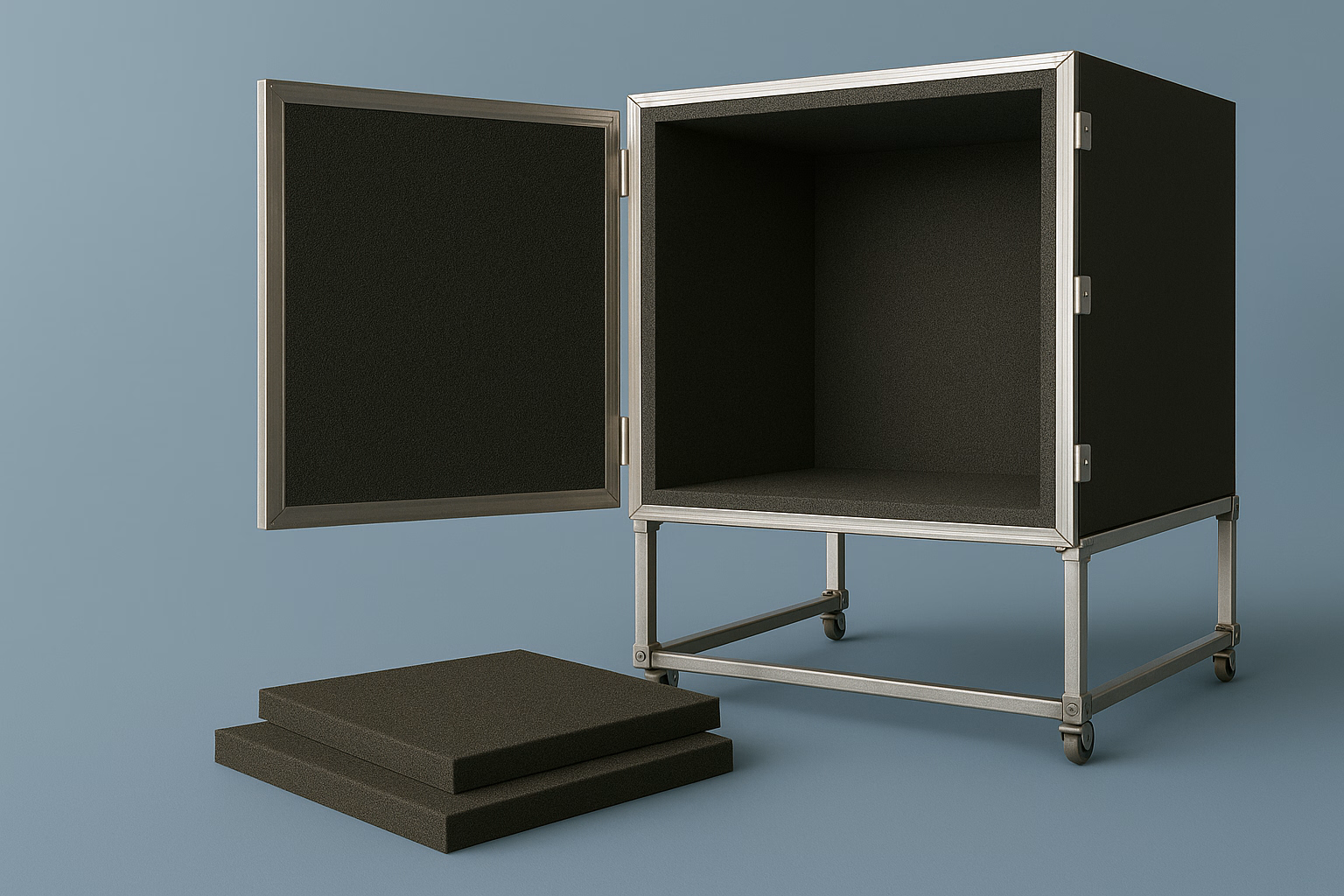
Type 2: Carbon-Loaded Foam Absorbers
Foam absorbers are what most people picture when they hear “RF absorber” – the dark pyramidal cones lining the walls of an anechoic chamber. But the category is broader than chamber linings. Carbon-loaded foams are used anywhere you need broadband absorption in free space, including antenna isolation, RCS (radar cross-section) reduction, and signal path management between systems.
How they work. Open-cell polyurethane foam is impregnated with carbon-based material. The carbon loading creates dielectric losses as RF energy passes through the foam structure. Performance depends on the loading profile and the foam thickness – thicker foams absorb lower frequencies.
There are two distinct subtypes, and they work differently:
Homogeneous (lossy) foam is uniformly loaded with carbon throughout the material. It absorbs RF energy passing through it and does not require a conductive backing. There is some front-face reflection, but the material attenuates the wave as it travels through the foam volume. This type is used to isolate two signals in free space or to line chamber walls where you want absorption without a metal ground plane behind the material.
Reticulated foam uses a tapered carbon loading – lighter at the front face, heavier toward the back. The front face is impedance-matched to free space (377 ohms), so the wave enters with minimal reflection. Inside the material, the wave scatters within the open-cell reticulated structure and is progressively absorbed as the loading increases. Reticulated foam must be installed on a conductive backing. The conductive surface creates a reflection that destructively interferes with the incoming wave at the front face, resulting in very low net reflection. Without the conductive backing, a reticulated foam absorber won’t achieve its rated performance.
Frequency range. Typically 1 GHz to 100+ GHz depending on foam thickness. Thicker foams extend performance to lower frequencies.
Form factor. Flat sheets, pyramid shapes, or wedge profiles. Generally thicker and bulkier than elastomer sheet absorbers. Not flexible enough to conform to curved surfaces.
3PB Solutions products in this category:
The AF Series Lossy Foam (1.0 – 40.0 GHz) is a homogeneous carbon-loaded open-cell polyurethane foam for free-space isolation and chamber applications. Does not require conductive backing.
The AF Series Reticulated Foam (4.0 – 100.0 GHz) is a tapered-loading reticulated open-cell polyurethane foam designed for installation on a conductive surface. Impedance-matched front face with progressive absorption through the material depth. Broadband performance across the microwave and millimeter-wave range.
The PIM Mitigation Series is a specialized version of the AF Series lossy foam wrapped in a weatherproof Herculite fabric for outdoor installation. These materials are widely deployed by major wireless carriers to improve small cell and macro cell antenna performance by reducing passive intermodulation (PIM) interference. If you’re working on 3G, 4G/LTE, or 5G antenna systems and struggling with PIM, this is a proven solution already in the field at scale.
Type 3: Ferrite Tiles and Sheets
Ferrite absorbers are the go-to material for low-frequency absorption below 1 GHz, where magnetically loaded elastomers and carbon foams start to lose effectiveness. They’re made from sintered ferrite ceramics – typically manganese-zinc or nickel-zinc compositions – and work through high magnetic permeability and loss at low frequencies.
Frequency range. Roughly 1 MHz to 1 GHz, with best performance in the 10 to 300 MHz range.
Form factor. Rigid tiles (typically 6mm thick) or flexible ferrite sheets. The rigid tiles are heavy – a significant consideration for ceiling-mounted installations in anechoic chambers. Flexible ferrite sheets are thinner and lighter but generally offer lower absorption.
Where they’re used. Anechoic chambers (especially hybrid chambers that combine ferrite tiles on the walls with foam pyramids for broadband coverage), EMC test facilities, power electronics enclosures, and shielded rooms. Also used in industrial environments near variable frequency drives and motor controllers that generate strong low-frequency emissions.
3PB Solutions does not currently manufacture ferrite tile absorbers. For applications requiring absorption below 500 MHz, we can recommend appropriate ferrite-based solutions or help you design a hybrid approach that combines ferrite for the low end with our elastomer or foam materials for higher frequencies.
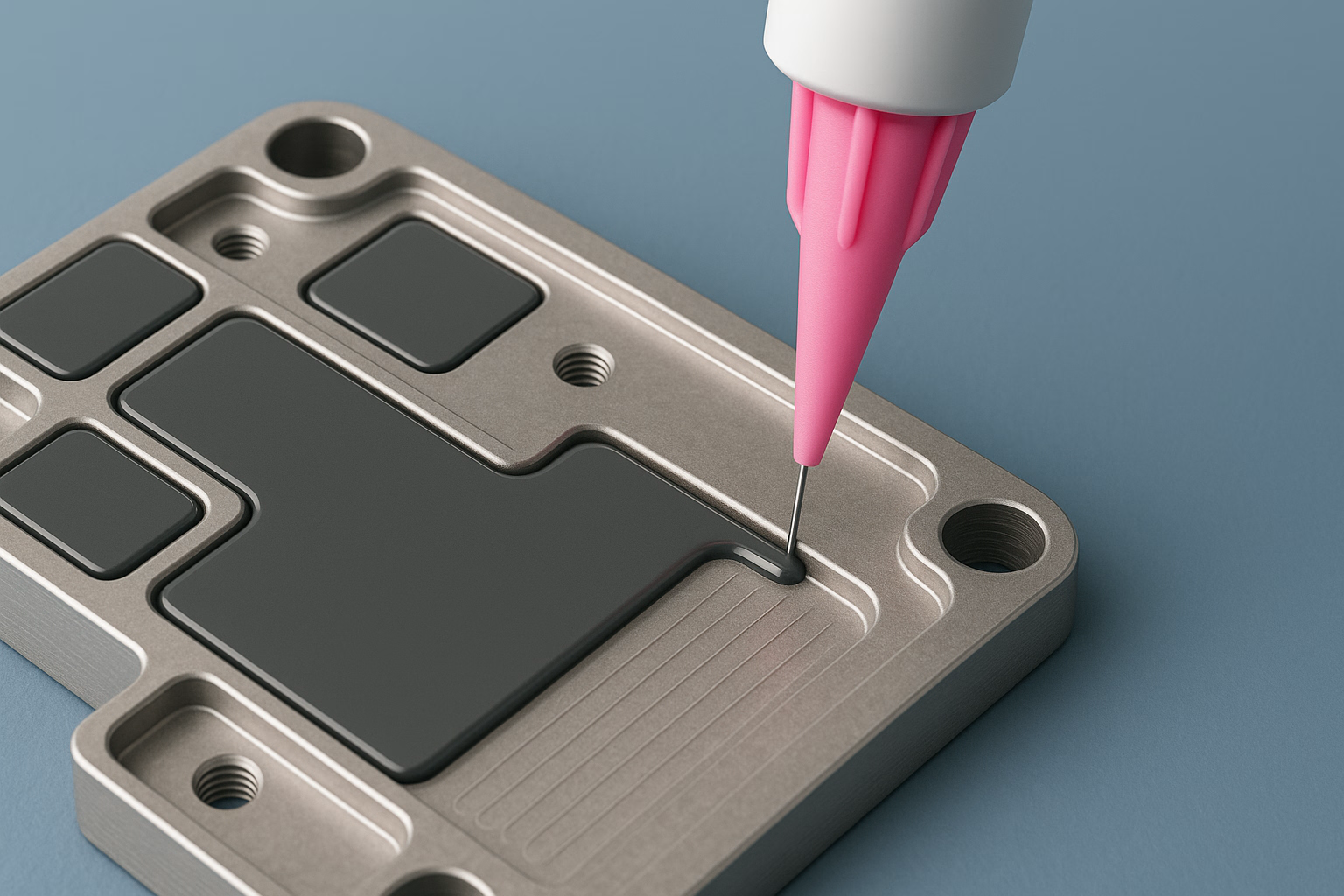
Type 4: Dispensable Absorbers
Not every cavity is a flat rectangle. Complex enclosure geometries, tight spaces, irregular surfaces, and high-volume production lines that can’t afford manual placement of die-cut sheets – these are the applications where dispensable absorbers make sense.
How they work. A liquid silicone base loaded with carbonyl iron powder. The material is dispensed as a paste or bead, then cures in place. Once cured, it functions as a magnetically loaded absorber through the same loss mechanism as the elastomer sheets above. The difference is the delivery method, not the physics.
Frequency range. 1.0 to 40.0 GHz depending on the loading level.
Form factor. Liquid paste dispensed by hand (syringe) or using automated dispensing equipment. Cures at room temperature or with heat, depending on formulation. Can fill irregular geometries that sheet materials can’t reach.
Where they’re used. Automotive radar modules, 5G antenna assemblies, high-volume consumer electronics production, compact RF enclosures with complex internal geometry, and any application where placing pre-cut absorber sheets isn’t practical or cost-effective at scale.
3PB Solutions products in this category:
The AC-001 Series (1.0 – 40.0 GHz) is a carbonyl iron-loaded liquid silicone available in six loading levels. What sets it apart: the viscosity, cure profile, and electrical performance can be customized to match your specific dispensing process and production requirements. If your automated line needs a particular flow characteristic or your cure cycle needs to match an existing oven schedule, the formulation can be adjusted. 3PB Solutions works with dispensing partners who are experienced with the AC-001 material, from prototyping through high-volume production. You can work with them directly and call out the AC-001 part number, or 3PB Solutions can manage the entire project end to end.
Type 5: Thermal Pad Absorbers
Some applications need RF absorption and thermal management in the same space. A component generates heat and EMI simultaneously, and you have room for one material, not two. Thermal pad absorbers handle both functions in a single layer.
How they work. A silicone elastomer base loaded with both magnetic filler (for RF absorption) and thermally conductive filler. The material absorbs electromagnetic energy through magnetic loss while simultaneously conducting heat from a component to a heatsink or chassis.
Frequency range. 2.0 to 18.0 GHz.
Form factor. Soft, slightly compressible pads with self-tack on both faces. Designed to be sandwiched between a heat-generating component and a heatsink or enclosure wall. No adhesive backing – the material stays in place through its natural tack and the compression of the assembly. Available in 0.020″, 0.040″, 0.060″, and 0.080″ thicknesses.
Where they’re used. Power amplifiers, high-speed processors, FPGA modules, radar transmit/receive modules, and any design where thermal management and EMI suppression compete for the same physical space.
3PB Solutions products in this category:
The DU Series (2.0 – 18.0 GHz) is available in two thermal conductivity grades: 1.5 W/mK and 2.5 W/mK. Both cover the same 2–18 GHz frequency range. Thickness selection is driven by the target frequency: 0.080″ for 2–6 GHz, 0.060″ for 6–10 GHz, 0.040″ for 10–14 GHz, and 0.020″ for 14 GHz and above. The higher thermal conductivity version moves more heat but has a slightly different RF absorption profile. Engineers select based on whether thermal performance or RF attenuation is the primary driver, then verify the other parameter meets requirements.
Type 6: Conformal and Paintable Absorbers
Conformal absorbers are spray-on or brush-on coatings containing RF-absorbing particles. They can be applied to irregular surfaces, compound curves, and structures that don’t accept sheet or tile materials.
Frequency range. Varies widely by formulation, but generally UHF through microwave bands.
Where they’re used. Aerospace structures, radomes, antenna housings, and military platforms where the absorber needs to follow the shape of a non-planar surface. Also used in some automotive applications on radar module housings.
3PB Solutions does not currently manufacture conformal coatings. For applications requiring paintable absorber solutions, contact our engineering team and we can point you in the right direction.
Absorber Type Comparison
This table summarizes the key differences between absorber types. Use it to narrow your search before requesting samples.
| Absorber Type | Loss Mechanism | Frequency Range | Form Factor | Best For |
|---|---|---|---|---|
| Magnetic elastomer sheet | Magnetic | 0.5 – 40 GHz | Thin flexible sheet | Cavity resonance, near-field suppression, surface current reduction, in-device EMI |
| Carbon-loaded foam (lossy) | Dielectric | 1 – 40+ GHz | Thick foam sheet | Free-space isolation, chamber lining, antenna separation |
| Carbon-loaded foam (reticulated) | Dielectric | 4 – 100+ GHz | Thick foam on conductor | Low-reflection broadband absorption, anechoic environments |
| Ferrite tile / sheet | Magnetic | 1 MHz – 1 GHz | Rigid tile or flex sheet | Low-frequency EMC chambers, power electronics, shielded rooms |
| Dispensable (liquid) | Magnetic | 1 – 40 GHz | Paste / bead | Complex geometries, automated production, tight cavities |
| Thermal pad absorber | Magnetic | 2 – 18 GHz | Compressible pad | Combined RF absorption + heat transfer |
| Conformal / paintable | Magnetic or dielectric | Varies | Spray / brush-on | Non-planar surfaces, radomes, aerospace structures |
RF Absorbers vs. EMI Shields: When to Use Which
This is one of the most common questions in EMI troubleshooting, and the answer isn’t either/or. Absorbers and shields solve different parts of the same problem, and many designs use both.
EMI shields – metal enclosures, board-level shield cans, conductive gaskets – work by reflecting electromagnetic energy. A conductive barrier blocks external interference from getting in and prevents internal emissions from getting out. Shields are effective, widely understood, and often the first line of defense.
The problem is what happens inside the shield. A metal enclosure is a resonant cavity. At frequencies where the cavity dimensions are a significant fraction of a wavelength, the enclosure itself can amplify internal noise through standing waves. Surface currents flow on the inside of the shield, re-radiating energy back into the cavity. Two components that were fine on an open bench suddenly interfere with each other once you put the lid on. Adding more shielding doesn’t help – it can actually make cavity resonance worse.
RF absorbers solve this by dissipating energy inside the cavity instead of reflecting it. Place an absorber on the inside wall of a shield can or enclosure, and the resonant energy gets converted to heat instead of bouncing between surfaces. Surface currents are attenuated. Component-to-component coupling is reduced.
The practical takeaway: if your device passes emissions on the bench but fails in its enclosure, you probably have a cavity resonance problem, and an absorber is the fix. If your device is susceptible to external interference, a shield is the first step. Most production electronics use a shield for primary containment and an absorber inside for resonance and coupling control.
3PB Solutions is a dedicated RF absorber manufacturer. For applications that need both shielding and absorption as a turnkey solution, we work with shielding partners to deliver integrated packages.
How to Select the Right Absorber
Here’s the decision process that works:
Step 1: Identify the problem frequency. If you know the frequency – from a failed emissions scan, a coupling measurement, or a simulation – start there. If you don’t know it, measure it. An absorber selected without knowing the target frequency is a guess.
Step 2: Match the frequency to an absorber type. Below 500 MHz, you’re looking at ferrite. 500 MHz to 40 GHz, magnetically loaded elastomers are usually the answer. Above 10 GHz in free space, consider carbon-loaded foams. Need both thermal management and absorption? Thermal pad absorbers. Complex geometry or automated production? Dispensable.
Step 3: Check your physical constraints. How much thickness do you have? Does the material need to be flexible? Does it need adhesive backing? What’s the operating temperature range? Does it need to meet UL 94 flammability requirements? All of 3PB Solutions’ products are RoHS and REACH compliant, with UL 94 flammability data available upon request.
Step 4: Decide between broadband and narrowband. If your problem spans a range of frequencies or you’re not sure exactly where the resonance falls, start with a broadband material from the LS/CB/XB/KU/KB/KA series. If you know the exact frequency and need maximum attenuation at that point, the TF Series narrowband materials deliver higher peak performance at specific frequencies.
Step 5: Consider starting with the US Series. If you’re evaluating absorber materials for the first time – or even if you think your problem frequency is above 3 GHz – the US Series is a smart starting point. It’s designed for 0.5 to 3.0 GHz but has been fielded successfully up to 18 GHz. Its non-silicone formulation and thin profile make it the most versatile first-try material in the 3PB Solutions line. Try it. If it solves the problem, you’re done. If you need more attenuation at a specific frequency, step up to the tuned silicone series for that band.
A Note on Attenuation Specifications
Engineers often look for -20 dB of attenuation on a datasheet. That’s 99% absorption, and it looks great in a design review. In practice, -10 dB (90% absorption) inside a cavity is often enough to resolve EMI issues and pass compliance testing. The difference between 90% and 99% absorption is meaningful in some applications, but for many cavity resonance and coupling problems, that first 90% is what gets you from fail to pass.
The reason datasheet numbers don’t translate directly to installed performance is that every application is different. Performance depends on where the absorber is placed, the geometry of the cavity, the coupling paths between components, and the mode structure of the resonance. A material that delivers -20 dB in an NRL arch fixture might deliver -10 dB in your enclosure – or -30 dB, depending on the specifics.
The most reliable approach is to test candidate materials in your actual enclosure and measure the result. 3PB Solutions provides complex permeability and permittivity data for all elastomer products, so engineers who want to model absorber performance in electromagnetic simulation tools (HFSS, CST, COMSOL) can do so before committing to physical samples. This is the fastest path from material selection to a working design.
Get Started
The fastest way to evaluate RF absorber materials is to request a free sample kit. Each kit includes pre-cut samples across multiple product lines and thicknesses so you can test directly in your application.
Not sure which absorber type fits your application? Contact our engineering team with your frequency range, enclosure details, and the problem you’re trying to solve. We’ll recommend the right starting point and have samples on your bench within days.
Quick Contact: Call (855) 785-5660 or email sales@3pbsolutions.com.
Frequently Asked Questions
What are the main types of RF absorber materials?
The main types are magnetically loaded elastomers (silicone or acrylic sheets loaded with iron-based fillers for 0.5 to 40 GHz), carbon-loaded foam absorbers (open-cell polyurethane for 1 to 100+ GHz broadband applications), ferrite tiles and sheets (ceramic materials for 1 MHz to 1 GHz), dispensable absorbers (liquid silicone with carbonyl iron for automated application), thin film absorbers (micron-thick deposited layers for GHz-range and above), and thermal pad absorbers (dual-function materials providing RF absorption and heat transfer). Selection depends on frequency range, form factor, environment, and application requirements.
What is the difference between an RF absorber and an EMI shield?
An EMI shield reflects electromagnetic energy using conductive materials like metal enclosures or gaskets. An RF absorber converts electromagnetic energy into heat using magnetic or dielectric loss materials. Shields can create secondary problems when reflected energy bounces inside an enclosure, causing cavity resonances or coupling between components. Absorbers eliminate this by dissipating the energy rather than redirecting it. Many designs use both: a conductive shield for primary containment and an absorber inside to suppress resonances and reduce internal coupling.
How do I choose the right RF absorber for my application?
Start by identifying your problem frequency. RF absorbers are frequency-dependent, so a material optimized for 2 GHz will not perform the same at 10 GHz. Next, consider form factor constraints: available thickness, flexibility, adhesive requirements. Evaluate the operating environment: temperature, humidity, vibration, flammability. Decide whether you need broadband coverage or narrowband peak absorption. 3PB Solutions offers complex permeability and permittivity data for electromagnetic modeling so engineers can simulate performance before committing to physical samples.
How much attenuation does an RF absorber need to provide?
It depends on the application. Many engineers specify -20 dB (99% absorption) on paper, but -10 dB (90% absorption) inside a cavity is often sufficient to resolve EMI issues and pass compliance testing. Every application is different – performance depends on component layout, cavity geometry, and coupling paths. Datasheet numbers from free-space test fixtures don’t directly translate to installed performance. The most reliable approach is testing candidate materials in your actual enclosure. 3PB Solutions provides complex permeability and permittivity data for engineers who want to model performance before testing.
What RF absorber materials does 3PB Solutions manufacture?
3PB Solutions manufactures RF absorbers covering 0.5 to 40 GHz in elastomer sheet form and 1 to 100+ GHz in foam form. The product line includes the US Series (0.5–3 GHz acrylic elastomer), LS through KA Series (1–40 GHz iron-loaded silicone), TF Series (narrowband frequency-specific), AF Series lossy and reticulated foam (1–100+ GHz), AC-001 dispensable absorber (1–40 GHz liquid silicone), and DU Series thermal pad absorbers (2–18 GHz). All sheet materials are available with PSA backing and custom die-cutting. Custom thicknesses, loading levels, and formulations are standard service. Request a sample kit to evaluate in your application.
Short version: RF absorbers are not interchangeable. Each type – elastomer sheet, foam, ferrite, dispensable, thermal pad – works through a different loss mechanism and performs best in a specific frequency range and form factor. Picking the wrong type wastes time and money. This guide explains how each type works, where it fits, and how to choose. Request a free sample kit to test materials in your application, or keep reading for the full breakdown.
Why Absorber Type Matters More Than You Think
Walk into most absorber manufacturers’ websites and you’ll see pages of black rectangles that all look the same. But under the surface, the differences are enormous. A carbon-loaded foam absorber and a magnetically loaded elastomer sheet might both claim to “absorb RF energy,” but they do it through completely different physical mechanisms, they work at different frequencies, and they solve different problems.
Picking the wrong absorber type is one of the most common mistakes in EMI troubleshooting. An engineer grabs whatever absorber material is sitting on the shelf, sticks it in the enclosure, and then wonders why the noise didn’t go away. The material wasn’t wrong – it was wrong for that frequency, that cavity, and that coupling mechanism.
Understanding absorber types saves you from that cycle. It’s the difference between solving an EMI problem in one iteration and burning three weeks swapping materials.
How RF Absorbers Work: Two Loss Mechanisms
Every RF absorber converts electromagnetic energy into heat. But there are two fundamentally different ways to get there, and the mechanism determines which frequencies the material can handle.
Magnetic loss absorbers use iron-based fillers – carbonyl iron powder, sendust-type alloys, or ferrite particles – suspended in a flexible matrix like silicone, acrylic, or epoxy. When an electromagnetic wave passes through the material, the magnetic domains in these particles rotate in response to the alternating field. That rotation dissipates energy as heat. Magnetic loss absorbers are most effective from roughly 500 MHz to 40 GHz depending on the filler type, loading level, and material thickness. They tend to be thin, flexible, and work well as sheet materials installed directly on or near the noise source.
Dielectric loss absorbers use carbon-based fillers – carbon black, graphite, or carbon fiber – in a foam or polymer matrix. The carbon particles interact with the electric field component of the wave, converting energy to heat through resistive losses. Carbon-loaded absorbers are typically used from 1 GHz up through 100 GHz and beyond. They tend to be thicker than magnetic absorbers and are commonly used in free-space applications like anechoic chamber linings and antenna isolation.
Some materials combine both mechanisms. But for material selection purposes, knowing which mechanism dominates tells you whether a given absorber type is even in the right ballpark for your application.
Type 1: Magnetically Loaded Elastomer Sheets
This is the workhorse category for in-device EMI suppression. If you’re solving a cavity resonance, suppressing near-field noise coupling between components on a PCB, or reducing surface currents inside a shielded enclosure, this is almost certainly where you start.
How they work. A flexible elastomer base (silicone, acrylic, or occasionally nitrile or neoprene) is loaded with magnetic filler particles. The type and concentration of filler determines the frequency response. Higher loading levels shift peak absorption to lower frequencies. Thicker materials also push performance lower. Engineers tune absorption by selecting the right combination of filler loading and material thickness.
Frequency range. Roughly 0.5 to 40 GHz depending on formulation. Different loading levels are optimized for different bands. This isn’t a one-size-fits-all category – a material designed for 2 GHz will underperform at 15 GHz, and vice versa.
Form factor. Thin, flexible sheets typically ranging from 0.010″ to 0.125″ thick. Supplied in rolls or sheets, available with pressure-sensitive adhesive (PSA) backing for direct application inside enclosures, on shield cans, or over PCB components. Can be die-cut to any 2D geometry.
Where they’re used. Consumer electronics (smartphones, laptops, wearables), telecom infrastructure (base stations, small cells, access points), automotive electronics (radar modules, infotainment, ADAS), medical devices, aerospace systems, and industrial controls. This is the broadest-application absorber category.
3PB Solutions products in this category:
The US Series is a proprietary magnetic-loaded acrylic elastomer designed for 0.5 to 3.0 GHz, but it has been fielded successfully in applications up to 18 GHz. It’s the material we recommend engineers try first regardless of frequency – if it solves the problem, you’re done, and you’ll spend less than you would on a frequency-specific material. The acrylic base eliminates silicone oil migration concerns, which matters in optical, medical, and aerospace environments where silicone contamination is a disqualifier. Available in 0.010″, 0.020″, and 0.040″ thicknesses. Sheets can be stacked to increase low-frequency performance. Most customers start with 0.020″ or 0.040″.
The LS Series (1.0 – 4.0 GHz), CB Series (4.0 – 8.0 GHz), XB Series (8.0 – 12.0 GHz), KU Series (12.0 – 18.0 GHz), KB Series (18.0 – 27.0 GHz), and KA Series (27.0 – 40.0 GHz) are iron-loaded silicone elastomers. Each is formulated with a specific loading level optimized for its target band. Custom thicknesses are available from 0.020″ to 0.125″ across the line, but each series has curated thicknesses tuned for best performance in its frequency range. The lower-frequency LS and CB Series offer more thickness options (0.040″ through 0.125″), while higher-frequency materials like the KU, KB, and KA Series are thinner by design – as thin as 0.037″ for the KA Series – because shorter wavelengths require less material depth. If you know your problem frequency falls within a specific band, these materials deliver higher peak absorption at that band than a general-purpose broadband material would.
The TF Series (2.0 – 18.0 GHz) is for narrowband applications where you need peak absorption at a specific frequency rather than coverage across a band. Each TF part number is a specific formulation and thickness combination selected to deliver maximum attenuation at an exact target frequency. If your cavity resonates at 6.2 GHz and you need every dB you can get at that frequency, the TF Series is the right choice.
Type 2: Carbon-Loaded Foam Absorbers
Foam absorbers are what most people picture when they hear “RF absorber” – the dark pyramidal cones lining the walls of an anechoic chamber. But the category is broader than chamber linings. Carbon-loaded foams are used anywhere you need broadband absorption in free space, including antenna isolation, RCS (radar cross-section) reduction, and signal path management between systems.
How they work. Open-cell polyurethane foam is impregnated with carbon-based material. The carbon loading creates dielectric losses as RF energy passes through the foam structure. Performance depends on the loading profile and the foam thickness – thicker foams absorb lower frequencies.
There are two distinct subtypes, and they work differently:
Homogeneous (lossy) foam is uniformly loaded with carbon throughout the material. It absorbs RF energy passing through it and does not require a conductive backing. There is some front-face reflection, but the material attenuates the wave as it travels through the foam volume. This type is used to isolate two signals in free space or to line chamber walls where you want absorption without a metal ground plane behind the material.
Reticulated foam uses a tapered carbon loading – lighter at the front face, heavier toward the back. The front face is impedance-matched to free space (377 ohms), so the wave enters with minimal reflection. Inside the material, the wave scatters within the open-cell reticulated structure and is progressively absorbed as the loading increases. Reticulated foam must be installed on a conductive backing. The conductive surface creates a reflection that destructively interferes with the incoming wave at the front face, resulting in very low net reflection. Without the conductive backing, a reticulated foam absorber won’t achieve its rated performance.
Frequency range. Typically 1 GHz to 100+ GHz depending on foam thickness. Thicker foams extend performance to lower frequencies.
Form factor. Flat sheets, pyramid shapes, or wedge profiles. Generally thicker and bulkier than elastomer sheet absorbers. Not flexible enough to conform to curved surfaces.
3PB Solutions products in this category:
The AF Series Lossy Foam (1.0 – 40.0 GHz) is a homogeneous carbon-loaded open-cell polyurethane foam for free-space isolation and chamber applications. Does not require conductive backing.
The AF Series Reticulated Foam (4.0 – 100.0 GHz) is a tapered-loading reticulated open-cell polyurethane foam designed for installation on a conductive surface. Impedance-matched front face with progressive absorption through the material depth. Broadband performance across the microwave and millimeter-wave range.
The PIM Mitigation Series is a specialized version of the AF Series lossy foam wrapped in a weatherproof Herculite fabric for outdoor installation. These materials are widely deployed by major wireless carriers to improve small cell and macro cell antenna performance by reducing passive intermodulation (PIM) interference. If you’re working on 3G, 4G/LTE, or 5G antenna systems and struggling with PIM, this is a proven solution already in the field at scale.
Type 3: Ferrite Tiles and Sheets
Ferrite absorbers are the go-to material for low-frequency absorption below 1 GHz, where magnetically loaded elastomers and carbon foams start to lose effectiveness. They’re made from sintered ferrite ceramics – typically manganese-zinc or nickel-zinc compositions – and work through high magnetic permeability and loss at low frequencies.
Frequency range. Roughly 1 MHz to 1 GHz, with best performance in the 10 to 300 MHz range.
Form factor. Rigid tiles (typically 6mm thick) or flexible ferrite sheets. The rigid tiles are heavy – a significant consideration for ceiling-mounted installations in anechoic chambers. Flexible ferrite sheets are thinner and lighter but generally offer lower absorption.
Where they’re used. Anechoic chambers (especially hybrid chambers that combine ferrite tiles on the walls with foam pyramids for broadband coverage), EMC test facilities, power electronics enclosures, and shielded rooms. Also used in industrial environments near variable frequency drives and motor controllers that generate strong low-frequency emissions.
3PB Solutions does not currently manufacture ferrite tile absorbers. For applications requiring absorption below 500 MHz, we can recommend appropriate ferrite-based solutions or help you design a hybrid approach that combines ferrite for the low end with our elastomer or foam materials for higher frequencies.
Type 4: Dispensable Absorbers
Not every cavity is a flat rectangle. Complex enclosure geometries, tight spaces, irregular surfaces, and high-volume production lines that can’t afford manual placement of die-cut sheets – these are the applications where dispensable absorbers make sense.
How they work. A liquid silicone base loaded with carbonyl iron powder. The material is dispensed as a paste or bead, then cures in place. Once cured, it functions as a magnetically loaded absorber through the same loss mechanism as the elastomer sheets above. The difference is the delivery method, not the physics.
Frequency range. 1.0 to 40.0 GHz depending on the loading level.
Form factor. Liquid paste dispensed by hand (syringe) or using automated dispensing equipment. Cures at room temperature or with heat, depending on formulation. Can fill irregular geometries that sheet materials can’t reach.
Where they’re used. Automotive radar modules, 5G antenna assemblies, high-volume consumer electronics production, compact RF enclosures with complex internal geometry, and any application where placing pre-cut absorber sheets isn’t practical or cost-effective at scale.
3PB Solutions products in this category:
The AC-001 Series (1.0 – 40.0 GHz) is a carbonyl iron-loaded liquid silicone available in six loading levels. What sets it apart: the viscosity, cure profile, and electrical performance can be customized to match your specific dispensing process and production requirements. If your automated line needs a particular flow characteristic or your cure cycle needs to match an existing oven schedule, the formulation can be adjusted. 3PB Solutions works with dispensing partners who are experienced with the AC-001 material, from prototyping through high-volume production. You can work with them directly and call out the AC-001 part number, or 3PB Solutions can manage the entire project end to end.
Type 5: Thermal Pad Absorbers
Some applications need RF absorption and thermal management in the same space. A component generates heat and EMI simultaneously, and you have room for one material, not two. Thermal pad absorbers handle both functions in a single layer.
How they work. A silicone elastomer base loaded with both magnetic filler (for RF absorption) and thermally conductive filler. The material absorbs electromagnetic energy through magnetic loss while simultaneously conducting heat from a component to a heatsink or chassis.
Frequency range. 2.0 to 18.0 GHz.
Form factor. Soft, slightly compressible pads with self-tack on both faces. Designed to be sandwiched between a heat-generating component and a heatsink or enclosure wall. No adhesive backing – the material stays in place through its natural tack and the compression of the assembly. Available in 0.020″, 0.040″, 0.060″, and 0.080″ thicknesses.
Where they’re used. Power amplifiers, high-speed processors, FPGA modules, radar transmit/receive modules, and any design where thermal management and EMI suppression compete for the same physical space.
3PB Solutions products in this category:
The DU Series (2.0 – 18.0 GHz) is available in two thermal conductivity grades: 1.5 W/mK and 2.5 W/mK. Both cover the same 2–18 GHz frequency range. Thickness selection is driven by the target frequency: 0.080″ for 2–6 GHz, 0.060″ for 6–10 GHz, 0.040″ for 10–14 GHz, and 0.020″ for 14 GHz and above. The higher thermal conductivity version moves more heat but has a slightly different RF absorption profile. Engineers select based on whether thermal performance or RF attenuation is the primary driver, then verify the other parameter meets requirements.
Type 6: Conformal and Paintable Absorbers
Conformal absorbers are spray-on or brush-on coatings containing RF-absorbing particles. They can be applied to irregular surfaces, compound curves, and structures that don’t accept sheet or tile materials.
Frequency range. Varies widely by formulation, but generally UHF through microwave bands.
Where they’re used. Aerospace structures, radomes, antenna housings, and military platforms where the absorber needs to follow the shape of a non-planar surface. Also used in some automotive applications on radar module housings.
3PB Solutions does not currently manufacture conformal coatings. For applications requiring paintable absorber solutions, contact our engineering team and we can point you in the right direction.
Absorber Type Comparison
This table summarizes the key differences between absorber types. Use it to narrow your search before requesting samples.
| Absorber Type | Loss Mechanism | Frequency Range | Form Factor | Best For |
|---|---|---|---|---|
| Magnetic elastomer sheet | Magnetic | 0.5 – 40 GHz | Thin flexible sheet | Cavity resonance, near-field suppression, surface current reduction, in-device EMI |
| Carbon-loaded foam (lossy) | Dielectric | 1 – 40+ GHz | Thick foam sheet | Free-space isolation, chamber lining, antenna separation |
| Carbon-loaded foam (reticulated) | Dielectric | 4 – 100+ GHz | Thick foam on conductor | Low-reflection broadband absorption, anechoic environments |
| Ferrite tile / sheet | Magnetic | 1 MHz – 1 GHz | Rigid tile or flex sheet | Low-frequency EMC chambers, power electronics, shielded rooms |
| Dispensable (liquid) | Magnetic | 1 – 40 GHz | Paste / bead | Complex geometries, automated production, tight cavities |
| Thermal pad absorber | Magnetic | 2 – 18 GHz | Compressible pad | Combined RF absorption + heat transfer |
| Conformal / paintable | Magnetic or dielectric | Varies | Spray / brush-on | Non-planar surfaces, radomes, aerospace structures |
RF Absorbers vs. EMI Shields: When to Use Which
This is one of the most common questions in EMI troubleshooting, and the answer isn’t either/or. Absorbers and shields solve different parts of the same problem, and many designs use both.
EMI shields – metal enclosures, board-level shield cans, conductive gaskets – work by reflecting electromagnetic energy. A conductive barrier blocks external interference from getting in and prevents internal emissions from getting out. Shields are effective, widely understood, and often the first line of defense.
The problem is what happens inside the shield. A metal enclosure is a resonant cavity. At frequencies where the cavity dimensions are a significant fraction of a wavelength, the enclosure itself can amplify internal noise through standing waves. Surface currents flow on the inside of the shield, re-radiating energy back into the cavity. Two components that were fine on an open bench suddenly interfere with each other once you put the lid on. Adding more shielding doesn’t help – it can actually make cavity resonance worse.
RF absorbers solve this by dissipating energy inside the cavity instead of reflecting it. Place an absorber on the inside wall of a shield can or enclosure, and the resonant energy gets converted to heat instead of bouncing between surfaces. Surface currents are attenuated. Component-to-component coupling is reduced.
The practical takeaway: if your device passes emissions on the bench but fails in its enclosure, you probably have a cavity resonance problem, and an absorber is the fix. If your device is susceptible to external interference, a shield is the first step. Most production electronics use a shield for primary containment and an absorber inside for resonance and coupling control.
3PB Solutions is a dedicated RF absorber manufacturer. For applications that need both shielding and absorption as a turnkey solution, we work with shielding partners to deliver integrated packages.
How to Select the Right Absorber
Here’s the decision process that works:
Step 1: Identify the problem frequency. If you know the frequency – from a failed emissions scan, a coupling measurement, or a simulation – start there. If you don’t know it, measure it. An absorber selected without knowing the target frequency is a guess.
Step 2: Match the frequency to an absorber type. Below 500 MHz, you’re looking at ferrite. 500 MHz to 40 GHz, magnetically loaded elastomers are usually the answer. Above 10 GHz in free space, consider carbon-loaded foams. Need both thermal management and absorption? Thermal pad absorbers. Complex geometry or automated production? Dispensable.
Step 3: Check your physical constraints. How much thickness do you have? Does the material need to be flexible? Does it need adhesive backing? What’s the operating temperature range? Does it need to meet UL 94 flammability requirements? All of 3PB Solutions’ products are RoHS and REACH compliant, with UL 94 flammability data available upon request.
Step 4: Decide between broadband and narrowband. If your problem spans a range of frequencies or you’re not sure exactly where the resonance falls, start with a broadband material from the LS/CB/XB/KU/KB/KA series. If you know the exact frequency and need maximum attenuation at that point, the TF Series narrowband materials deliver higher peak performance at specific frequencies.
Step 5: Consider starting with the US Series. If you’re evaluating absorber materials for the first time – or even if you think your problem frequency is above 3 GHz – the US Series is a smart starting point. It’s designed for 0.5 to 3.0 GHz but has been fielded successfully up to 18 GHz. Its non-silicone formulation and thin profile make it the most versatile first-try material in the 3PB Solutions line. Try it. If it solves the problem, you’re done. If you need more attenuation at a specific frequency, step up to the tuned silicone series for that band.
A Note on Attenuation Specifications
Engineers often look for -20 dB of attenuation on a datasheet. That’s 99% absorption, and it looks great in a design review. In practice, -10 dB (90% absorption) inside a cavity is often enough to resolve EMI issues and pass compliance testing. The difference between 90% and 99% absorption is meaningful in some applications, but for many cavity resonance and coupling problems, that first 90% is what gets you from fail to pass.
The reason datasheet numbers don’t translate directly to installed performance is that every application is different. Performance depends on where the absorber is placed, the geometry of the cavity, the coupling paths between components, and the mode structure of the resonance. A material that delivers -20 dB in an NRL arch fixture might deliver -10 dB in your enclosure – or -30 dB, depending on the specifics.
The most reliable approach is to test candidate materials in your actual enclosure and measure the result. 3PB Solutions provides complex permeability and permittivity data for all elastomer products, so engineers who want to model absorber performance in electromagnetic simulation tools (HFSS, CST, COMSOL) can do so before committing to physical samples. This is the fastest path from material selection to a working design.
Get Started
The fastest way to evaluate RF absorber materials is to request a free sample kit. Each kit includes pre-cut samples across multiple product lines and thicknesses so you can test directly in your application.
Not sure which absorber type fits your application? Contact our engineering team with your frequency range, enclosure details, and the problem you’re trying to solve. We’ll recommend the right starting point and have samples on your bench within days.
Quick Contact: Call (855) 785-5660 or email sales@3pbsolutions.com.
Frequently Asked Questions
What are the main types of RF absorber materials?
The main types are magnetically loaded elastomers (silicone or acrylic sheets loaded with iron-based fillers for 0.5 to 40 GHz), carbon-loaded foam absorbers (open-cell polyurethane for 1 to 100+ GHz broadband applications), ferrite tiles and sheets (ceramic materials for 1 MHz to 1 GHz), dispensable absorbers (liquid silicone with carbonyl iron for automated application), thin film absorbers (micron-thick deposited layers for GHz-range and above), and thermal pad absorbers (dual-function materials providing RF absorption and heat transfer). Selection depends on frequency range, form factor, environment, and application requirements.
What is the difference between an RF absorber and an EMI shield?
An EMI shield reflects electromagnetic energy using conductive materials like metal enclosures or gaskets. An RF absorber converts electromagnetic energy into heat using magnetic or dielectric loss materials. Shields can create secondary problems when reflected energy bounces inside an enclosure, causing cavity resonances or coupling between components. Absorbers eliminate this by dissipating the energy rather than redirecting it. Many designs use both: a conductive shield for primary containment and an absorber inside to suppress resonances and reduce internal coupling.
How do I choose the right RF absorber for my application?
Start by identifying your problem frequency. RF absorbers are frequency-dependent, so a material optimized for 2 GHz will not perform the same at 10 GHz. Next, consider form factor constraints: available thickness, flexibility, adhesive requirements. Evaluate the operating environment: temperature, humidity, vibration, flammability. Decide whether you need broadband coverage or narrowband peak absorption. 3PB Solutions offers complex permeability and permittivity data for electromagnetic modeling so engineers can simulate performance before committing to physical samples.
How much attenuation does an RF absorber need to provide?
It depends on the application. Many engineers specify -20 dB (99% absorption) on paper, but -10 dB (90% absorption) inside a cavity is often sufficient to resolve EMI issues and pass compliance testing. Every application is different – performance depends on component layout, cavity geometry, and coupling paths. Datasheet numbers from free-space test fixtures don’t directly translate to installed performance. The most reliable approach is testing candidate materials in your actual enclosure. 3PB Solutions provides complex permeability and permittivity data for engineers who want to model performance before testing.
What RF absorber materials does 3PB Solutions manufacture?
3PB Solutions manufactures RF absorbers covering 0.5 to 40 GHz in elastomer sheet form and 1 to 100+ GHz in foam form. The product line includes the US Series (0.5–3 GHz acrylic elastomer), LS through KA Series (1–40 GHz iron-loaded silicone), TF Series (narrowband frequency-specific), AF Series lossy and reticulated foam (1–100+ GHz), AC-001 dispensable absorber (1–40 GHz liquid silicone), and DU Series thermal pad absorbers (2–18 GHz). All sheet materials are available with PSA backing and custom die-cutting. Custom thicknesses, loading levels, and formulations are standard service. Request a sample kit to evaluate in your application.
Short version: RF absorbers are not interchangeable. Each type – elastomer sheet, foam, ferrite, dispensable, thermal pad – works through a different loss mechanism and performs best in a specific frequency range and form factor. Picking the wrong type wastes time and money. This guide explains how each type works, where it fits, and how to choose. Request a free sample kit to test materials in your application, or keep reading for the full breakdown.
Why Absorber Type Matters More Than You Think
Walk into most absorber manufacturers’ websites and you’ll see pages of black rectangles that all look the same. But under the surface, the differences are enormous. A carbon-loaded foam absorber and a magnetically loaded elastomer sheet might both claim to “absorb RF energy,” but they do it through completely different physical mechanisms, they work at different frequencies, and they solve different problems.
Picking the wrong absorber type is one of the most common mistakes in EMI troubleshooting. An engineer grabs whatever absorber material is sitting on the shelf, sticks it in the enclosure, and then wonders why the noise didn’t go away. The material wasn’t wrong – it was wrong for that frequency, that cavity, and that coupling mechanism.
Understanding absorber types saves you from that cycle. It’s the difference between solving an EMI problem in one iteration and burning three weeks swapping materials.
How RF Absorbers Work: Two Loss Mechanisms
Every RF absorber converts electromagnetic energy into heat. But there are two fundamentally different ways to get there, and the mechanism determines which frequencies the material can handle.
Magnetic loss absorbers use iron-based fillers – carbonyl iron powder, sendust-type alloys, or ferrite particles – suspended in a flexible matrix like silicone, acrylic, or epoxy. When an electromagnetic wave passes through the material, the magnetic domains in these particles rotate in response to the alternating field. That rotation dissipates energy as heat. Magnetic loss absorbers are most effective from roughly 500 MHz to 40 GHz depending on the filler type, loading level, and material thickness. They tend to be thin, flexible, and work well as sheet materials installed directly on or near the noise source.
Dielectric loss absorbers use carbon-based fillers – carbon black, graphite, or carbon fiber – in a foam or polymer matrix. The carbon particles interact with the electric field component of the wave, converting energy to heat through resistive losses. Carbon-loaded absorbers are typically used from 1 GHz up through 100 GHz and beyond. They tend to be thicker than magnetic absorbers and are commonly used in free-space applications like anechoic chamber linings and antenna isolation.
Some materials combine both mechanisms. But for material selection purposes, knowing which mechanism dominates tells you whether a given absorber type is even in the right ballpark for your application.
Type 1: Magnetically Loaded Elastomer Sheets
This is the workhorse category for in-device EMI suppression. If you’re solving a cavity resonance, suppressing near-field noise coupling between components on a PCB, or reducing surface currents inside a shielded enclosure, this is almost certainly where you start.
How they work. A flexible elastomer base (silicone, acrylic, or occasionally nitrile or neoprene) is loaded with magnetic filler particles. The type and concentration of filler determines the frequency response. Higher loading levels shift peak absorption to lower frequencies. Thicker materials also push performance lower. Engineers tune absorption by selecting the right combination of filler loading and material thickness.
Frequency range. Roughly 0.5 to 40 GHz depending on formulation. Different loading levels are optimized for different bands. This isn’t a one-size-fits-all category – a material designed for 2 GHz will underperform at 15 GHz, and vice versa.
Form factor. Thin, flexible sheets typically ranging from 0.010″ to 0.125″ thick. Supplied in rolls or sheets, available with pressure-sensitive adhesive (PSA) backing for direct application inside enclosures, on shield cans, or over PCB components. Can be die-cut to any 2D geometry.
Where they’re used. Consumer electronics (smartphones, laptops, wearables), telecom infrastructure (base stations, small cells, access points), automotive electronics (radar modules, infotainment, ADAS), medical devices, aerospace systems, and industrial controls. This is the broadest-application absorber category.
3PB Solutions products in this category:
The US Series is a proprietary magnetic-loaded acrylic elastomer designed for 0.5 to 3.0 GHz, but it has been fielded successfully in applications up to 18 GHz. It’s the material we recommend engineers try first regardless of frequency – if it solves the problem, you’re done, and you’ll spend less than you would on a frequency-specific material. The acrylic base eliminates silicone oil migration concerns, which matters in optical, medical, and aerospace environments where silicone contamination is a disqualifier. Available in 0.010″, 0.020″, and 0.040″ thicknesses. Sheets can be stacked to increase low-frequency performance. Most customers start with 0.020″ or 0.040″.
The LS Series (1.0 – 4.0 GHz), CB Series (4.0 – 8.0 GHz), XB Series (8.0 – 12.0 GHz), KU Series (12.0 – 18.0 GHz), KB Series (18.0 – 27.0 GHz), and KA Series (27.0 – 40.0 GHz) are iron-loaded silicone elastomers. Each is formulated with a specific loading level optimized for its target band. Custom thicknesses are available from 0.020″ to 0.125″ across the line, but each series has curated thicknesses tuned for best performance in its frequency range. The lower-frequency LS and CB Series offer more thickness options (0.040″ through 0.125″), while higher-frequency materials like the KU, KB, and KA Series are thinner by design – as thin as 0.037″ for the KA Series – because shorter wavelengths require less material depth. If you know your problem frequency falls within a specific band, these materials deliver higher peak absorption at that band than a general-purpose broadband material would.
The TF Series (2.0 – 18.0 GHz) is for narrowband applications where you need peak absorption at a specific frequency rather than coverage across a band. Each TF part number is a specific formulation and thickness combination selected to deliver maximum attenuation at an exact target frequency. If your cavity resonates at 6.2 GHz and you need every dB you can get at that frequency, the TF Series is the right choice.
Type 2: Carbon-Loaded Foam Absorbers
Foam absorbers are what most people picture when they hear “RF absorber” – the dark pyramidal cones lining the walls of an anechoic chamber. But the category is broader than chamber linings. Carbon-loaded foams are used anywhere you need broadband absorption in free space, including antenna isolation, RCS (radar cross-section) reduction, and signal path management between systems.
How they work. Open-cell polyurethane foam is impregnated with carbon-based material. The carbon loading creates dielectric losses as RF energy passes through the foam structure. Performance depends on the loading profile and the foam thickness – thicker foams absorb lower frequencies.
There are two distinct subtypes, and they work differently:
Homogeneous (lossy) foam is uniformly loaded with carbon throughout the material. It absorbs RF energy passing through it and does not require a conductive backing. There is some front-face reflection, but the material attenuates the wave as it travels through the foam volume. This type is used to isolate two signals in free space or to line chamber walls where you want absorption without a metal ground plane behind the material.
Reticulated foam uses a tapered carbon loading – lighter at the front face, heavier toward the back. The front face is impedance-matched to free space (377 ohms), so the wave enters with minimal reflection. Inside the material, the wave scatters within the open-cell reticulated structure and is progressively absorbed as the loading increases. Reticulated foam must be installed on a conductive backing. The conductive surface creates a reflection that destructively interferes with the incoming wave at the front face, resulting in very low net reflection. Without the conductive backing, a reticulated foam absorber won’t achieve its rated performance.
Frequency range. Typically 1 GHz to 100+ GHz depending on foam thickness. Thicker foams extend performance to lower frequencies.
Form factor. Flat sheets, pyramid shapes, or wedge profiles. Generally thicker and bulkier than elastomer sheet absorbers. Not flexible enough to conform to curved surfaces.
3PB Solutions products in this category:
The AF Series Lossy Foam (1.0 – 40.0 GHz) is a homogeneous carbon-loaded open-cell polyurethane foam for free-space isolation and chamber applications. Does not require conductive backing.
The AF Series Reticulated Foam (4.0 – 100.0 GHz) is a tapered-loading reticulated open-cell polyurethane foam designed for installation on a conductive surface. Impedance-matched front face with progressive absorption through the material depth. Broadband performance across the microwave and millimeter-wave range.
The PIM Mitigation Series is a specialized version of the AF Series lossy foam wrapped in a weatherproof Herculite fabric for outdoor installation. These materials are widely deployed by major wireless carriers to improve small cell and macro cell antenna performance by reducing passive intermodulation (PIM) interference. If you’re working on 3G, 4G/LTE, or 5G antenna systems and struggling with PIM, this is a proven solution already in the field at scale.
Type 3: Ferrite Tiles and Sheets
Ferrite absorbers are the go-to material for low-frequency absorption below 1 GHz, where magnetically loaded elastomers and carbon foams start to lose effectiveness. They’re made from sintered ferrite ceramics – typically manganese-zinc or nickel-zinc compositions – and work through high magnetic permeability and loss at low frequencies.
Frequency range. Roughly 1 MHz to 1 GHz, with best performance in the 10 to 300 MHz range.
Form factor. Rigid tiles (typically 6mm thick) or flexible ferrite sheets. The rigid tiles are heavy – a significant consideration for ceiling-mounted installations in anechoic chambers. Flexible ferrite sheets are thinner and lighter but generally offer lower absorption.
Where they’re used. Anechoic chambers (especially hybrid chambers that combine ferrite tiles on the walls with foam pyramids for broadband coverage), EMC test facilities, power electronics enclosures, and shielded rooms. Also used in industrial environments near variable frequency drives and motor controllers that generate strong low-frequency emissions.
3PB Solutions does not currently manufacture ferrite tile absorbers. For applications requiring absorption below 500 MHz, we can recommend appropriate ferrite-based solutions or help you design a hybrid approach that combines ferrite for the low end with our elastomer or foam materials for higher frequencies.
Type 4: Dispensable Absorbers
Not every cavity is a flat rectangle. Complex enclosure geometries, tight spaces, irregular surfaces, and high-volume production lines that can’t afford manual placement of die-cut sheets – these are the applications where dispensable absorbers make sense.
How they work. A liquid silicone base loaded with carbonyl iron powder. The material is dispensed as a paste or bead, then cures in place. Once cured, it functions as a magnetically loaded absorber through the same loss mechanism as the elastomer sheets above. The difference is the delivery method, not the physics.
Frequency range. 1.0 to 40.0 GHz depending on the loading level.
Form factor. Liquid paste dispensed by hand (syringe) or using automated dispensing equipment. Cures at room temperature or with heat, depending on formulation. Can fill irregular geometries that sheet materials can’t reach.
Where they’re used. Automotive radar modules, 5G antenna assemblies, high-volume consumer electronics production, compact RF enclosures with complex internal geometry, and any application where placing pre-cut absorber sheets isn’t practical or cost-effective at scale.
3PB Solutions products in this category:
The AC-001 Series (1.0 – 40.0 GHz) is a carbonyl iron-loaded liquid silicone available in six loading levels. What sets it apart: the viscosity, cure profile, and electrical performance can be customized to match your specific dispensing process and production requirements. If your automated line needs a particular flow characteristic or your cure cycle needs to match an existing oven schedule, the formulation can be adjusted. 3PB Solutions works with dispensing partners who are experienced with the AC-001 material, from prototyping through high-volume production. You can work with them directly and call out the AC-001 part number, or 3PB Solutions can manage the entire project end to end.
Type 5: Thermal Pad Absorbers
Some applications need RF absorption and thermal management in the same space. A component generates heat and EMI simultaneously, and you have room for one material, not two. Thermal pad absorbers handle both functions in a single layer.
How they work. A silicone elastomer base loaded with both magnetic filler (for RF absorption) and thermally conductive filler. The material absorbs electromagnetic energy through magnetic loss while simultaneously conducting heat from a component to a heatsink or chassis.
Frequency range. 2.0 to 18.0 GHz.
Form factor. Soft, slightly compressible pads with self-tack on both faces. Designed to be sandwiched between a heat-generating component and a heatsink or enclosure wall. No adhesive backing – the material stays in place through its natural tack and the compression of the assembly. Available in 0.020″, 0.040″, 0.060″, and 0.080″ thicknesses.
Where they’re used. Power amplifiers, high-speed processors, FPGA modules, radar transmit/receive modules, and any design where thermal management and EMI suppression compete for the same physical space.
3PB Solutions products in this category:
The DU Series (2.0 – 18.0 GHz) is available in two thermal conductivity grades: 1.5 W/mK and 2.5 W/mK. Both cover the same 2–18 GHz frequency range. Thickness selection is driven by the target frequency: 0.080″ for 2–6 GHz, 0.060″ for 6–10 GHz, 0.040″ for 10–14 GHz, and 0.020″ for 14 GHz and above. The higher thermal conductivity version moves more heat but has a slightly different RF absorption profile. Engineers select based on whether thermal performance or RF attenuation is the primary driver, then verify the other parameter meets requirements.
Type 6: Conformal and Paintable Absorbers
Conformal absorbers are spray-on or brush-on coatings containing RF-absorbing particles. They can be applied to irregular surfaces, compound curves, and structures that don’t accept sheet or tile materials.
Frequency range. Varies widely by formulation, but generally UHF through microwave bands.
Where they’re used. Aerospace structures, radomes, antenna housings, and military platforms where the absorber needs to follow the shape of a non-planar surface. Also used in some automotive applications on radar module housings.
3PB Solutions does not currently manufacture conformal coatings. For applications requiring paintable absorber solutions, contact our engineering team and we can point you in the right direction.
Absorber Type Comparison
This table summarizes the key differences between absorber types. Use it to narrow your search before requesting samples.
| Absorber Type | Loss Mechanism | Frequency Range | Form Factor | Best For |
|---|---|---|---|---|
| Magnetic elastomer sheet | Magnetic | 0.5 – 40 GHz | Thin flexible sheet | Cavity resonance, near-field suppression, surface current reduction, in-device EMI |
| Carbon-loaded foam (lossy) | Dielectric | 1 – 40+ GHz | Thick foam sheet | Free-space isolation, chamber lining, antenna separation |
| Carbon-loaded foam (reticulated) | Dielectric | 4 – 100+ GHz | Thick foam on conductor | Low-reflection broadband absorption, anechoic environments |
| Ferrite tile / sheet | Magnetic | 1 MHz – 1 GHz | Rigid tile or flex sheet | Low-frequency EMC chambers, power electronics, shielded rooms |
| Dispensable (liquid) | Magnetic | 1 – 40 GHz | Paste / bead | Complex geometries, automated production, tight cavities |
| Thermal pad absorber | Magnetic | 2 – 18 GHz | Compressible pad | Combined RF absorption + heat transfer |
| Conformal / paintable | Magnetic or dielectric | Varies | Spray / brush-on | Non-planar surfaces, radomes, aerospace structures |
RF Absorbers vs. EMI Shields: When to Use Which
This is one of the most common questions in EMI troubleshooting, and the answer isn’t either/or. Absorbers and shields solve different parts of the same problem, and many designs use both.
EMI shields – metal enclosures, board-level shield cans, conductive gaskets – work by reflecting electromagnetic energy. A conductive barrier blocks external interference from getting in and prevents internal emissions from getting out. Shields are effective, widely understood, and often the first line of defense.
The problem is what happens inside the shield. A metal enclosure is a resonant cavity. At frequencies where the cavity dimensions are a significant fraction of a wavelength, the enclosure itself can amplify internal noise through standing waves. Surface currents flow on the inside of the shield, re-radiating energy back into the cavity. Two components that were fine on an open bench suddenly interfere with each other once you put the lid on. Adding more shielding doesn’t help – it can actually make cavity resonance worse.
RF absorbers solve this by dissipating energy inside the cavity instead of reflecting it. Place an absorber on the inside wall of a shield can or enclosure, and the resonant energy gets converted to heat instead of bouncing between surfaces. Surface currents are attenuated. Component-to-component coupling is reduced.
The practical takeaway: if your device passes emissions on the bench but fails in its enclosure, you probably have a cavity resonance problem, and an absorber is the fix. If your device is susceptible to external interference, a shield is the first step. Most production electronics use a shield for primary containment and an absorber inside for resonance and coupling control.
3PB Solutions is a dedicated RF absorber manufacturer. For applications that need both shielding and absorption as a turnkey solution, we work with shielding partners to deliver integrated packages.
How to Select the Right Absorber
Here’s the decision process that works:
Step 1: Identify the problem frequency. If you know the frequency – from a failed emissions scan, a coupling measurement, or a simulation – start there. If you don’t know it, measure it. An absorber selected without knowing the target frequency is a guess.
Step 2: Match the frequency to an absorber type. Below 500 MHz, you’re looking at ferrite. 500 MHz to 40 GHz, magnetically loaded elastomers are usually the answer. Above 10 GHz in free space, consider carbon-loaded foams. Need both thermal management and absorption? Thermal pad absorbers. Complex geometry or automated production? Dispensable.
Step 3: Check your physical constraints. How much thickness do you have? Does the material need to be flexible? Does it need adhesive backing? What’s the operating temperature range? Does it need to meet UL 94 flammability requirements? All of 3PB Solutions’ products are RoHS and REACH compliant, with UL 94 flammability data available upon request.
Step 4: Decide between broadband and narrowband. If your problem spans a range of frequencies or you’re not sure exactly where the resonance falls, start with a broadband material from the LS/CB/XB/KU/KB/KA series. If you know the exact frequency and need maximum attenuation at that point, the TF Series narrowband materials deliver higher peak performance at specific frequencies.
Step 5: Consider starting with the US Series. If you’re evaluating absorber materials for the first time – or even if you think your problem frequency is above 3 GHz – the US Series is a smart starting point. It’s designed for 0.5 to 3.0 GHz but has been fielded successfully up to 18 GHz. Its non-silicone formulation and thin profile make it the most versatile first-try material in the 3PB Solutions line. Try it. If it solves the problem, you’re done. If you need more attenuation at a specific frequency, step up to the tuned silicone series for that band.
A Note on Attenuation Specifications
Engineers often look for -20 dB of attenuation on a datasheet. That’s 99% absorption, and it looks great in a design review. In practice, -10 dB (90% absorption) inside a cavity is often enough to resolve EMI issues and pass compliance testing. The difference between 90% and 99% absorption is meaningful in some applications, but for many cavity resonance and coupling problems, that first 90% is what gets you from fail to pass.
The reason datasheet numbers don’t translate directly to installed performance is that every application is different. Performance depends on where the absorber is placed, the geometry of the cavity, the coupling paths between components, and the mode structure of the resonance. A material that delivers -20 dB in an NRL arch fixture might deliver -10 dB in your enclosure – or -30 dB, depending on the specifics.
The most reliable approach is to test candidate materials in your actual enclosure and measure the result. 3PB Solutions provides complex permeability and permittivity data for all elastomer products, so engineers who want to model absorber performance in electromagnetic simulation tools (HFSS, CST, COMSOL) can do so before committing to physical samples. This is the fastest path from material selection to a working design.
Get Started
The fastest way to evaluate RF absorber materials is to request a free sample kit. Each kit includes pre-cut samples across multiple product lines and thicknesses so you can test directly in your application.
Not sure which absorber type fits your application? Contact our engineering team with your frequency range, enclosure details, and the problem you’re trying to solve. We’ll recommend the right starting point and have samples on your bench within days.
Quick Contact: Call (855) 785-5660 or email sales@3pbsolutions.com.
Frequently Asked Questions
What are the main types of RF absorber materials?
The main types are magnetically loaded elastomers (silicone or acrylic sheets loaded with iron-based fillers for 0.5 to 40 GHz), carbon-loaded foam absorbers (open-cell polyurethane for 1 to 100+ GHz broadband applications), ferrite tiles and sheets (ceramic materials for 1 MHz to 1 GHz), dispensable absorbers (liquid silicone with carbonyl iron for automated application), thin film absorbers (micron-thick deposited layers for GHz-range and above), and thermal pad absorbers (dual-function materials providing RF absorption and heat transfer). Selection depends on frequency range, form factor, environment, and application requirements.
What is the difference between an RF absorber and an EMI shield?
An EMI shield reflects electromagnetic energy using conductive materials like metal enclosures or gaskets. An RF absorber converts electromagnetic energy into heat using magnetic or dielectric loss materials. Shields can create secondary problems when reflected energy bounces inside an enclosure, causing cavity resonances or coupling between components. Absorbers eliminate this by dissipating the energy rather than redirecting it. Many designs use both: a conductive shield for primary containment and an absorber inside to suppress resonances and reduce internal coupling.
How do I choose the right RF absorber for my application?
Start by identifying your problem frequency. RF absorbers are frequency-dependent, so a material optimized for 2 GHz will not perform the same at 10 GHz. Next, consider form factor constraints: available thickness, flexibility, adhesive requirements. Evaluate the operating environment: temperature, humidity, vibration, flammability. Decide whether you need broadband coverage or narrowband peak absorption. 3PB Solutions offers complex permeability and permittivity data for electromagnetic modeling so engineers can simulate performance before committing to physical samples.
How much attenuation does an RF absorber need to provide?
It depends on the application. Many engineers specify -20 dB (99% absorption) on paper, but -10 dB (90% absorption) inside a cavity is often sufficient to resolve EMI issues and pass compliance testing. Every application is different – performance depends on component layout, cavity geometry, and coupling paths. Datasheet numbers from free-space test fixtures don’t directly translate to installed performance. The most reliable approach is testing candidate materials in your actual enclosure. 3PB Solutions provides complex permeability and permittivity data for engineers who want to model performance before testing.
What RF absorber materials does 3PB Solutions manufacture?
3PB Solutions manufactures RF absorbers covering 0.5 to 40 GHz in elastomer sheet form and 1 to 100+ GHz in foam form. The product line includes the US Series (0.5–3 GHz acrylic elastomer), LS through KA Series (1–40 GHz iron-loaded silicone), TF Series (narrowband frequency-specific), AF Series lossy and reticulated foam (1–100+ GHz), AC-001 dispensable absorber (1–40 GHz liquid silicone), and DU Series thermal pad absorbers (2–18 GHz). All sheet materials are available with PSA backing and custom die-cutting. Custom thicknesses, loading levels, and formulations are standard service. Request a sample kit to evaluate in your application.
Short version: RF absorbers are not interchangeable. Each type – elastomer sheet, foam, ferrite, dispensable, thermal pad – works through a different loss mechanism and performs best in a specific frequency range and form factor. Picking the wrong type wastes time and money. This guide explains how each type works, where it fits, and how to choose. Request a free sample kit to test materials in your application, or keep reading for the full breakdown.
Why Absorber Type Matters More Than You Think
Walk into most absorber manufacturers’ websites and you’ll see pages of black rectangles that all look the same. But under the surface, the differences are enormous. A carbon-loaded foam absorber and a magnetically loaded elastomer sheet might both claim to “absorb RF energy,” but they do it through completely different physical mechanisms, they work at different frequencies, and they solve different problems.
Picking the wrong absorber type is one of the most common mistakes in EMI troubleshooting. An engineer grabs whatever absorber material is sitting on the shelf, sticks it in the enclosure, and then wonders why the noise didn’t go away. The material wasn’t wrong – it was wrong for that frequency, that cavity, and that coupling mechanism.
Understanding absorber types saves you from that cycle. It’s the difference between solving an EMI problem in one iteration and burning three weeks swapping materials.
How RF Absorbers Work: Two Loss Mechanisms
Every RF absorber converts electromagnetic energy into heat. But there are two fundamentally different ways to get there, and the mechanism determines which frequencies the material can handle.
Magnetic loss absorbers use iron-based fillers – carbonyl iron powder, sendust-type alloys, or ferrite particles – suspended in a flexible matrix like silicone, acrylic, or epoxy. When an electromagnetic wave passes through the material, the magnetic domains in these particles rotate in response to the alternating field. That rotation dissipates energy as heat. Magnetic loss absorbers are most effective from roughly 500 MHz to 40 GHz depending on the filler type, loading level, and material thickness. They tend to be thin, flexible, and work well as sheet materials installed directly on or near the noise source.
Dielectric loss absorbers use carbon-based fillers – carbon black, graphite, or carbon fiber – in a foam or polymer matrix. The carbon particles interact with the electric field component of the wave, converting energy to heat through resistive losses. Carbon-loaded absorbers are typically used from 1 GHz up through 100 GHz and beyond. They tend to be thicker than magnetic absorbers and are commonly used in free-space applications like anechoic chamber linings and antenna isolation.
Some materials combine both mechanisms. But for material selection purposes, knowing which mechanism dominates tells you whether a given absorber type is even in the right ballpark for your application.
Type 1: Magnetically Loaded Elastomer Sheets
This is the workhorse category for in-device EMI suppression. If you’re solving a cavity resonance, suppressing near-field noise coupling between components on a PCB, or reducing surface currents inside a shielded enclosure, this is almost certainly where you start.
How they work. A flexible elastomer base (silicone, acrylic, or occasionally nitrile or neoprene) is loaded with magnetic filler particles. The type and concentration of filler determines the frequency response. Higher loading levels shift peak absorption to lower frequencies. Thicker materials also push performance lower. Engineers tune absorption by selecting the right combination of filler loading and material thickness.
Frequency range. Roughly 0.5 to 40 GHz depending on formulation. Different loading levels are optimized for different bands. This isn’t a one-size-fits-all category – a material designed for 2 GHz will underperform at 15 GHz, and vice versa.
Form factor. Thin, flexible sheets typically ranging from 0.010″ to 0.125″ thick. Supplied in rolls or sheets, available with pressure-sensitive adhesive (PSA) backing for direct application inside enclosures, on shield cans, or over PCB components. Can be die-cut to any 2D geometry.
Where they’re used. Consumer electronics (smartphones, laptops, wearables), telecom infrastructure (base stations, small cells, access points), automotive electronics (radar modules, infotainment, ADAS), medical devices, aerospace systems, and industrial controls. This is the broadest-application absorber category.
3PB Solutions products in this category:
The US Series is a proprietary magnetic-loaded acrylic elastomer designed for 0.5 to 3.0 GHz, but it has been fielded successfully in applications up to 18 GHz. It’s the material we recommend engineers try first regardless of frequency – if it solves the problem, you’re done, and you’ll spend less than you would on a frequency-specific material. The acrylic base eliminates silicone oil migration concerns, which matters in optical, medical, and aerospace environments where silicone contamination is a disqualifier. Available in 0.010″, 0.020″, and 0.040″ thicknesses. Sheets can be stacked to increase low-frequency performance. Most customers start with 0.020″ or 0.040″.
The LS Series (1.0 – 4.0 GHz), CB Series (4.0 – 8.0 GHz), XB Series (8.0 – 12.0 GHz), KU Series (12.0 – 18.0 GHz), KB Series (18.0 – 27.0 GHz), and KA Series (27.0 – 40.0 GHz) are iron-loaded silicone elastomers. Each is formulated with a specific loading level optimized for its target band. Custom thicknesses are available from 0.020″ to 0.125″ across the line, but each series has curated thicknesses tuned for best performance in its frequency range. The lower-frequency LS and CB Series offer more thickness options (0.040″ through 0.125″), while higher-frequency materials like the KU, KB, and KA Series are thinner by design – as thin as 0.037″ for the KA Series – because shorter wavelengths require less material depth. If you know your problem frequency falls within a specific band, these materials deliver higher peak absorption at that band than a general-purpose broadband material would.
The TF Series (2.0 – 18.0 GHz) is for narrowband applications where you need peak absorption at a specific frequency rather than coverage across a band. Each TF part number is a specific formulation and thickness combination selected to deliver maximum attenuation at an exact target frequency. If your cavity resonates at 6.2 GHz and you need every dB you can get at that frequency, the TF Series is the right choice.
Type 2: Carbon-Loaded Foam Absorbers
Foam absorbers are what most people picture when they hear “RF absorber” – the dark pyramidal cones lining the walls of an anechoic chamber. But the category is broader than chamber linings. Carbon-loaded foams are used anywhere you need broadband absorption in free space, including antenna isolation, RCS (radar cross-section) reduction, and signal path management between systems.
How they work. Open-cell polyurethane foam is impregnated with carbon-based material. The carbon loading creates dielectric losses as RF energy passes through the foam structure. Performance depends on the loading profile and the foam thickness – thicker foams absorb lower frequencies.
There are two distinct subtypes, and they work differently:
Homogeneous (lossy) foam is uniformly loaded with carbon throughout the material. It absorbs RF energy passing through it and does not require a conductive backing. There is some front-face reflection, but the material attenuates the wave as it travels through the foam volume. This type is used to isolate two signals in free space or to line chamber walls where you want absorption without a metal ground plane behind the material.
Reticulated foam uses a tapered carbon loading – lighter at the front face, heavier toward the back. The front face is impedance-matched to free space (377 ohms), so the wave enters with minimal reflection. Inside the material, the wave scatters within the open-cell reticulated structure and is progressively absorbed as the loading increases. Reticulated foam must be installed on a conductive backing. The conductive surface creates a reflection that destructively interferes with the incoming wave at the front face, resulting in very low net reflection. Without the conductive backing, a reticulated foam absorber won’t achieve its rated performance.
Frequency range. Typically 1 GHz to 100+ GHz depending on foam thickness. Thicker foams extend performance to lower frequencies.
Form factor. Flat sheets, pyramid shapes, or wedge profiles. Generally thicker and bulkier than elastomer sheet absorbers. Not flexible enough to conform to curved surfaces.
3PB Solutions products in this category:
The AF Series Lossy Foam (1.0 – 40.0 GHz) is a homogeneous carbon-loaded open-cell polyurethane foam for free-space isolation and chamber applications. Does not require conductive backing.
The AF Series Reticulated Foam (4.0 – 100.0 GHz) is a tapered-loading reticulated open-cell polyurethane foam designed for installation on a conductive surface. Impedance-matched front face with progressive absorption through the material depth. Broadband performance across the microwave and millimeter-wave range.
The PIM Mitigation Series is a specialized version of the AF Series lossy foam wrapped in a weatherproof Herculite fabric for outdoor installation. These materials are widely deployed by major wireless carriers to improve small cell and macro cell antenna performance by reducing passive intermodulation (PIM) interference. If you’re working on 3G, 4G/LTE, or 5G antenna systems and struggling with PIM, this is a proven solution already in the field at scale.
Type 3: Ferrite Tiles and Sheets
Ferrite absorbers are the go-to material for low-frequency absorption below 1 GHz, where magnetically loaded elastomers and carbon foams start to lose effectiveness. They’re made from sintered ferrite ceramics – typically manganese-zinc or nickel-zinc compositions – and work through high magnetic permeability and loss at low frequencies.
Frequency range. Roughly 1 MHz to 1 GHz, with best performance in the 10 to 300 MHz range.
Form factor. Rigid tiles (typically 6mm thick) or flexible ferrite sheets. The rigid tiles are heavy – a significant consideration for ceiling-mounted installations in anechoic chambers. Flexible ferrite sheets are thinner and lighter but generally offer lower absorption.
Where they’re used. Anechoic chambers (especially hybrid chambers that combine ferrite tiles on the walls with foam pyramids for broadband coverage), EMC test facilities, power electronics enclosures, and shielded rooms. Also used in industrial environments near variable frequency drives and motor controllers that generate strong low-frequency emissions.
3PB Solutions does not currently manufacture ferrite tile absorbers. For applications requiring absorption below 500 MHz, we can recommend appropriate ferrite-based solutions or help you design a hybrid approach that combines ferrite for the low end with our elastomer or foam materials for higher frequencies.
Type 4: Dispensable Absorbers
Not every cavity is a flat rectangle. Complex enclosure geometries, tight spaces, irregular surfaces, and high-volume production lines that can’t afford manual placement of die-cut sheets – these are the applications where dispensable absorbers make sense.
How they work. A liquid silicone base loaded with carbonyl iron powder. The material is dispensed as a paste or bead, then cures in place. Once cured, it functions as a magnetically loaded absorber through the same loss mechanism as the elastomer sheets above. The difference is the delivery method, not the physics.
Frequency range. 1.0 to 40.0 GHz depending on the loading level.
Form factor. Liquid paste dispensed by hand (syringe) or using automated dispensing equipment. Cures at room temperature or with heat, depending on formulation. Can fill irregular geometries that sheet materials can’t reach.
Where they’re used. Automotive radar modules, 5G antenna assemblies, high-volume consumer electronics production, compact RF enclosures with complex internal geometry, and any application where placing pre-cut absorber sheets isn’t practical or cost-effective at scale.
3PB Solutions products in this category:
The AC-001 Series (1.0 – 40.0 GHz) is a carbonyl iron-loaded liquid silicone available in six loading levels. What sets it apart: the viscosity, cure profile, and electrical performance can be customized to match your specific dispensing process and production requirements. If your automated line needs a particular flow characteristic or your cure cycle needs to match an existing oven schedule, the formulation can be adjusted. 3PB Solutions works with dispensing partners who are experienced with the AC-001 material, from prototyping through high-volume production. You can work with them directly and call out the AC-001 part number, or 3PB Solutions can manage the entire project end to end.
Type 5: Thermal Pad Absorbers
Some applications need RF absorption and thermal management in the same space. A component generates heat and EMI simultaneously, and you have room for one material, not two. Thermal pad absorbers handle both functions in a single layer.
How they work. A silicone elastomer base loaded with both magnetic filler (for RF absorption) and thermally conductive filler. The material absorbs electromagnetic energy through magnetic loss while simultaneously conducting heat from a component to a heatsink or chassis.
Frequency range. 2.0 to 18.0 GHz.
Form factor. Soft, slightly compressible pads with self-tack on both faces. Designed to be sandwiched between a heat-generating component and a heatsink or enclosure wall. No adhesive backing – the material stays in place through its natural tack and the compression of the assembly. Available in 0.020″, 0.040″, 0.060″, and 0.080″ thicknesses.
Where they’re used. Power amplifiers, high-speed processors, FPGA modules, radar transmit/receive modules, and any design where thermal management and EMI suppression compete for the same physical space.
3PB Solutions products in this category:
The DU Series (2.0 – 18.0 GHz) is available in two thermal conductivity grades: 1.5 W/mK and 2.5 W/mK. Both cover the same 2–18 GHz frequency range. Thickness selection is driven by the target frequency: 0.080″ for 2–6 GHz, 0.060″ for 6–10 GHz, 0.040″ for 10–14 GHz, and 0.020″ for 14 GHz and above. The higher thermal conductivity version moves more heat but has a slightly different RF absorption profile. Engineers select based on whether thermal performance or RF attenuation is the primary driver, then verify the other parameter meets requirements.
Type 6: Conformal and Paintable Absorbers
Conformal absorbers are spray-on or brush-on coatings containing RF-absorbing particles. They can be applied to irregular surfaces, compound curves, and structures that don’t accept sheet or tile materials.
Frequency range. Varies widely by formulation, but generally UHF through microwave bands.
Where they’re used. Aerospace structures, radomes, antenna housings, and military platforms where the absorber needs to follow the shape of a non-planar surface. Also used in some automotive applications on radar module housings.
3PB Solutions does not currently manufacture conformal coatings. For applications requiring paintable absorber solutions, contact our engineering team and we can point you in the right direction.
Absorber Type Comparison
This table summarizes the key differences between absorber types. Use it to narrow your search before requesting samples.
| Absorber Type | Loss Mechanism | Frequency Range | Form Factor | Best For |
|---|---|---|---|---|
| Magnetic elastomer sheet | Magnetic | 0.5 – 40 GHz | Thin flexible sheet | Cavity resonance, near-field suppression, surface current reduction, in-device EMI |
| Carbon-loaded foam (lossy) | Dielectric | 1 – 40+ GHz | Thick foam sheet | Free-space isolation, chamber lining, antenna separation |
| Carbon-loaded foam (reticulated) | Dielectric | 4 – 100+ GHz | Thick foam on conductor | Low-reflection broadband absorption, anechoic environments |
| Ferrite tile / sheet | Magnetic | 1 MHz – 1 GHz | Rigid tile or flex sheet | Low-frequency EMC chambers, power electronics, shielded rooms |
| Dispensable (liquid) | Magnetic | 1 – 40 GHz | Paste / bead | Complex geometries, automated production, tight cavities |
| Thermal pad absorber | Magnetic | 2 – 18 GHz | Compressible pad | Combined RF absorption + heat transfer |
| Conformal / paintable | Magnetic or dielectric | Varies | Spray / brush-on | Non-planar surfaces, radomes, aerospace structures |
RF Absorbers vs. EMI Shields: When to Use Which
This is one of the most common questions in EMI troubleshooting, and the answer isn’t either/or. Absorbers and shields solve different parts of the same problem, and many designs use both.
EMI shields – metal enclosures, board-level shield cans, conductive gaskets – work by reflecting electromagnetic energy. A conductive barrier blocks external interference from getting in and prevents internal emissions from getting out. Shields are effective, widely understood, and often the first line of defense.
The problem is what happens inside the shield. A metal enclosure is a resonant cavity. At frequencies where the cavity dimensions are a significant fraction of a wavelength, the enclosure itself can amplify internal noise through standing waves. Surface currents flow on the inside of the shield, re-radiating energy back into the cavity. Two components that were fine on an open bench suddenly interfere with each other once you put the lid on. Adding more shielding doesn’t help – it can actually make cavity resonance worse.
RF absorbers solve this by dissipating energy inside the cavity instead of reflecting it. Place an absorber on the inside wall of a shield can or enclosure, and the resonant energy gets converted to heat instead of bouncing between surfaces. Surface currents are attenuated. Component-to-component coupling is reduced.
The practical takeaway: if your device passes emissions on the bench but fails in its enclosure, you probably have a cavity resonance problem, and an absorber is the fix. If your device is susceptible to external interference, a shield is the first step. Most production electronics use a shield for primary containment and an absorber inside for resonance and coupling control.
3PB Solutions is a dedicated RF absorber manufacturer. For applications that need both shielding and absorption as a turnkey solution, we work with shielding partners to deliver integrated packages.
How to Select the Right Absorber
Here’s the decision process that works:
Step 1: Identify the problem frequency. If you know the frequency – from a failed emissions scan, a coupling measurement, or a simulation – start there. If you don’t know it, measure it. An absorber selected without knowing the target frequency is a guess.
Step 2: Match the frequency to an absorber type. Below 500 MHz, you’re looking at ferrite. 500 MHz to 40 GHz, magnetically loaded elastomers are usually the answer. Above 10 GHz in free space, consider carbon-loaded foams. Need both thermal management and absorption? Thermal pad absorbers. Complex geometry or automated production? Dispensable.
Step 3: Check your physical constraints. How much thickness do you have? Does the material need to be flexible? Does it need adhesive backing? What’s the operating temperature range? Does it need to meet UL 94 flammability requirements? All of 3PB Solutions’ products are RoHS and REACH compliant, with UL 94 flammability data available upon request.
Step 4: Decide between broadband and narrowband. If your problem spans a range of frequencies or you’re not sure exactly where the resonance falls, start with a broadband material from the LS/CB/XB/KU/KB/KA series. If you know the exact frequency and need maximum attenuation at that point, the TF Series narrowband materials deliver higher peak performance at specific frequencies.
Step 5: Consider starting with the US Series. If you’re evaluating absorber materials for the first time – or even if you think your problem frequency is above 3 GHz – the US Series is a smart starting point. It’s designed for 0.5 to 3.0 GHz but has been fielded successfully up to 18 GHz. Its non-silicone formulation and thin profile make it the most versatile first-try material in the 3PB Solutions line. Try it. If it solves the problem, you’re done. If you need more attenuation at a specific frequency, step up to the tuned silicone series for that band.
A Note on Attenuation Specifications
Engineers often look for -20 dB of attenuation on a datasheet. That’s 99% absorption, and it looks great in a design review. In practice, -10 dB (90% absorption) inside a cavity is often enough to resolve EMI issues and pass compliance testing. The difference between 90% and 99% absorption is meaningful in some applications, but for many cavity resonance and coupling problems, that first 90% is what gets you from fail to pass.
The reason datasheet numbers don’t translate directly to installed performance is that every application is different. Performance depends on where the absorber is placed, the geometry of the cavity, the coupling paths between components, and the mode structure of the resonance. A material that delivers -20 dB in an NRL arch fixture might deliver -10 dB in your enclosure – or -30 dB, depending on the specifics.
The most reliable approach is to test candidate materials in your actual enclosure and measure the result. 3PB Solutions provides complex permeability and permittivity data for all elastomer products, so engineers who want to model absorber performance in electromagnetic simulation tools (HFSS, CST, COMSOL) can do so before committing to physical samples. This is the fastest path from material selection to a working design.
Get Started
The fastest way to evaluate RF absorber materials is to request a free sample kit. Each kit includes pre-cut samples across multiple product lines and thicknesses so you can test directly in your application.
Not sure which absorber type fits your application? Contact our engineering team with your frequency range, enclosure details, and the problem you’re trying to solve. We’ll recommend the right starting point and have samples on your bench within days.
Quick Contact: Call (855) 785-5660 or email sales@3pbsolutions.com.
Frequently Asked Questions
What are the main types of RF absorber materials?
The main types are magnetically loaded elastomers (silicone or acrylic sheets loaded with iron-based fillers for 0.5 to 40 GHz), carbon-loaded foam absorbers (open-cell polyurethane for 1 to 100+ GHz broadband applications), ferrite tiles and sheets (ceramic materials for 1 MHz to 1 GHz), dispensable absorbers (liquid silicone with carbonyl iron for automated application), thin film absorbers (micron-thick deposited layers for GHz-range and above), and thermal pad absorbers (dual-function materials providing RF absorption and heat transfer). Selection depends on frequency range, form factor, environment, and application requirements.
What is the difference between an RF absorber and an EMI shield?
An EMI shield reflects electromagnetic energy using conductive materials like metal enclosures or gaskets. An RF absorber converts electromagnetic energy into heat using magnetic or dielectric loss materials. Shields can create secondary problems when reflected energy bounces inside an enclosure, causing cavity resonances or coupling between components. Absorbers eliminate this by dissipating the energy rather than redirecting it. Many designs use both: a conductive shield for primary containment and an absorber inside to suppress resonances and reduce internal coupling.
How do I choose the right RF absorber for my application?
Start by identifying your problem frequency. RF absorbers are frequency-dependent, so a material optimized for 2 GHz will not perform the same at 10 GHz. Next, consider form factor constraints: available thickness, flexibility, adhesive requirements. Evaluate the operating environment: temperature, humidity, vibration, flammability. Decide whether you need broadband coverage or narrowband peak absorption. 3PB Solutions offers complex permeability and permittivity data for electromagnetic modeling so engineers can simulate performance before committing to physical samples.
How much attenuation does an RF absorber need to provide?
It depends on the application. Many engineers specify -20 dB (99% absorption) on paper, but -10 dB (90% absorption) inside a cavity is often sufficient to resolve EMI issues and pass compliance testing. Every application is different – performance depends on component layout, cavity geometry, and coupling paths. Datasheet numbers from free-space test fixtures don’t directly translate to installed performance. The most reliable approach is testing candidate materials in your actual enclosure. 3PB Solutions provides complex permeability and permittivity data for engineers who want to model performance before testing.
What RF absorber materials does 3PB Solutions manufacture?
3PB Solutions manufactures RF absorbers covering 0.5 to 40 GHz in elastomer sheet form and 1 to 100+ GHz in foam form. The product line includes the US Series (0.5–3 GHz acrylic elastomer), LS through KA Series (1–40 GHz iron-loaded silicone), TF Series (narrowband frequency-specific), AF Series lossy and reticulated foam (1–100+ GHz), AC-001 dispensable absorber (1–40 GHz liquid silicone), and DU Series thermal pad absorbers (2–18 GHz). All sheet materials are available with PSA backing and custom die-cutting. Custom thicknesses, loading levels, and formulations are standard service. Request a sample kit to evaluate in your application.
